
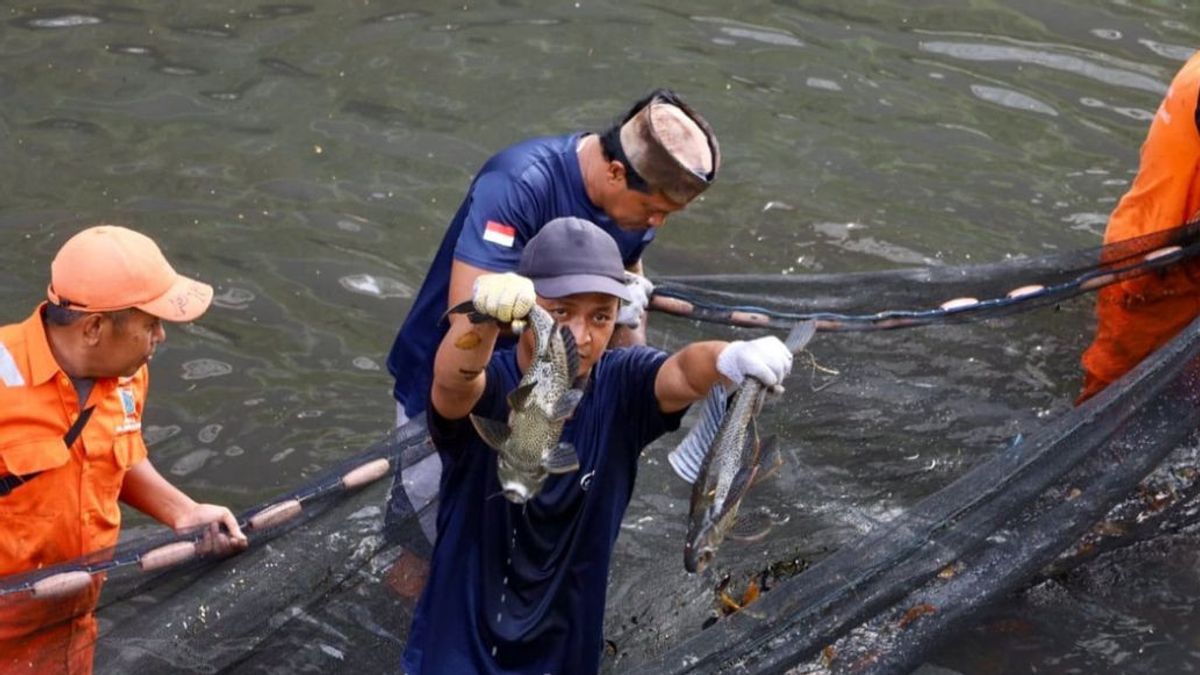


Jakarta is busy catching sapu-sapu fish. DKI Jakarta Governor Pramono Anung even went down to review the activity directly and asked that the activity be expanded to all areas of Jakarta. On April 17, 2026, joint officers caught around 68,880 sapu-sapu fish with a total weight of 6.98 tons. This step is commendable. However, the Ciliwung problem is not merely about fish. The main problem is dirty water, waste that continues to enter, and a river that has not really been restored.
Therefore, the mop-mop fish should be read as a symptom. It is indeed an invasive species that is disturbing. But its appearance in large numbers also shows something more fundamental, namely that the river is in a condition that makes it easier for resistant species to live and dominate.
Research published in the Biology News issued by BRIN in 2025 recorded 37 fish species in Ciliwung from field research 2023-2024. Of that number, 26 are native species and 11 are exotic species. This finding is important. This means that Ciliwung still has fish diversity. But at the same time, the pressure from non-native species is also real.
In a study published in the journal Biodiversitas, the mop-mop fish (Pterygoplichthys pardalis) is said to dominate the Ciliwung which has long been known as a polluted waterway. This fish is known to be very tolerant of poor water quality. Therefore, in addition to having no natural predators, the explosion of its population is also worth or can also be seen as a sign that the ability of rivers to support healthy life is declining.
The problem does not stop at the many sapu-sapu fish. The question is deeper. When the Ciliwung is polluted, local fish are also increasingly difficult to live. Native species that are more sensitive to water quality will be pushed, and may even disappear from parts of the river that are deteriorating. On the other hand, fish that are resistant to dirty water are actually easier to survive and dominate. So, pollution not only triggers a sapu-sapu explosion, but also removes local fish from their own habitat.
The picture is seen in the official report of the DKI Jakarta Environmental Service. In the document of the Ciliwung River Pollutant Source Inventory of the DKI Jakarta Province which was uploaded on July 30, 2025, it was stated that of the 30 sample locations, 63 percent showed a COD value exceeding the quality standard of 100 mg/L, with an average of 1,259.39 mg/L. COD is a measure to see the magnitude of the pollutant load in water. The higher the number, the heavier the pollution.
On the ammonia parameter, the report also noted that 50 percent of the 30 sample locations exceeded the quality standard of 10 mg/L, with an average of 19.86 mg/L. Ammonia generally comes from household waste and organic matter. At high levels, this substance is toxic to fish and disrupts aquatic life.
For total coliform, the situation is more severe. All sample locations showed values above the quality standard of 3,000 MPN/100 mL, with an average of 15,052,000 MPN/100 mL. Coliform is an indicator of contamination from human or animal feces. Such a high figure indicates the strong suspicion of contamination from domestic waste around the river flow and the areas connected to it.
These figures show a more serious root problem. In waters with such high pollution loads, fish that cannot tolerate dirty water will find it difficult to survive. Local fish that need better water quality will continue to be stressed. On the other hand, fish that are resistant to bad conditions will be easier to dominate. Therefore, the capture of sweep-sweep fish can help reduce disturbances in the river, but does not automatically restore the Ciliwung.
As long as water quality is not improved, the same problem will continue to recur. The capture of sweep fishing only addresses the visible symptoms. The root of the problem is still not resolved, namely that waste still flows into the river, sanitation is poor, supervision is weak, and habitats continue to be damaged. In such circumstances, local fish will find it increasingly difficult to live and their living space will be increasingly narrow.
The arrest operation is easy to see the results. The numbers are clear and the activities are easy to publicize. But the recovery of the river requires more fundamental work, namely waste supervision, sanitation improvement, arrangement of pollutant sources, and habitat restoration. This work is not always visible. But it is precisely what determines whether the Ciliwung really improves or just looks busy to be handled.
Therefore, the war against the mop fish should not be considered as the main answer to the Ciliwung problem. This step only touches the visible part. As long as the river water remains dirty and the source of pollution is not cleaned up, the same problem will continue to appear in different forms. The measure of success should not only be how many mop fish are lifted, but whether the water quality improves, waste is reduced, habitats recover, and local fish have a place to live again.
The English, Chinese, Japanese, Arabic, and French versions are automatically generated by the AI. So there may still be inaccuracies in translating, please always see Indonesian as our main language. (system supported by DigitalSiber.id)
Most Popular Tags
#Prabowo Subianto #donald trump #firearm #8791 #giias 2026Popular


