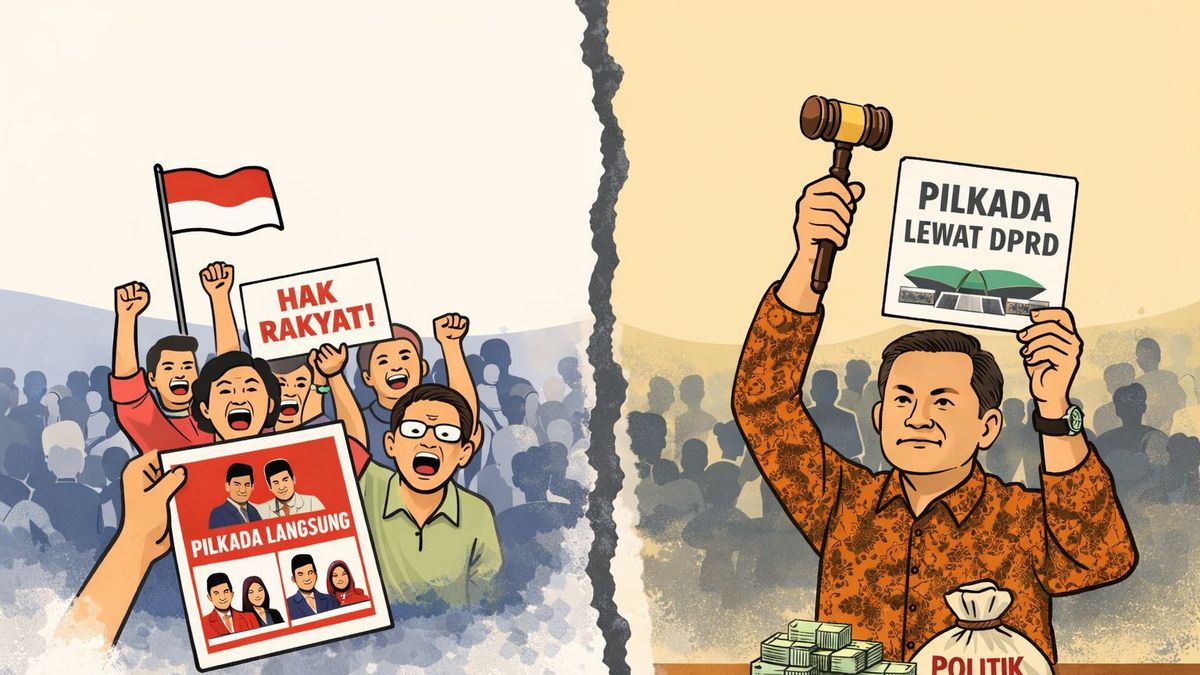


The discourse on returning the election of regional heads through the DPRD is again crowded. Several major parties such as Golkar, Gerindra, to PKB voiced their support. The reasons are various. Starting from cost savings, reducing money politics, to strengthening the function of the DPRD.
However, the voice of rejection is no less loud. PDIP General Chairperson Megawati Sukarnoputri called it "poco-poco gymnastics", backwards-forward. Muhammadiyah General Chairperson Haedar Nashir in the media revealed that the discourse should be carefully studied. Surveys also show that the majority of people reject the regional head being elected by the DPRD.
The Litbang Kompas poll, as reported by Kompas, in December 2025 showed that 77.3 percent of the total 510 respondents wanted direct gubernatorial elections to be held. Respondents came from 76 cities in 38 provinces that were randomly selected with a 95 percent confidence level.
Meanwhile, the results of the Lingkaran Survei Indonesia (LSI) Denny JA survey released in January 2025, also showed that 66.1 percent of respondents said they were not in agreement or did not agree at all with the idea of the DPRD's pilkada.
Meanwhile, the group that supports the election of regional heads through the DPRD argues that direct elections are too expensive. The 2024 election budget reaches Rp. 76 trillion, and the 2024 simultaneous election budget is estimated to suck in tens of trillions of rupiah. If it is totaled since the reform era, our democratic costs are extraordinary. Even as quoted by the seskab website, the 2019 elections and elections cost Rp. 25.5 trillion.
This cost is alleged to be the root of the rampant money politics. Those who run for the Pilkada must have a large capital. As a result, many are entangled in political debt, making the position a field for capital return. This also gives birth to puppet leaders of oligarchy or political dynasties.
The group that rejects has a different view. For them, direct elections are the people's right. That is the essence of post-reform democracy. Returning it to the DPRD is the same as revoking the people's right to directly choose their leaders.
Chairman of Commission II of the House of Representatives, Muhammad Rifqinizamy Karsayuda, emphasized that Law Number 10 of 2016 concerning the Election of Governors, Regents, and Mayors (Pilkada Law) has not been a legislative agenda of the House of Representatives until now.
- https://voi.id/berita/551892/pilkada-asimetris-dinilai-merusak-konsistensi-semua-tingkatan-pemilu
- https://voi.id/berita/551890/e-voting-bisa-kurangi-praktik-politik-uang-di-pilkada
- https://voi.id/berita/551256/menko-yusril-pilkada-lewat-dprd-permudah-pengawasan-politik-uang
- https://voi.id/berita/550895/pdip-usul-pilkada-lewat-e-voting-komisi-ii-dpr-kita-bahas-semua-usulan
- https://voi.id/berita/550859/komisi-ii-dpr-tegaskan-revisi-uu-pilkada-tak-masuk-prolegnas-2026
"We respect the evolving discourse, but what I want to say and inform is that until this moment, until today, the Law on the Election of Governors, Regents, and Mayors has not been the DPR's legislative agenda," he said in mid-January.
If the problem is the high cost and money politics, it should be the implementation that is improved, not the system. It is not the voters that are reduced, but the control mechanism that is strengthened.
"We can reduce the cost of the Pilkada with technology. E-voting, for example, has long been discussed. Other countries such as India, Australia, Brazil, even the Netherlands have implemented it.
Political money can also be suppressed by strengthening Bawaslu, improving the campaign fund audit system, and giving firm sanctions.
"We cannot solve the governance problem by cutting people's rights. Democracy is expensive, but it is much more expensive if people lose their rights.
People now are not like 20 years ago. They are information literate, active on social media, and more critical. If their voting rights are revoked, it could be that dissatisfaction will be channeled in other ways - demonstrations, digital pressure, to political defiance.
"We cannot improve democracy by anti-democratic means. Retreat to the DPRD system without major reforms in political governance will only make the people more apathetic. And political apathy is the long-term enemy of democracy.
If our electoral system no longer represents the voice of the people, it is not impossible for the people to create their own way. Through citizen forums, digital communities, or social movements. Moreover, social media is now very powerful. They can choose their own leaders, outside the formal mechanism. It could be one day, people no longer believe in the results of the official Pilkada. But they trust the results of voting through community applications more.
When the system is no longer trusted, then formal democracy will lose to social democracy. And when that happens, we not only lose democracy - but also lose control. And we don't want that to happen.
The English, Chinese, Japanese, Arabic, and French versions are automatically generated by the AI. So there may still be inaccuracies in translating, please always see Indonesian as our main language. (system supported by DigitalSiber.id)
Most Popular Tags
#Prabowo Subianto #donald trump #firearm #8791 #giias 2026Popular