
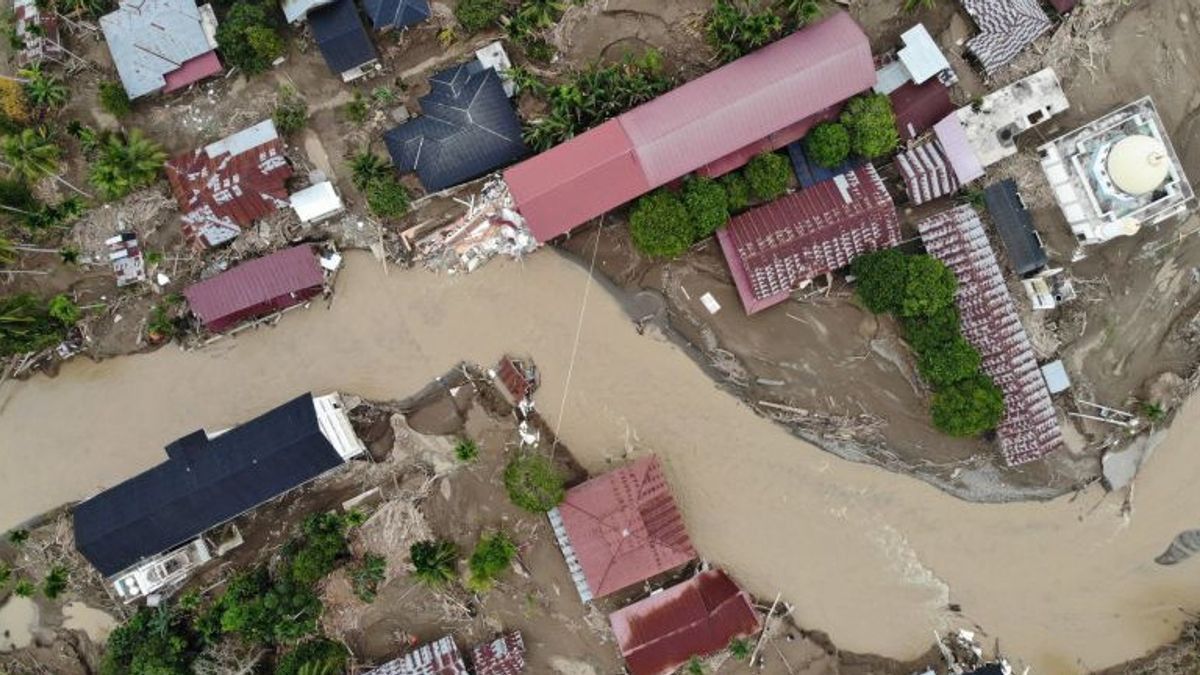


Floods and landslides that hit Sumatra are not small events. Aceh, North Sumatra, and West Sumatra have suffered widespread impacts. Thousands of houses were damaged, infrastructure paralyzed, and the death toll continued to increase. However, until now, the government has not designated this event as a national disaster. President Prabowo Subianto also openly rejected foreign aid on the grounds that the country was still able to handle the impact of the disaster.
The government emphasized that the non-establishment of the national disaster status does not mean that the country is negligent. Assistance is still being distributed, the budget is being disbursed, and the state budget is being prepared for tens of trillions of rupiah for rehabilitation and reconstruction. The president and his cabinet members are said to continue to monitor developments in the field. This affirmation has been repeatedly conveyed, including by the Cabinet Secretary Teddy Indra Wijaya who stated that the government is working to the maximum to help the victims.
Normatively, the government's argument has a legal footing. Law Number 24 of 2007 concerning Disaster Management regulates the mechanism for handling in stages. The regional government is the main responsible party, while the central government intervenes if the regional capacity is considered no longer adequate. This framework is the main basis for the counter-establishment of the national disaster status.
UGM Disaster Study Center (PSBA) Expert, Prof. Djati Mardiatno, S.Si., M.Si., as quoted from the official UGM website, emphasized that the determination of the national disaster status cannot be solely based on the number of casualties or the area affected. According to him, the determination of the status must follow the hierarchical mechanism regulated in the legislation.
He explained that the escalation of the disaster status could only be carried out when the district or city government had declared that it was unable to handle the impact of the disaster. The process began with the establishment of an emergency status by the regional head, followed by the provincial level, and then to the central government if the regional capacity was really exceeded.
Another issue that has also emerged is the issue of foreign aid. The determination of the status of a national disaster often opens the door to the entry of international aid. The government considers this to need to be strictly controlled. The Minister of Home Affairs emphasized that foreign aid cannot be accepted without official mechanisms and permits, on the grounds of maintaining sovereignty and accountability of the state.
The context is reflected in the case in Medan. Medan Mayor Rico Waas returned foreign aid in the form of 30 tons of rice sent from the United Arab Emirates. The decision was said to follow the instructions of the central government. The move triggered various public reactions. Some considered the decision appropriate for procedural compliance, while others questioned the sensitivity of the policy in the midst of an emergency.
Minister of Home Affairs Tito Karnavian then explained that the aid did not come from the official government of the United Arab Emirates, but from the United Arab Emirates Crescent organization. According to Tito, the rice was eventually diverted through the Muhammadiyah Medical Center in Medan.
At this point, the argument of the pro-national disaster designation camp strengthened. They assessed that the disaster in Sumatra had met the national criteria. The impact was cross-provincial, significant casualties, widespread infrastructure damage, and the economic burden of the region was getting heavier. Bank Indonesia even projected a slowdown in economic growth in the affected areas due to disruptions in production and distribution activities.
The Professor of Environmental Law at the University of North Sumatra (USU), Prof. Suhadi, as quoted from hukumonline, assessed that the provincial government and BNPB have a strong basis to encourage the determination of the national disaster status to the central government. The considerations include the number of victims, material losses, and damage to transportation access which caused a number of isolated areas.
The facts on the ground reinforce this view. The Ministry of Public Works noted that dozens of national roads in Aceh could not be passed. The distribution of logistics was hampered and access to the affected areas was very limited. In a number of locations, residents had to wait for help for days.
This situation has created a symbol of despair. Residents waved white flags as a sign of emergency. Member of Commission IV of the DPR, Daniel Johan, assessed that this action was not a political symbol, but an expression of desperation due to the slow handling of post-disaster. Home Minister Tito Karnavian also admitted that the waving of the white flag reflected the aspirations of residents who needed a faster response.
In the end, the debate on the status of the national disaster reveals a more fundamental problem, residents in disaster areas grapple with logistical, access, and time constraints. Status can be debated at the meeting table, but in the field, delays always have real consequences.
The disaster in Sumatra once again shows that the presence of the state is not measured in terms of policy terms, but rather by the speed of action. The water is indeed receding, but the loss cannot be delayed. In emergency situations, the government is obliged to act quickly, open the facts honestly, and show readiness to accept public input - including openness to criticism and evaluation of policies. That's where the public's trust is at stake.
The English, Chinese, Japanese, Arabic, and French versions are automatically generated by the AI. So there may still be inaccuracies in translating, please always see Indonesian as our main language. (system supported by DigitalSiber.id)


