
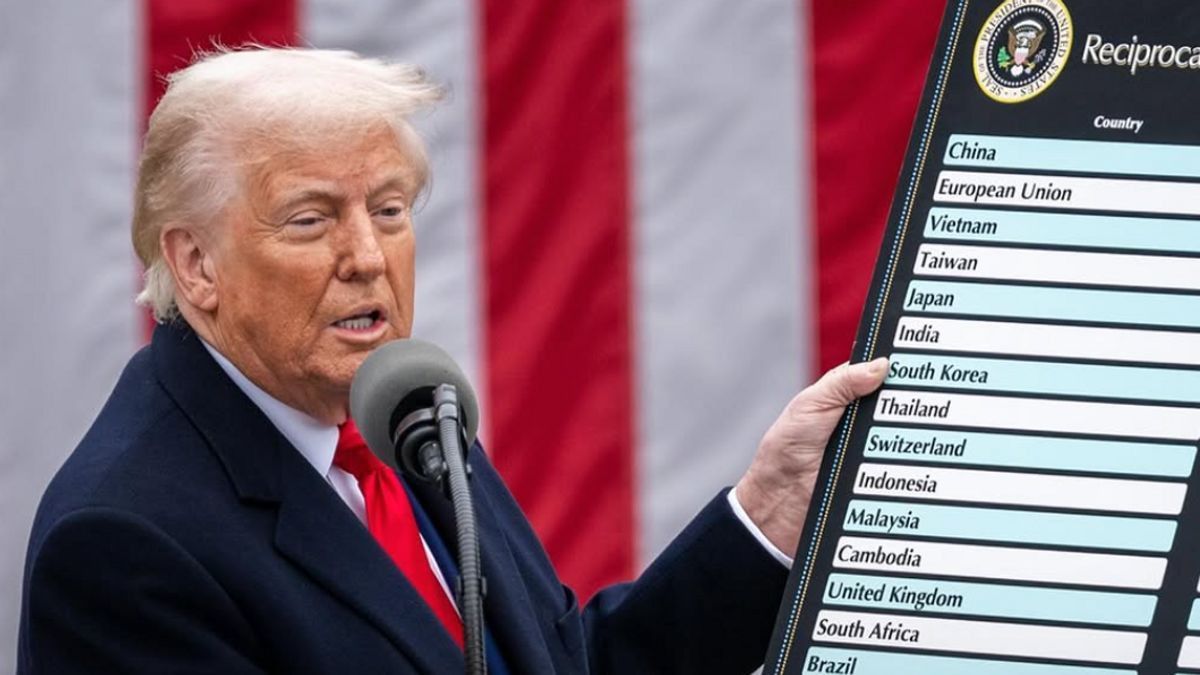


US President Donald Trump's new tariffs aren't just numbers. They're a ticking time bomb that's quietly exploding at the heart of Indonesia's downstreaming strategy. It's no longer just about exports. It's a direct threat to national economic sovereignty.
In April 2025, the United States officially imposed import tariffs of up to 32 percent on Indonesian products. They call this policy "reciprocal." Reciprocal means reciprocal. In the context of trade, if one country imposes high tariffs or taxes on goods from another country, the injured country can retaliate with equal tariffs.
The United States calls its import tariff policy against Indonesia a reciprocal policy—meaning equal retaliation. But in reality, it's unfair. Indonesia doesn't impose high tariffs on American goods. To be honest, this isn't an attempt to equalize trade treatment, but rather a subtle ploy to eliminate competitors from the US market.
The problem is, the Indonesian products subject to tariffs aren't just any goods. They're the result of the downstreaming process: plastic products, food and beverages, electronics, textiles, and electrical equipment. Finished goods, the result of investment and technology, are no longer the raw materials they were a decade ago. This is the crux of the problem.
These high tariffs directly impact downstream production. This is because tariffs are imposed not on raw materials, but on processed goods. Imagine: when Indonesia exports raw copper or nickel ore, the tariff is low. But when we process those raw materials into electrical cables or electric vehicle batteries domestically, then export them to the US, the tariff suddenly jumps to 32 percent. The implication is clear: major countries prefer us to continue exporting raw materials. They don't want us to upgrade to a finished goods producer.
The consequences are very concrete. Our products lose out in the global market due to higher prices. Already established factories struggle to sell their products. Investment becomes hesitant. The much-vaunted downstream sector could die before it even gets off the ground. This isn't speculation; it's a real threat.
The Indonesian Olefin, Aromatic, and Plastic Industry Association (INAPLAS) is also concerned and is urging the government to immediately address this with firm market protection policies. One way is to expedite anti-dumping and safeguard investigations. The electronics and electrical equipment industry shares this sentiment. They are urging the government to maintain the TKDN requirement so that the domestic market can absorb production, as export prospects are increasingly slim. This doesn't include the textile, food and beverage, and automotive component manufacturing industries.
The downstream sector is a source of employment. It's a place where investment flows in. It's a long value chain. If this sector is hit, thousands of jobs could be at risk. The MSMEs that support it will also be paralyzed. People's purchasing power will decline. And the entire economic cycle will decline.
The government is trying to respond. President Prabowo Subianto has established diplomatic communications with Malaysia, the Philippines, and Singapore and even flew to meet with the Malaysian Prime Minister. The Indonesian Chamber of Commerce and Industry (KADIN) is preparing a delegation to Washington. The Indonesian Association of Indonesian Trade (Apindo) is proposing a bilateral agreement. Another problem arises because there is still no replacement for the Indonesian Ambassador to the US after Rosan Roeslani was appointed Deputy Minister of State-Owned Enterprises and then Minister of Investment.
The Minister of Culture, Fadli Zon, also spoke out. This was not due to his position, but to the accuracy of his stance. The London School of Economics graduate called Trump's tariffs a new form of unilateralism that harms developing countries and creates turmoil in the global market. He believes Indonesia must stop exporting raw materials. "Added value, jobs, and industrial sovereignty can only be achieved through downstreaming," Fadli said.
Fadli urged that diplomacy be accompanied by concrete action. Build alternative markets. Strengthen the domestic production ecosystem. Don't expect concessions from outside, especially if the world proves unfair. To date, the US has not imposed tariffs on products from Russia and North Korea—two countries that are politically hostile to Washington. Indonesia, which has long been an open trading partner, is being punished. This is both an irony and a stern rebuke.
This situation further demonstrates that only countries with strong economic courage and political strategies can survive. Look at China. When the US imposed high tariffs, they didn't bow down. They retaliated by imposing a 34 percent tariff on all American goods. China is undaunted by losing its market share. Because what they are defending is not just export figures, but the dignity of their industry.
Bank Indonesia warned that this tariff pressure could cause the rupiah to fluctuate, or simply put, further pressure. Last week, the exchange rate reached around Rp16,500 per US dollar. Inflation looms. Import costs are rising. Prices could be pushed up. Ultimately, it is the people who feel the impact most. Because these tariffs aren't just about industry. They can also affect households through price increases and job losses.
Indef economist Eisha Maghfiruha Rachbini suggested that Indonesia immediately open its markets to Africa, Central Asia, and South America. But all of this requires time and logistical support.
If the government fails to respond systematically and swiftly, downstreaming will remain a pipe dream. Newly established factories could collapse before they can even begin to produce anything. We'll return to being a raw material exporter, just like before. These tariffs aren't just import duties. They're a test of the course of history. They're about whether we dare to stand on our own two feet.
The English, Chinese, Japanese, Arabic, and French versions are automatically generated by the AI. So there may still be inaccuracies in translating, please always see Indonesian as our main language. (system supported by DigitalSiber.id)


