
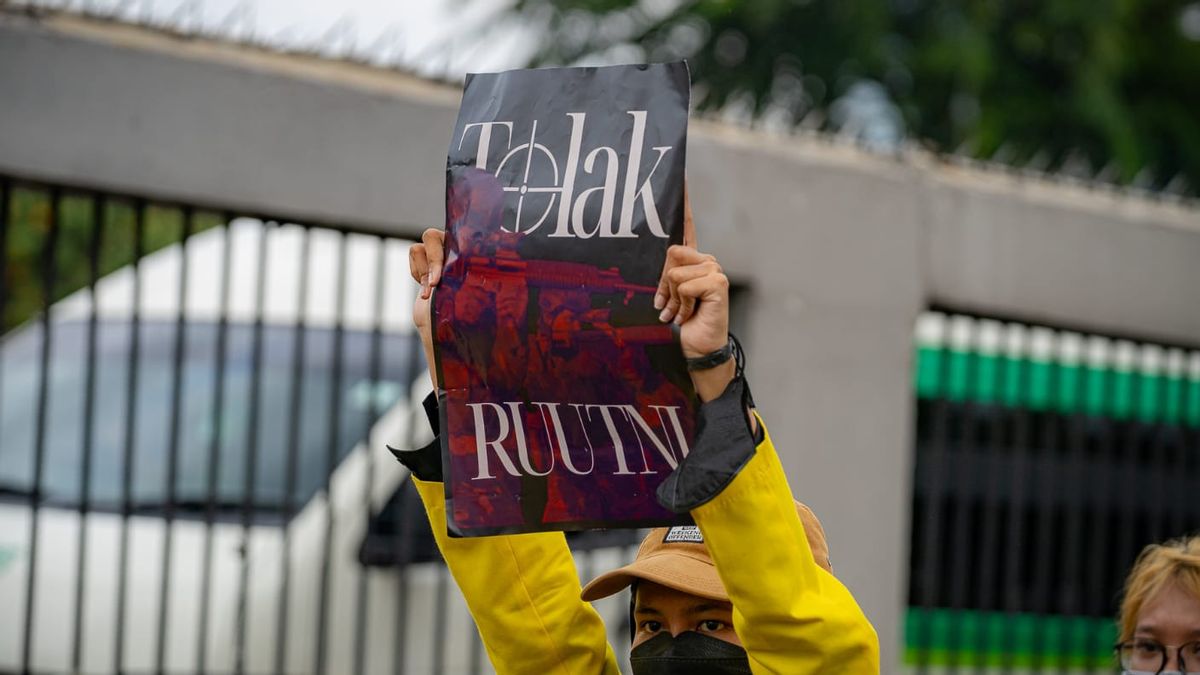


The day after the House of Representatives (DPR) passed the revised TNI Law, the parliamentary fence was breached. Students entered the parliamentary building. Chants of "reject militarism" echoed in the heart of democracy. But elsewhere, the government remained calm. Unperturbed. Unmoved.
Amidst this situation, one name stood out: Prabowo Subianto. As President of the Republic of Indonesia, less than a year into his term, Prabowo faced a major initial test. The revised TNI Law awaited only one signature. But the public hoped he would uphold the principle of civilian supremacy, despite his military background.
The new TNI Law may appear calm. However, several of its articles have raised concerns among many. One of them concerns the extension of the retirement age for high-ranking officers, from 58 to 60, and even to 62 for four-star generals. For democracy observers, this is not about age, but about expanding the scope of influence within the military.
Another article in the spotlight concerns the placement of active-duty soldiers in civilian positions. Now, active-duty soldiers can fill 14 strategic positions in ministries and institutions. The most notable point: there is no need to resign from active duty. This creates a potential conflict of interest. The military can perform civilian functions without leaving the military structure.
The military's role has also been expanded. The TNI (Indonesian National Armed Forces) can be involved in matters related to radicalism, drugs, natural disasters, and even cybersecurity. However, without strong civilian boundaries and oversight, this could expand into areas that should be handled by civilian institutions.
The Chairperson of the National Human Rights Commission (Komnas HAM), Atnike Nova Sigiro, assessed the legislative process for revising the TNI Law as flawed. She called it an abusive lawmaking practice. The discussions were closed-door, rushed, and lacked public participation. Many parties opposed the move: students, NGOs, and academics.
However, former Coordinating Minister for Political, Legal, and Security Affairs and legal expert Mahfud MD believes the articles in the TNI Law do not imply the dual function of the Indonesian National Armed Forces (ABRI) as they did during the Soeharto era. Instead, they reinforce a long-standing concept.
"Many people's concerns are understandable, as the drafting process lacked meaningful public participation, was not transparent, and seemed to be playing hide-and-seek and then suddenly emerged," Mahfud said on a private television station.
Meanwhile, Defense Minister Lt. Gen. (Ret.) Sjafrie Sjamsoeddin stated that military involvement in non-war affairs is part of Military Operations Other Than War (OMSP). "The military now knows its limits," he said. He believes the country needs the TNI's support to face new challenges, not just war.
However, Karlina Supelli has a different view. The philosopher and Director of the Postgraduate Program at the Driyarkara School of Political, Legal, and Security Affairs stated that there is a fundamental error in the legal logic behind the drafting of the TNI Law. She highlighted academic papers that use the practice of placing military personnel in civilian institutions as a legal basis. "If a wrong practice is legalized, that's a logical fallacy. It's already been done, and then justification is sought," Karlina said at a press conference for the National Conscience Movement last week.
Rejection of the TNI Law spread to several regions. At the same time, the Jakarta Composite Index (JCI) plummeted. Investors were anxious. They may not care about the content of each article. But they were closely monitoring the direction of democracy and the stability of national leadership.
At this point, Prabowo Subianto's role is crucial. He can sign this law as a sign of respect for the legislative process. But he can also ensure its implementation does not violate democratic principles. He can ensure the TNI remains professional and prevents a return to the era of the ABRI (Indonesian Armed Forces) Dual Function.
Minister of Law, Supratman Andi Agtas, stated that those objecting to the TNI Law can pursue constitutional channels through a judicial review at the Constitutional Court. That is the legitimate scope for correction in a democracy, not violence or street pressure.
Prabowo Subianto has strong assets: public legitimacy and political power. But he must be vigilant. Because in politics, perception can be stronger than reality. And what's most dangerous isn't the law itself, but how the public interprets its symbols and the direction it takes.
The English, Chinese, Japanese, Arabic, and French versions are automatically generated by the AI. So there may still be inaccuracies in translating, please always see Indonesian as our main language. (system supported by DigitalSiber.id)


