
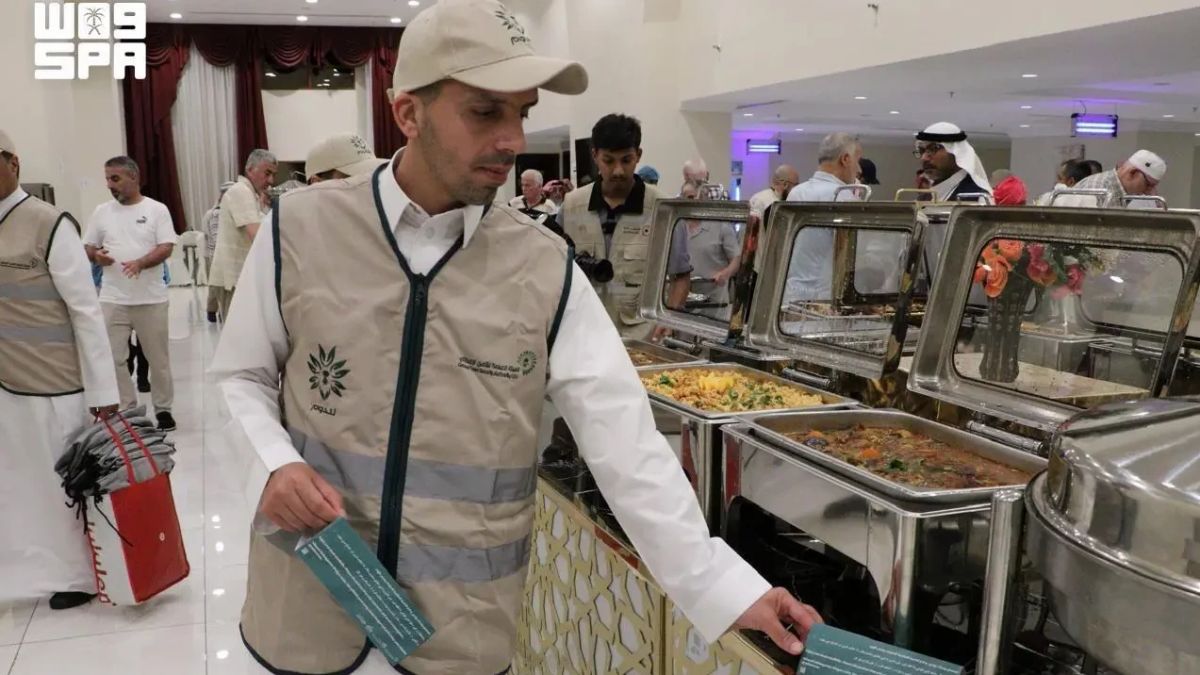


Saudi Arabia - Saudi authorities, catering companies and charities are stepping up efforts to reduce food waste, improve food planning and divert surplus food to those in need across Mecca and beyond this year, as millions of meals are distributed during the 1447 Hijri Hajj season.
Hajj service providers say that food management during Hajj has been monitored more closely in recent years, with tighter supervision and partnerships aimed at minimizing unnecessary waste while maintaining high standards of food safety and nutrition.
Abdullah Ali bin Mahfouz, general manager of Abdullah Ali bin Mahfouz Co. for Domestic Congregation Services, said the company had coordinated closely with approved catering providers to ensure food was prepared according to the needs of the congregation and in controlled quantities.
"We have an agreement with a food and catering management company registered with the Ministry of Health and the Ministry of Hajj and Umrah. We are coordinating with Rawabi Al-Sham restaurants to provide the right amount of food during the Hajj pilgrimage and are working hard to ensure that food waste is minimized," he explained, as reported by Arab News (29/5).
"The team is tasked with monitoring the handling and storage of food during the Hajj season, with 30 to 40 staff members overseeing the food process, including items that can be safely stored for the next day. Food is prepared carefully to accommodate pilgrims with various health conditions, including diabetes, high blood pressure, and other dietary needs until the end of the Hajj," he said.
"We have also collaborated with the Hefz Al-Nema Community Association, which collects leftovers in small containers to redistribute. We know the importance of balancing food consumption and reducing waste," added bin Mahfouz.
Food distribution remains a major logistical challenge for service providers, with charities across Makkah playing a key role in collecting and redistributing excess food from pilgrim camps and catering facilities.
Haton Abdulaziz Al-Olayan, an executive official at the Hefz Al-Nema Community Association, said his organization works with dozens of Hajj camps every year, collects excess food and distributes it to those in need in and outside Mecca. "This year we are working with 35 camps. The number varies every year. Last year, we collected about 64,000 meals, supported by a team of about 40 volunteers," he said.
In parallel, the Kidana Development Company, the implementing agency of the Royal Commission for Makkah City and Holy Places, is working strategically with several entities to further reduce food waste by diverting excess food to charitable distribution centers.
Meanwhile, the Ekram Association for Food Preservation continues its annual effort to collect and redistribute excess food during the hajj.
According to the association, around 800 kg of excess food is handled during the Hajj season every year.
Ahmed Al-Matrafi, the association's director, said Ekram had signed agreements with public and private sector entities to target locations where food wastage is most common.
"This agreement includes partnerships with catering agencies, pilgrim facilities, and hotels in the central area of Makkah," he said.
The excess food saved includes hot meals, fruits, vegetables, frozen food, drinks, baked goods, sweets and meat products, which are redistributed to needy families and individuals throughout Makkah.
Meanwhile, other domestic haj service providers said that reducing food waste has become a shared responsibility across sectors.
Al-Rukun Services Executive Manager Mohammed Saeed said compliance with ministry regulations and environmental considerations were the main things in camp operations.
"There are several organizations and associations that manage food surpluses and strive to reduce waste, and we have partnered with groups that collect leftover food. About 35 volunteers work with us. During Hajj, food waste must be minimized through controlled food preparation, in accordance with Islamic teachings that prohibit waste," he explained.
Meanwhile, the National Waste Management Center continues to strengthen its efforts to manage Hajj waste through initiatives that collect food and organic waste from camps and facilities, sort it at designated collection points, and process it through recycling and composting systems.
This process turns organic waste into fertilizer and other useful byproducts, in coordination with other Hajj service providers, to support a cleaner and sustainable Hajj environment.
The English, Chinese, Japanese, Arabic, and French versions are automatically generated by the AI. So there may still be inaccuracies in translating, please always see Indonesian as our main language. (system supported by DigitalSiber.id)
Most Popular Tags
#Prabowo Subianto #donald trump #firearm #8791 #giias 2026Popular


