

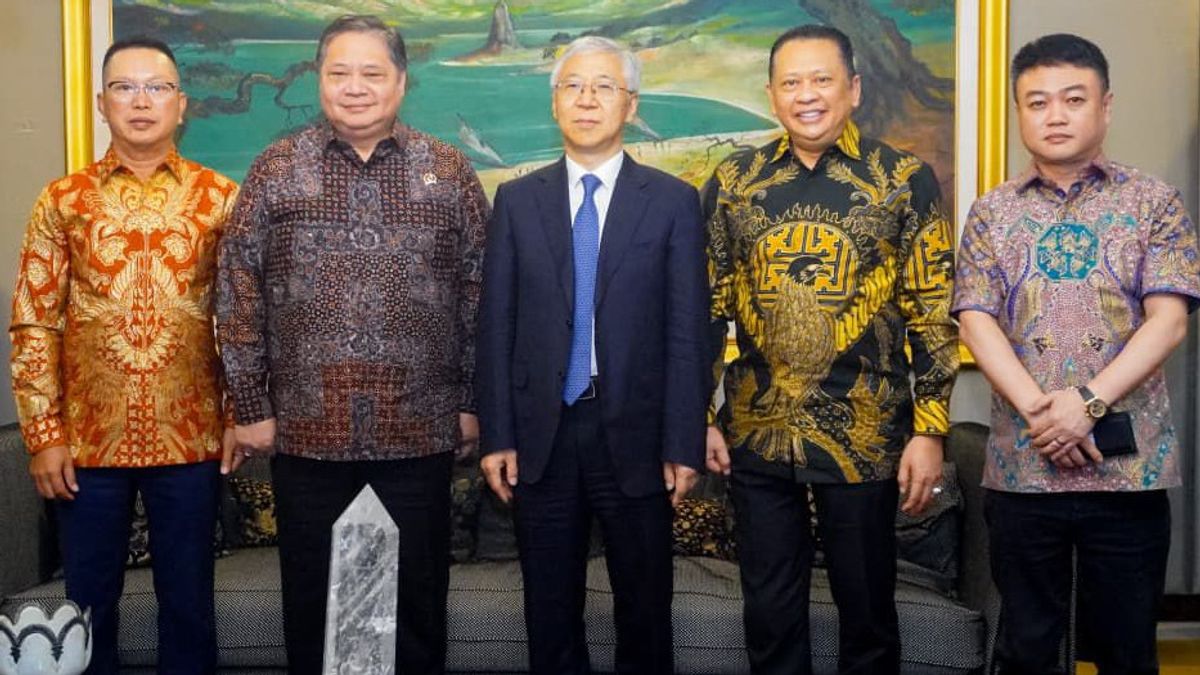


JAKARTA - Bambang Soesatyo (Bamsoet) encourages Chinese investors to enter the data center project in Indonesia. According to Bamsoet, Indonesia's growing digital market must be followed by the development of cloud infrastructure, artificial intelligence, and data storage.
Bamsoet conveyed this encouragement after accompanying the Deputy Governor of Hebei Province, China, Zhao Chenxin, along with a number of Chinese businessmen met with Coordinating Minister for the Economy Airlangga Hartarto in Jakarta, Tuesday, May 26.
"Investors from China have the technological capacity, financing, and experience in building a large-scale digital ecosystem that can be combined with domestic potential," said Bamsoet.
He said Indonesia needs to become the main destination for data center investment by providing regulatory certainty, energy availability, fiscal incentives, and licensing ease.
According to Bamsoet, the need for data centers in Indonesia is increasing as digital, cloud, and AI services grow. He said the number of internet device connections in Indonesia has reached more than 350 million. The Indonesian data center market is also projected to reach 9.43 billion US dollars by 2030.
Bamsoet assessed that a number of regions have great opportunities for the development of international-scale data centers. Batam is superior because it is close to Singapore. Cikarang is strong because it is in the Java industrial corridor. Manado is starting to be looked at because it is connected to international submarine cable networks to the US market.
"Indonesia has all the prerequisites to become a new force in the data center industry in Asia," said Bamsoet.
However, Bamsoet reminded that digital investment should not stand alone. He assessed that strengthening the digital economy must go hand in hand with improving logistics, trade, and national shipping lines.
According to him, Indonesia's dependence on foreign ships for export-import transportation still makes logistics costs high and foreign exchange flows out. Indonesia's logistics costs are said to be above 14 percent of gross domestic product.
"As long as the export-import maritime transport is still dominated by foreign parties and trade governance is not transparent, then the national economic benefits will continue to leak," said Bamsoet.
He encouraged the improvement of ports, customs, export systems, and the strengthening of the national fleet. Bamsoet also highlighted the alleged practice of manipulating export documents, under-invoicing, transfer pricing, and placing profits abroad.
According to the Deputy Chairperson of the Golkar Party and Chairman of the Association of Commodity Trading Companies, Distributors, and Industrial (ARDIN) Indonesia, strengthening export supervision and the obligation to place foreign exchange from exports in the country is important so that the benefits of trade return to the national economy.
"Every dollar from the export of natural resources must have an impact on national development," he said.
Bamsoet assessed that the development of data centers, the improvement of shipping lines, and the strengthening of the maritime industry need to be read as a package of economic transformation in Indonesia. Not only so that Indonesia becomes a large digital market, but also so that its added value does not run abroad.
The English, Chinese, Japanese, Arabic, and French versions are automatically generated by the AI. So there may still be inaccuracies in translating, please always see Indonesian as our main language. (system supported by DigitalSiber.id)
Popular


