

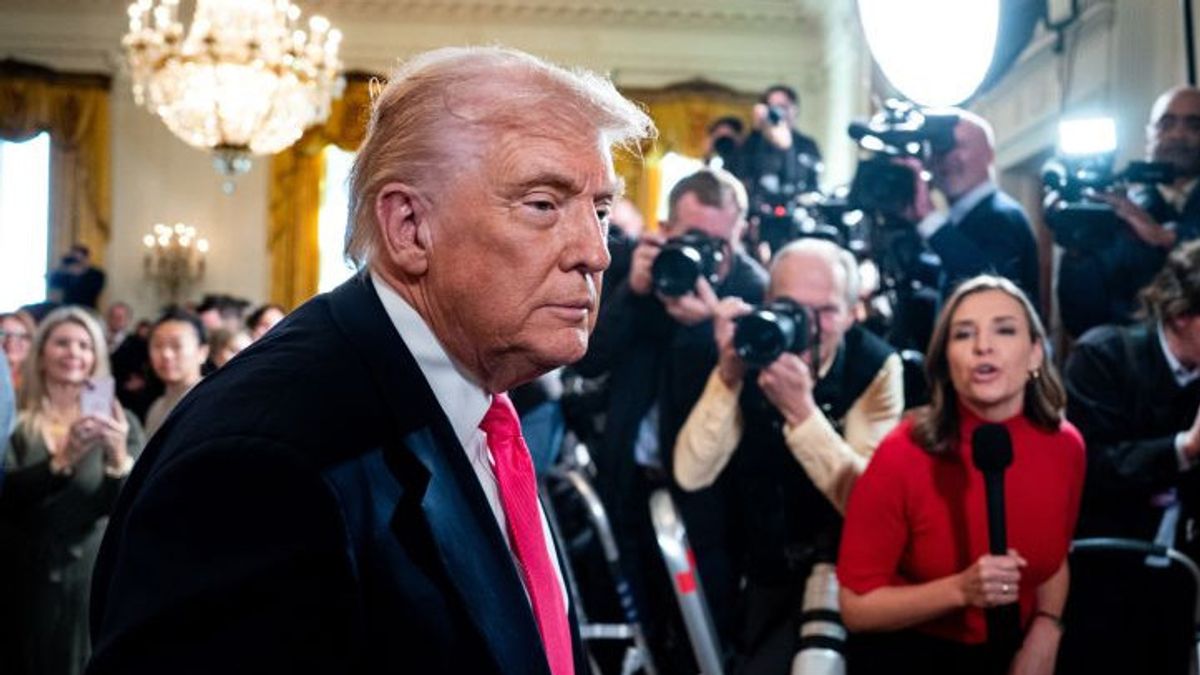


JAKARTA - Three months after the war against Iran began, US President Donald Trump is facing a big question: is he really winning?
Although the United States managed to launch various military attacks against Iran's strategic facilities, a number of analysts assessed that the victory that Trump had claimed was not yet clearly visible in the geopolitical reality of the Middle East region.
On the contrary, the prolonged conflict is beginning to change into a political, economic, and diplomatic burden for Washington.
Since the military operation against Iran began, Trump has repeatedly said that the United States has succeeded in surpassing the operation's targets and weakening Tehran's power. The White House even stated that all the main targets in the military operation named Operation Epic Fury had been achieved.
But on the ground, Iran has still been able to maintain its strategic influence. Tehran still controls the vital Strait of Hormuz, which is the lifeline of the world's oil distribution. Iran's nuclear program has also not really stopped, while the government in Tehran has survived despite continued military and economic pressure from Washington.
The situation raises new questions about the effectiveness of Trump's strategy. A number of analysts assess that the United States has indeed won many battles militarily, but it is not necessarily winning the war politically.
Former Middle East negotiator for Republican and Democratic administrations Aaron David Miller assessed that the war, which was originally designed as a quick victory, has now turned into a long-term strategic problem for Trump.
"We are now in the third month and the war, which was originally designed as a quick victory for Trump, now looks like a long-term strategic failure," Miller said as quoted by Reuters, Sunday, May 24.
The pressure on Trump is increasing because he is known to be very sensitive to the image of political defeat. In the Iran conflict, Trump faces a difficult situation when the world's largest military power has not been able to force Iran to fully submit.
On the other hand, Trump is also in a political dilemma. If he accepts a compromise with Iran, he risks being seen as backing down from his hardline stance. But if he continues to escalate the war, the United States could be trapped in a long, costly and exhausting conflict.
In fact, the domestic conditions of the United States also complicate Trump's position. Fuel prices have started to rise due to disruptions in global energy distribution. Economic uncertainty also triggered public pressure on his administration ahead of the November 2026 midterm elections.
Whereas previously Trump campaigned with a promise to avoid prolonged foreign wars.
In addition to economic issues, relations between the United States and a number of European allies have also begun to experience tension. Several European countries are said to be disappointed because the conflict with Iran is considered to have taken place without sufficient consultation with Washington's traditional allies.
Meanwhile, China and Russia are said to be using the war to study the pattern of US military operations and its weaknesses in facing Iran's asymmetric war strategy.
However, not all parties judge Trump to have failed. Former senior Trump adviser Alexander Gray assessed that the great damage to Iran's military capabilities was enough to be called a strategic victory for the United States.
According to him, the war also made the Arab Gulf countries closer to Washington and away from China's influence.
However, a number of key targets of the United States have not been fully achieved.
Iran still maintains its nuclear program and has shown no signs of significantly halting uranium enrichment. In fact, a number of analysts warn that a war could actually encourage Iran to accelerate the development of nuclear weapons as a strategic protection, as North Korea did.
In addition, Iranian proxy groups in the Middle East are still active in various conflict areas.
Brookings Institution senior researcher Robert Kagan even assessed that the impact of the Iran war could be a major blow to the global position of the United States.
According to Kagan, the geopolitical damage caused by the conflict has the potential to be greater than the impact of the Vietnam and Afghanistan wars on Washington's global image and influence.
With that condition, the question regarding Donald Trump's victory in the Iran war is still far from a definitive answer.
Militarily, the United States may be superior. But politically, diplomatically, and strategically, the war has opened up new uncertainties that are not necessarily beneficial to Washington or Trump himself.
The English, Chinese, Japanese, Arabic, and French versions are automatically generated by the AI. So there may still be inaccuracies in translating, please always see Indonesian as our main language. (system supported by DigitalSiber.id)


