

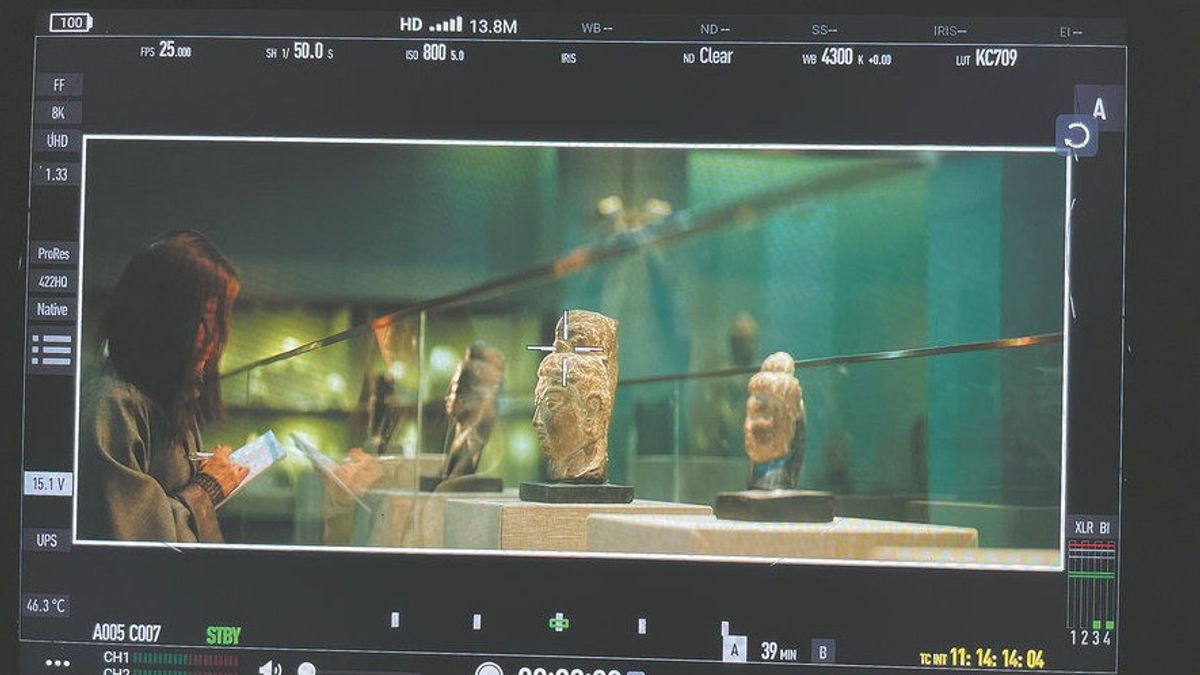


JAKARTA - The palm-sized stone fragment finally found its place. When it was hit against the wall of the Middle Binyang Cave in the Longmen Cave Complex, China, the data showed a 93.3 percent match rate.
According to a report by China Daily quoted Friday, May 22, the fragment is believed to be part of the face of Emperor Xiaowen, ruler of the Northern Wei Dynasty. This finding is an important part of the documentary How I Miss "Her" by Chen Yi, which aired on the documentary channel China Central Television. The research involved the Longmen Grottoes Research Institute.
"It was the most unforgettable moment," said Chen, who witnessed the process. "It was really unexpected. We found the face of Emperor Xiaowen."
The relief comes from the stone panel Emperor and Empress Paying Homage to the Buddha, a Chinese Buddhist cave art from the Northern Wei Dynasty, around 386-534.
The traces are not clean. In the 1930s, a Beijing antiques dealer named Yue Bin dismantled the panel at the request of an overseas buyer. The two panels were carved into more than 6,000 fragments.
About 4,000 fragments were taken to the United States and are scattered at the Metropolitan Museum of Art in New York and the Nelson-Atkins Museum of Art in Kansas City. About 2,300 other fragments are stored in the Longmen warehouse.
The task of the researchers is complicated because the original and fake fragments are mixed. According to the notes of Yue Bin's confession quoted in the film, the looters mixed the fake fragments to raise the price.
Abroad, the restoration process also leaves questions. At the Nelson-Atkins Museum of Art, curator Laurence Sickman once put the fragments together with plaster for two to three years. Academics assess that the panel not only contains ancient traces, but also modern reconstruction traces.
"The end result is a great mystery in the history of Chinese art," said Chen.
One of the key figures in the documentary is Wen Yucheng, Honorary Director of the Longmen Cave Research Institute who is now 87 years old. He began sorting through the Longmen fragments in 1965, shortly after graduating from Peking University's archaeology.
Six decades later, Wen is a living witness to the old plunder and the long effort to repair the damage.
Documentary study instructor Xiao Guangyi from Chengdu College of Arts and Sciences said the most powerful moment in the film came when the researcher tested the fragment against the cave wall.
"Little by little, centimeter by centimeter, until it fits," said Xiao.
The project began to open up to Chen in 2022. At that time, he was making a documentary series Hello AI about artificial intelligence and cultural heritage in Yungang Caves, Shanxi. He then met Huang Xianfeng, a remote sensing expert from Wuhan University.
From the meeting, Chen learned about the Longmen relief project. He then searched through archives from New York to Cambridge, Massachusetts.
One important clue was found in the Harvard University archives. There was a letter from Sickman to Alan Priest of the Metropolitan Museum of Art, accompanied by a sketch of a man's head. The sketch reinforces the suspicion that the American curator had once searched for the same fragment as the one later found in the Longmen warehouse.
China Daily reported that the full-scale digital restoration project at the Longmen Cave Research Institute only started in 2024. The project is led by senior researcher Gao Junping.
Researcher Tian Hengci from the Chinese Academy of Sciences, who is used to studying lunar samples, uses nondestruc-tive testing technology. This technology can examine objects without damaging them. The tool detects trace elements up to one part per million, a kind of geological fingerprint to find out the origin of the rock.
Of the five candidate fragments, only one matched the chemical composition of the original cave wall. The fragment was coded H05. The other four were fakes.
However, finding H05 is only halfway. The cave wall is about two meters by four meters. H05 is only the size of a palm.
The researchers then used high-precision 3D scanning, AI-assisted surface matching, and a method called "digital reunion". The point is, the fragments in various collections are scanned and reassembled virtually without having to move the physical object.
"Academically, the term 'digital reunion' is not entirely accurate, but it helps people understand what we are doing," said Chen.
Chen prefers to call it a "civilization reserve".
"For humans in the next 200 years, this digital model will be a legacy in itself, a record of how we in the present are trying to save what can still be saved," he said.
The English, Chinese, Japanese, Arabic, and French versions are automatically generated by the AI. So there may still be inaccuracies in translating, please always see Indonesian as our main language. (system supported by DigitalSiber.id)
Most Popular Tags
#Prabowo Subianto #donald trump #firearm #8791 #giias 2026Popular


