

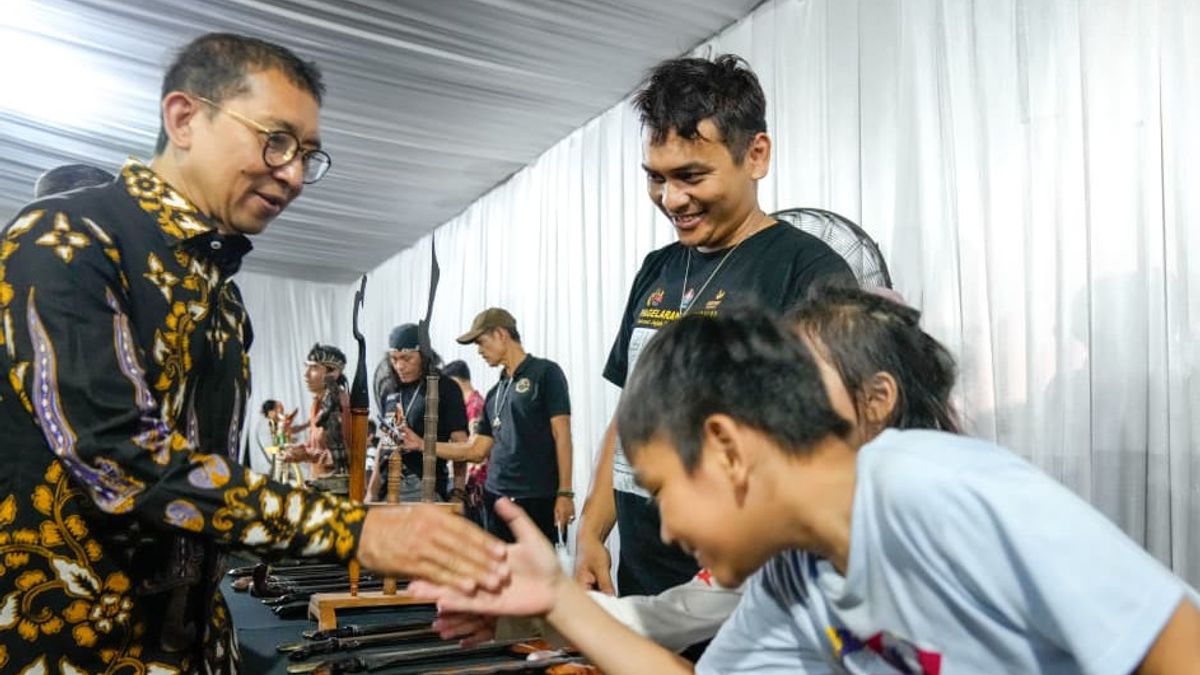


JAKARTA - Minister of Culture Fadli Zon opened the 2026 National Keris Day series at the TMII Heritage Museum, Jakarta, Saturday, May 23. He emphasized that keris is not enough to be kept as a heirloom, but must give value to the master, craftsman, collector, and community.
The commemoration entitled Heritage of Cross-Generational Inheritance will last until June 28, 2026. The activity was held by the Ministry of Culture together with the National Secretariat for Indonesian Perkerisan (SNKI).
"This keris is original from Indonesia, not from other countries. The evidence is in the reliefs of our temples," said Fadli.
According to Fadli, keris is not just a collection or mystical symbol. Keris has a history, philosophy, hand skills, and long knowledge of the people of Nusantara.
Therefore, the government encourages books, exhibitions, podcasts, and keris markets to be more easily accessible to the public, especially young people.
"The involvement of the younger generation is important so that the culture of perkerisan continues to live and develop in the future," he said.
Fadli also assessed that contemporary krises by contemporary masters need to be given space. Kris, he said, can be part of the cultural economy if the ecosystem is maintained, from blade makers, warangka artisans, collectors, to communities.
SNKI Secretary General Basuki Teguh Yuwono said that the keris community in Indonesia continues to grow. SNKI encourages the formation of associations, certification of professions, and the use of technology to introduce keris to a wider community.
"We want to present the culture of perkerisan with a new face," said Basuki.
In the opening, Fadli handed over the 2026 SNKI Award to a number of cultural figures and activists. The Ministry of Culture also handed over paron assistance to five perkerisan communities as support for the tradition of empu and besalen.
In addition to the national keris exhibition, the 2026 National Keris Day series will be filled with the SNKI National Working Conference and the Keris Exchange which involves collectors, academics, masters, and communities from various regions.
Keris has been recognized by UNESCO as a Masterpiece of the Oral and Intangible Heritage of Humanity since 2005. However, this recognition is not enough if keris is only seen as a heirloom. The challenge now is to make young people understand, interested, and see keris as knowledge, works, and an economic source.
The English, Chinese, Japanese, Arabic, and French versions are automatically generated by the AI. So there may still be inaccuracies in translating, please always see Indonesian as our main language. (system supported by DigitalSiber.id)
Most Popular Tags
#Prabowo Subianto #donald trump #Febrie Adriansyah #8791 #giias 2026Popular


