
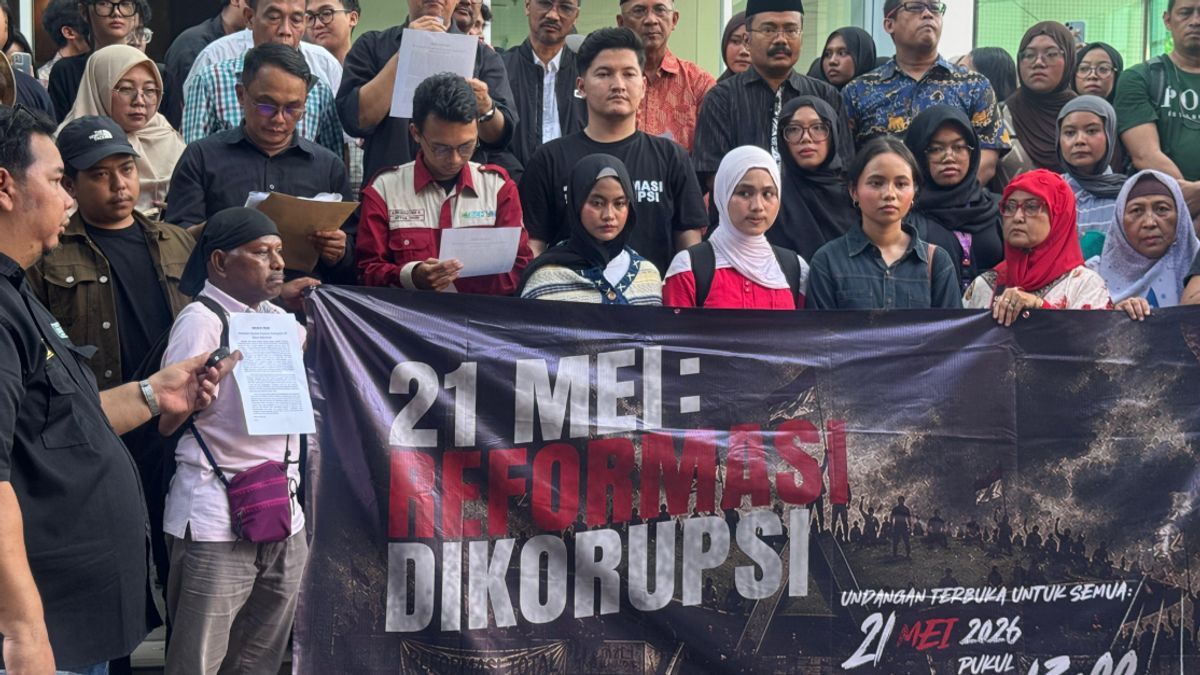


JAKARTA - Twenty-eight years after the 1998 Reformasi, Indonesia faces a serious problem: the reform agenda is increasingly far from the original ideals of the people's struggle, while the symbol of reform is increasingly often used to strengthen the legitimacy of power.
Today, the public witnessed the emergence of two very different faces of reform. On one side, there is a group that commemorates reform by placing the government as a representation of the success of democracy and the continuation of reform ideals. The narrative built emphasizes national stability, economic optimism, support for the government, and constructive escort of power.
On the other hand, there are still civil society groups who view reform as a tool for correcting the state. For this group, reform is not just a historical ceremony, but a reminder that power must continue to be monitored so that it does not fall back into the concentration of oligarchy, the practice of Corruption Collusion and Nepotism (KKN), weakening democracy, and abuse of state institutions.
The difference in position shows that what is going on today is not just a commemoration of the 1998 Reformasi, but a struggle for interpretation of the reform itself.
Muhammad Suryawijaya, Political and Public Communication Analyst of Menteng Kleb, assessed that the 1998 Reformasi was basically born to limit power, not to glorify power. Reformasi emerged from the anger of the people against the practices of the state which were too dominant, corrupt, centralized, and repressive.
"Therefore, the six main agendas of reform have a clear direction: to bring prosperity to the people, to uphold the rule of law, to eradicate KKN to its roots, to strengthen democracy, to limit political power, to remove the dual function of the TNI, to expand regional autonomy, and to ensure the state is subject to the mandate of the constitution," he said. Muhammad Suryawijaya to VOI, Friday, May 22.
But after 28 years have passed, reality shows that most of these agendas have not been carried out seriously. Corruption remains a structural problem. The economic-political oligarchy is increasingly consolidated. Political dynasties and patronage are becoming more open. Democracy is experiencing a quality setback. Civil liberties are under pressure. Economic inequality is still high. Even some state institutions are again showing symptoms of dominance over the civil space.
In such a situation, reform should be a space for evaluating the direction of the nation's journey, not just a tool for the legitimacy of the ruler's politics. Therefore, Menteng Kleb considers it dangerous when the symbols and identities of the 1998 Reformasi are used to build the impression that the entire reform agenda has been successfully carried out by the current power.
Such views actually have the potential to cover up the fundamental problems that Indonesia's democracy still faces. Reform is reduced to a slogan of stability and national optimism, while its main substance - namely the limitation of power and oversight of the state - is slowly marginalized.
"Menteng Kleb also assesses that democracy is beginning to experience setbacks when public space only gives space to reform narratives that are compatible with the interests of power. Reform is ultimately narrowed down to reform that is safe for the country, not reform that dares to correct the country," he said.
In fact, the greatest spirit of the 1998 Reformasi was the courage of the people to remind that no power should be left without criticism and supervision. Reformasi was never born to create a new cult of power, whoever the ruler.
Therefore, Menteng Kleb emphasized that maintaining reform today means maintaining criticism, maintaining civil liberties, maintaining the independence of civil society, and ensuring that the agenda to eradicate KKN, the rule of law, and the limitation of power does not stop being mere political slogans.
"If reform is only commemorated as a symbol of unity without the courage to correct the deviation of power, then reform has lost most of its historical meaning," he said.
The English, Chinese, Japanese, Arabic, and French versions are automatically generated by the AI. So there may still be inaccuracies in translating, please always see Indonesian as our main language. (system supported by DigitalSiber.id)
Popular


