

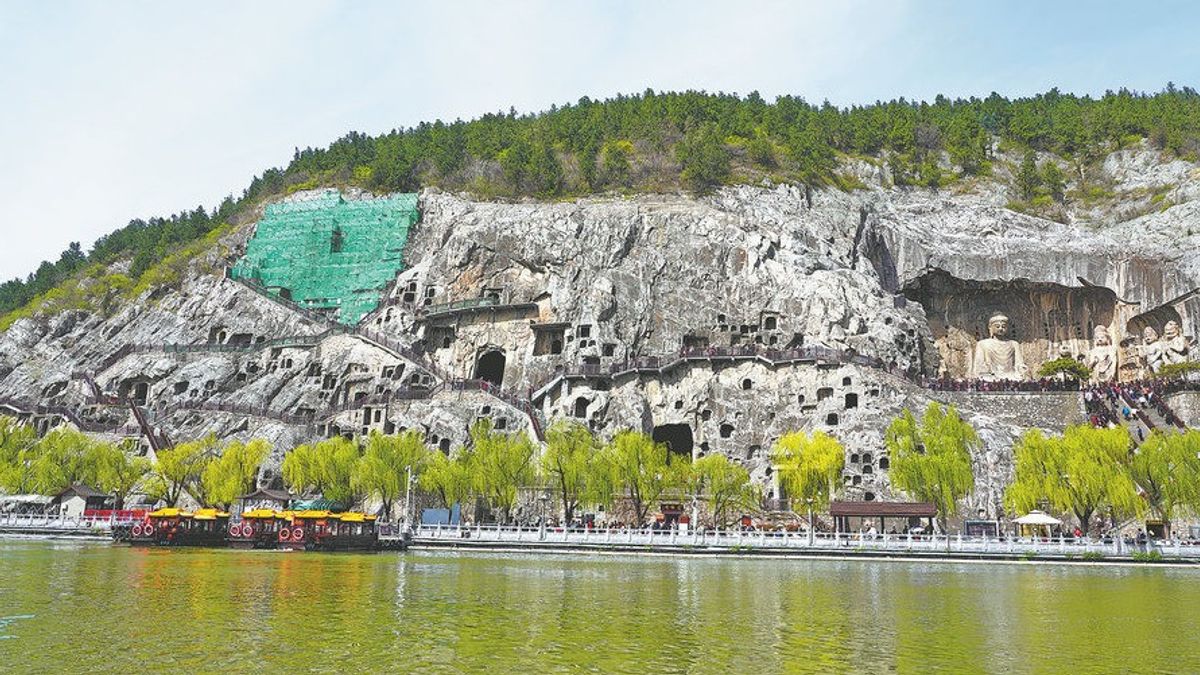


JAKARTA - Conservation workers in Longmen Cave, Henan Province, China, have discovered an ancient Diamond Sutra carving that has been hidden in a cliff about 30 meters high.
Launching a report by China Daily, Thursday, May 21, the findings began on March 28 when workers inspected rocks and crevices in the Liuzuota area. Routine inspections are carried out to prevent the risk of rocks falling at the UNESCO World Heritage site.
But that morning was different. A number of workers saw traces of writing on the vertical cliff wall. They then reported it to the Longmen Cave Academy.
Academy researcher Zhao Shumei said the carving was so high that it had escaped the attention of visitors.
"People usually walk by without knowing it's there," Zhao said.
After being examined and compared with old data, the researchers confirmed that the writing was an engraving of The Diamond Sutra, or Diamond Sutra, one of the important texts in Buddhism.
The carving is about 30 to 40 meters south of the giant statue of the Buddha Lushena. The writing uses the kaishu style, a regular character known for its neatness and readability, from the Tang Dynasty in 618-907.
The top of the carving is still well preserved. Researchers suspect that the text was once in a stone niche. Over time, the niche eroded. Only a portion of the roof remains and protects the carving from wind and sun.
The text contains the version of the Diamond Sutra translated by Kumarajiva, a Buddhist scholar from the late Qin period. Kumarajiva translated the sutra in Chang'an, now Xi'an, in 402.
Ma Chaolong, deputy director of the research center for cave temple protection and cultural heritage monitoring at the Longmen Cave Academy, said Kumarajiva's version was the earliest Chinese translation of the sutra.
According to Zhao, the translation is known to be simple, beautiful, and easy for people to understand. In the time of Emperor Tang Li Longji, this version was officially distributed and widely used.
Near the carving, researchers also found three holes that were suspected of having been used to store Buddhist ashes. The Longmen Cave Academy is still investigating the possibility of a relationship between the holes and the silk carving.
Zhao said the silk carvings on the cliff, like the construction of the Buddha statue, usually show the religious beliefs of Buddhists.
Until now, Longmen Cave has stored five Diamond Sutra carvings. This latest finding is said to be one of the best preserved.
Previously, the Diamond Sutra engraving was also found in Cave Number 429. However, the old findings mostly contained the final part of the sutra. This new engraving actually contains more of the beginning, thus complementing the previous findings.
This discovery adds to the list of important findings from the Longmen Cave conservation project. In recent years, researchers have also found traces of gold on the face of the Lushena Buddha. The findings indicate that the statue may have been covered with gold leaves.
In addition, a statue of Bodhisattva was found to have a glass eyeball.
Zhao said the findings came from a very thorough conservation inspection. Every year, the team examines the cliff surface to ensure that fragile rocks have been strengthened and dangerous cracks have been dealt with.
Zhao said the routine inspection was important to protect the cave and the safety of visitors.
The English, Chinese, Japanese, Arabic, and French versions are automatically generated by the AI. So there may still be inaccuracies in translating, please always see Indonesian as our main language. (system supported by DigitalSiber.id)
Most Popular Tags
#Prabowo Subianto #donald trump #firearm #8791 #giias 2026Popular


