

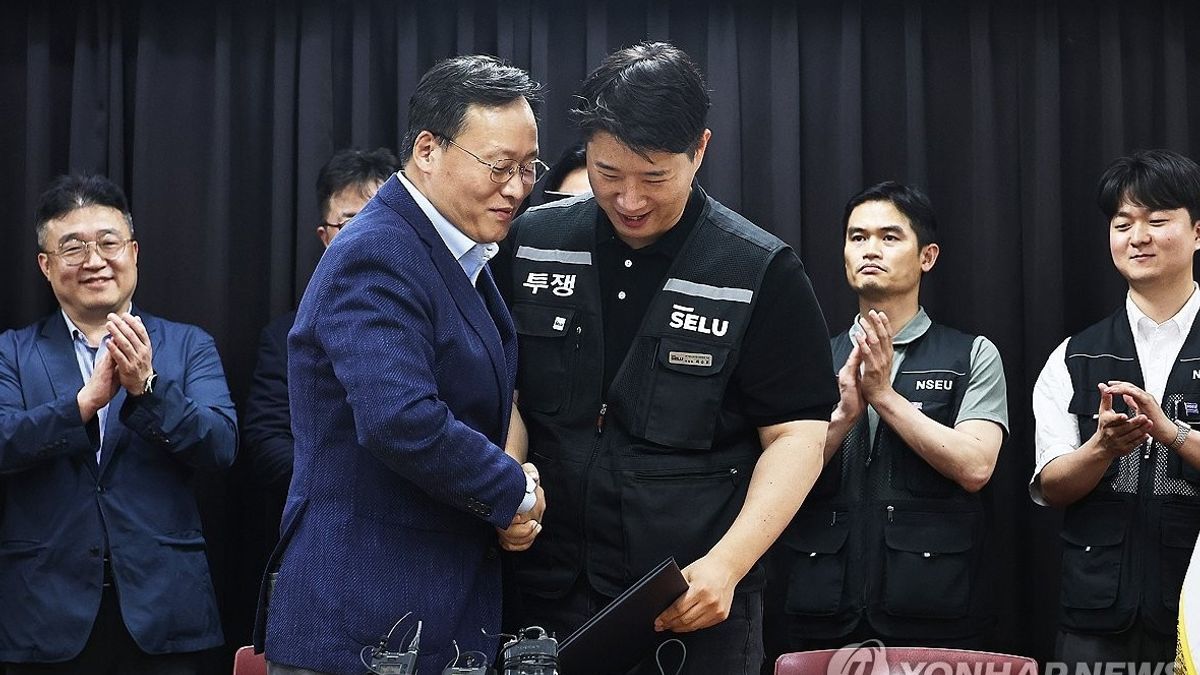


JAKARTA - Samsung Electronics and its largest labor union reached a temporary wage agreement just one hour before a major strike began. This agreement eased concerns about the South Korean economy and the global chip supply chain.
Reported by Yonhap, Thursday, May 21, the 18-day strike was originally scheduled to begin Thursday and would involve nearly 48,000 union members. Industry observers estimate that losses could reach 100 trillion won, or about 66.7 billion US dollars, if the action takes place in full.
Negotiations have been deadlocked since late last year. The basis is a performance-based bonus from the semiconductor business related to artificial intelligence or AI. The business is enjoying a surge in global demand for memory chips.
In the interim agreement, Samsung will prepare a special semiconductor bonus of 10.5 percent of business performance profit, without a limit.
Part of the bonus will be paid in the form of company shares for at least 10 years. This scheme is linked to the chip division's target to post annual operating profits of more than 200 trillion won in 2026-2028 and 100 trillion won in 2029-2035.
Of the total bonus funds, 40 percent is given to the division as a whole. The rest, 60 percent, is distributed to each business unit. However, the division for the loss-making division - one of the most contentious issues - was delayed for one year.
If Samsung's operating profit this year reaches 300 trillion won, the bonus for each chip division employee could reach 600 million won. The division has about 28,000 employees.
The tentative deal will be decided by a vote of union members from Friday until May 27.
The South Korean government intervened after negotiations failed several times. The presidential office expressed regret over the stalled wage talks. The labor minister then went directly to mediate the final negotiations.
The government's involvement shows the huge role Samsung plays in South Korea's economy. Chip exports account for about 35 percent of the country's total exports.
In the first quarter of 2026, South Korea's exports reached a record 219.9 billion US dollars. Semiconductor shipments jumped 139 percent to 78.5 billion US dollars.
The risk is also felt in the stock market. Samsung accounts for about a quarter of the market capitalization of the Korea Composite Stock Price Index benchmark index. A major strike at the company is feared to push the index deeper.
Global companies that rely on South Korea's semiconductor supply chains have also been worried.
Samsung dominates about a third of the global DRAM market, memory chips used in laptops, smart phones, and AI data centers. According to TrendForce quoted by Yonhap, Samsung returned to the global DRAM market leader in the fourth quarter of last year, driven by sales of high-bandwidth memory chips, namely high-speed memory chips for AI needs.
Industry estimates say an 18-day strike could cut global DRAM supply by 3-4 percent and NAND flash by 2-3 percent. NAND flash is a data storage chip widely used in mobile phones, laptops, and data centers.
For now, the risk of a major strike has eased. However, Samsung and its labor union agreement is still awaiting member votes.
The English, Chinese, Japanese, Arabic, and French versions are automatically generated by the AI. So there may still be inaccuracies in translating, please always see Indonesian as our main language. (system supported by DigitalSiber.id)
Most Popular Tags
#Prabowo Subianto #donald trump #2026 World Cup #Febrie Adriansyah #8791Popular


