
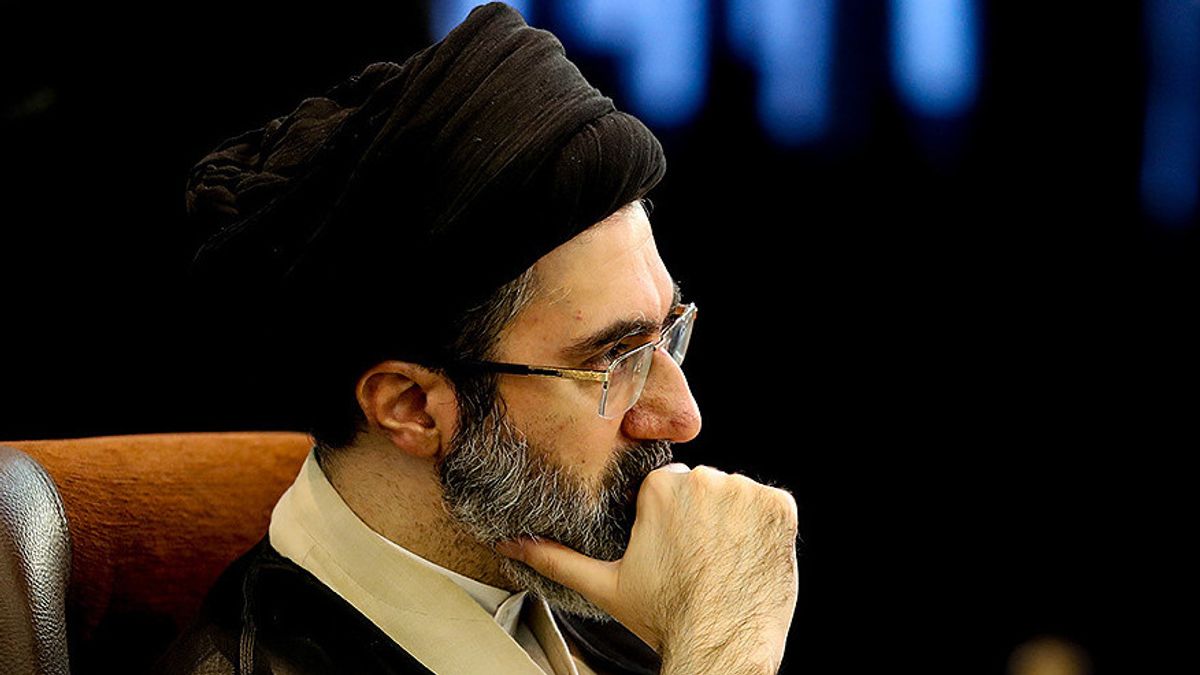


JAKARTA - Iranian officials revealed that Supreme Leader Mojtaba Khamenei suffered what was described as a non-serious but must-have stitches, when the country's latest conflict with the United States and Israel broke out in February.
"Nothing serious happened" to Iranian Supreme Leader Mojtaba Khamenei when he was taken to hospital after the outbreak of war with the United States and Israel on February 28, Iran's semi-official ISNA news agency reported on Monday, citing a health ministry official.
"These wounds are not the type of wounds that will damage the face of the supreme leader, nor will they make him disabled or result in amputation of limbs," said the Head of the Public Relations and Information Center of the Iranian Ministry of Health, Hossein Kermanpour, launching Al Arabiya (19/5).
"Several stitches were applied to the wounds. One of the areas that the doctor decided to sew immediately was his leg," he continued.
Mojtaba Khamenei has not appeared in public since the start of the war. Earlier this month, Iranian President Masoud Pezeshkian said he had met with the Supreme Leader of Iran.
"What impressed me the most during this meeting was the vision and the humble and sincere approach of the supreme leader of the Islamic revolution," President Pezeshkian said in a video broadcast by state television, Al Arabiya reported from Reuters.
Meanwhile, US intelligence agencies assess that Mojtaba has helped devise war strategies and negotiations with the US, although he has never been in public, although there is still uncertainty as to the extent of Mojtaba's authority in the Iranian leadership structure, after the US-Israeli attack killed a number of senior officials, including Supreme Leader Ayatollah Ali Khamenei.
The agencies believe that Mojtaba Khamenei continues to communicate through trusted messengers and direct meetings during his physical recovery.
It is known that the latest conflict in the Middle East broke out on February 28, 2025, when the US and Israel launched an attack on the capital Tehran and a number of other cities in Iran. Iran responded by carrying out attacks on Israeli territory and related US infrastructure in neighboring countries in the Middle East. The conflict quickly escalated into one of the most dangerous regional wars in decades, disrupting shipping through the Strait of Hormuz, shaking the global energy market, and causing missile and drone attacks across the Middle East.
Mojtaba Khamenei became the Supreme Leader of Iran after his father, who was also the Supreme Leader of Iran, Ayatollah Ali Khamenei, was in the first day's attack on Tehran.
Tensions eased after a two-week ceasefire with Pakistani intermediaries was agreed, although in negotiations in Islamabad, the two countries had not managed to agree on an escalation. The ceasefire was then extended indefinitely as US President Donald Trump announced the end of the first arms ceasefire.
The English, Chinese, Japanese, Arabic, and French versions are automatically generated by the AI. So there may still be inaccuracies in translating, please always see Indonesian as our main language. (system supported by DigitalSiber.id)


