

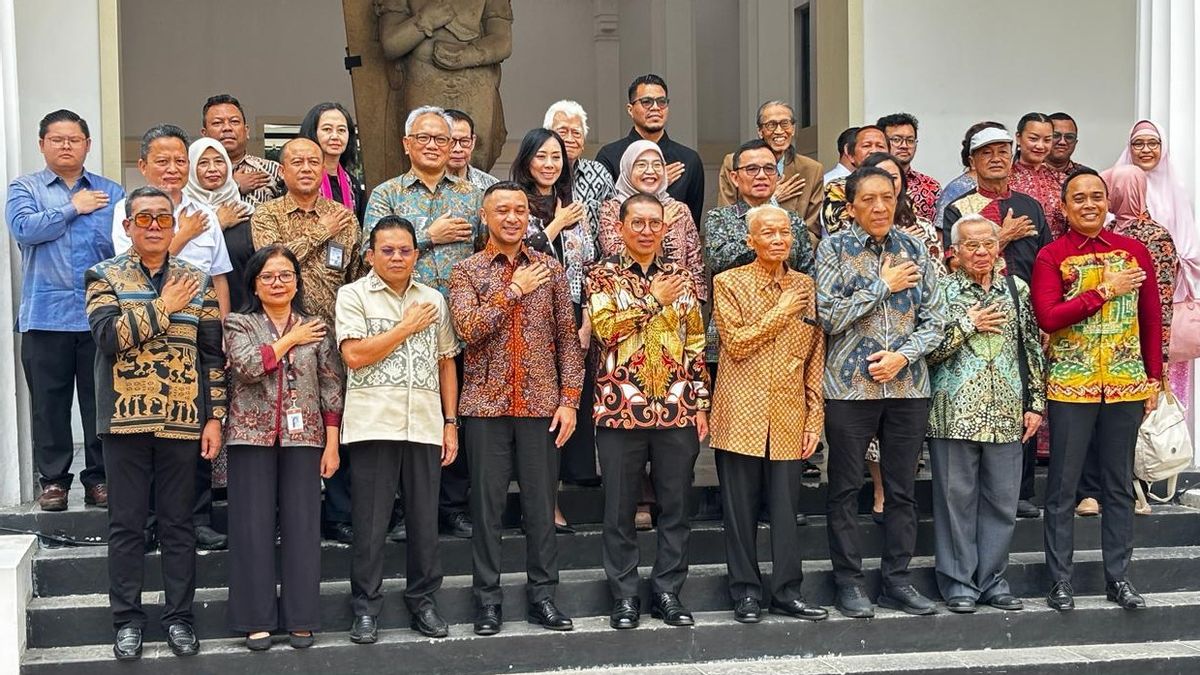


JAKARTA - Minister of Culture (Menbud) Fadli Zon emphasized the direction of museum policy in Indonesia. Museums should no longer be seen as a place to store inanimate objects, but must be transformed into upstream infrastructure or providers of the main raw materials for the development of the national cultural industry.
This was conveyed by Fadli when delivering a cultural oration in the commemoration of International Museum Day 2026 which carried the theme "Museums Uniting a Divided World" at the National Museum of Indonesia, Central Jakarta, Monday, May 18.
Fadli explained that the wealth of megadiversity and the length of the Nusantara civilization are extraordinary cultural capital. These legacies can be used to provide real economic impact for the wider community without losing their spiritual values.
"Museums must be understood as a source of raw materials for the cultural industry. Museums play a role in maintaining collections, narratives, values, knowledge, and imagination which are cultural capital for local economic potential, cultural destinations, films, animation, games, culinary, digital content, and also various new forms of creation," said Fadli.
Four Policy Foundations for MuseologyStill in his cultural oration, Fadli said that the museum policy in the future would at least stand on four main foundations, namely: • Instrument of Forming National Identity: Rediscovering national identity so that the nation stands on its historical foundation. • Space of Pride: Become a healthy public space to strengthen social cohesion in the midst of fragmentation and polarization of the world. • Restoration of Cultural Sovereignty: Continuing the agenda of repatriation of cultural heritage seriously. One of the milestones is the repatriation of 28,131 Dubois collection fossils from the Netherlands in 2025. • Upstream Infrastructure of Cultural Economy: Developing cultural capital into public value and sustainable economic value through the process of valorization.
Until April 2026, the Ministry of Culture recorded that Indonesia has 516 museums in various regions. Of these, 373 museums (72.3%) have been registered with the national registration number, and 234 museums (45.3%) have met the A, B, or C type standardization.
Although the data shows that more than 70% of museum visitors in 2025 are young people under the age of 35, Fadli assessed that the number of museums in Indonesia is still relatively small compared to its potential.
In order to increase the active participation of the younger generation, the Ministry of Culture also officially launched the Passport Museum.
This initiative is designed as a physical instrument that provides incentives in the form of discounts for visits, as well as a means of collecting a record of cultural travel for young generations.
The model adopts the success of similar programs abroad such as KulturPass in Germany and Museumkaart in the Netherlands.
Fadli hopes that the presence of these new innovations can change the public perception of museum institutions massively and sustainably.
"We hope that the reintroduction of material culture through the Passport Museum can become a wish list. We want to make visiting the museum a cultural lifestyle," concluded Menbud Fadli Zon.
The English, Chinese, Japanese, Arabic, and French versions are automatically generated by the AI. So there may still be inaccuracies in translating, please always see Indonesian as our main language. (system supported by DigitalSiber.id)


