

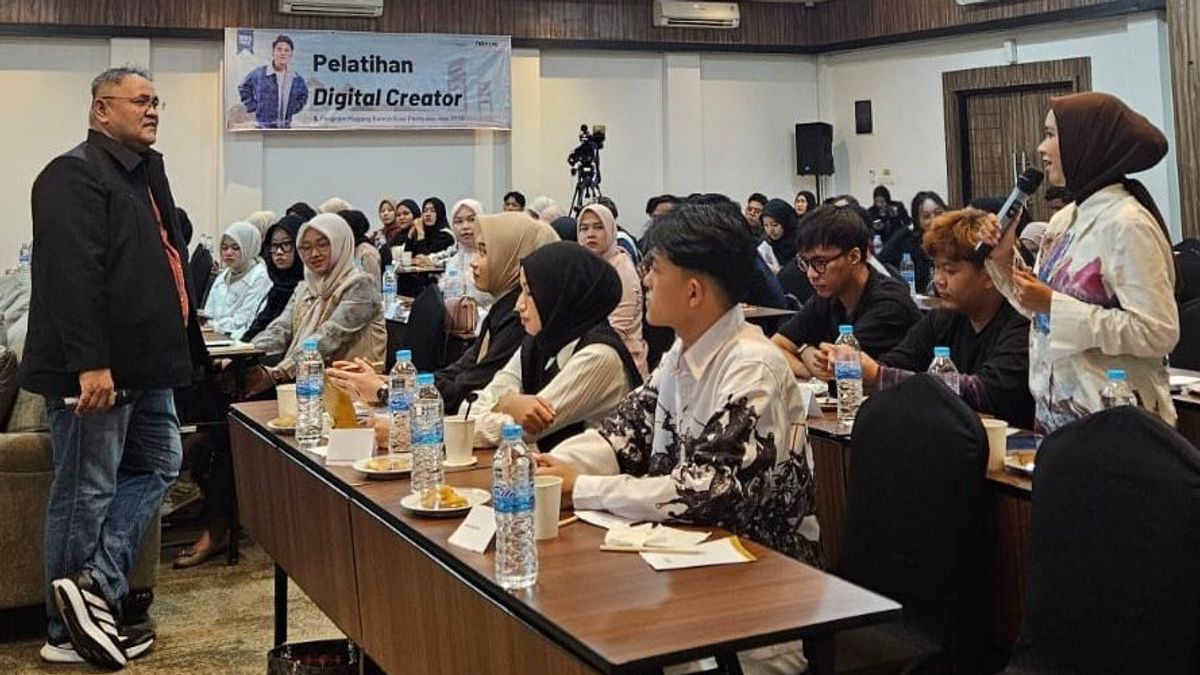


PALEMBANG - The Director of Geopolitics of the GREAT Institute, Dr. Teguh Santosa, explained his analysis of the dynamics of national leadership in front of dozens of content creators in a workshop held in Palembang, South Sumatra, Saturday, May 16, 2026.
In his presentation, he emphasized that each era has unique challenges. Therefore, the policies taken by leaders in an era cannot be generalized with leaders in other eras.
"Every period has different challenges. Leaders in every period also take different policies, the essence of which is that Indonesia can survive in the midst of world turmoil," said the lecturer at UIN Syarif Hidayatullah Jakarta in opening the session.
He compared four Indonesian leaders in different periods, namely Sukarno, Soeharto, B.J. Habibie, and Prabowo Subianto. According to him, each of them faced global and domestic issues with their own characteristics and uniqueness that shaped their policy styles.
In the era of Soekarno, the challenge was to maintain political independence in the midst of the cold war and decolonization. Soeharto faced pressure on economic stability and national integration after 1965. Habibie had to save the economy in the midst of a monetary crisis and a democratic transition.
"Entering the Prabowo era, the challenge changes again. In the first few months of 2026 alone, we have witnessed the collapse of the international system by disputes involving superpowers," said Teguh, who is also the Chairman of the Indonesian Cyber Media Network (JMSI).
He explained that the collapse of the multilateral order, which was previously considered established, made Indonesia no longer able to rely on security and economic guarantees from outside. This situation forces foreign and domestic policies to be directed at internal consolidation.
Therefore, according to Teguh, Prabowo's policy is directed at efforts to strengthen national resilience in various fields, economics, politics, technology, and so on. The focus is not expansion, but strengthening the foundation.
Teguh called this approach the principle of inclusive security. "Indonesia cannot rely on its security on the other side, whether it is a neighboring country or the international system itself. Inclusive security means that we build our ability to survive from within, we are responsible for our security," he said.
Within this framework, programs such as free nutritious meals, red and white cooperatives, people's schools, and industrial downstreaming are placed as strategic steps. "This is not just a social program. This is a need to strengthen the foundation and the horses of the nation so that they do not falter when the storm comes," he explained.
He compared the policy with China's experience in the past few decades. According to him, in the early 2000s Beijing managed to carry out massive industrialization and downstream processing to absorb a large number of workers and reduce dependence on foreign supply chains.
"Prabowo also sees that Indonesia must do this. Without downstream processing, we will continue to be exporters of raw materials and importers of finished goods. This position makes us structurally vulnerable," said Teguh.
To strengthen his analysis, he quoted the views of political realism thinkers. He referred to Hans Morgenthau who stated that international politics is a struggle for power, and a state that is unable to maintain its own power will be eliminated.
"Morgenthau reminded that universal morality cannot replace national interests. The state must take care of itself first," said Teguh.
He also referred to Kenneth Waltz, the father of structural realism, who emphasized that the structure of the anarchic international system forces countries to self-help. "Waltz said, in a system without a central authority, countries cannot hope for the goodness of other countries. The only thing you can rely on is your own ability," he said.
Teguh assessed that Prabowo's national resilience policy was in line with that logic. When the international system is no longer able to provide certainty, the rational answer is to strengthen domestic capacity in the food, energy, technology, and defense sectors.
Closing his presentation, he invited content creators to understand the geopolitical context behind public policies.
"The narrative that you build must be based on the understanding that Indonesia is rearranging its position. Not just following the flow, but creating its own flow," he concluded.
The English, Chinese, Japanese, Arabic, and French versions are automatically generated by the AI. So there may still be inaccuracies in translating, please always see Indonesian as our main language. (system supported by DigitalSiber.id)
Most Popular Tags
#Prabowo Subianto #donald trump #earthquake #independence day #8791 #hut riPopular


