

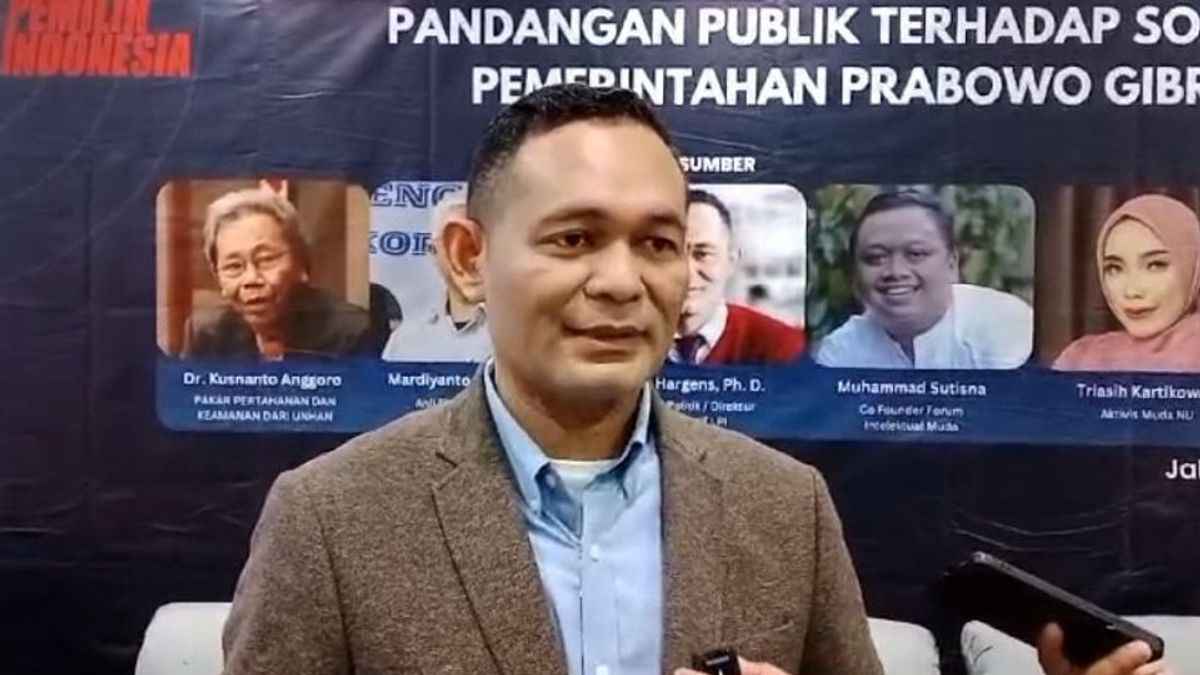


JAKARTA - The discourse on strengthening the National Police Commission (Kompolnas) has resurfaced along with the discussion of the Polri reform which was said to have been accepted by President Prabowo Subianto on May 5, 2026. National Police Chief General Listyo Sigit Prabowo assessed that strengthening the role of Kompolnas was more appropriate to be integrated into the Police Law than to be formed through a separate law.
This view was supported by senior political analyst Boni Hargens. According to him, Kompolnas is an integral part of the institutional ecosystem of the National Police so that its strengthening is more effective within the framework of the existing Police Law.
"Kompolnas which is regulated appropriately will become a strategic partner of the National Police, not just a supervisory institution that is outside and isolated from the internal dynamics of the police," said Boni in Jakarta, Monday, May 11.
The discussion on the formation of a special law for Kompolnas was previously conveyed by former Kompolnas Commissioner Poengky Indarti. The proposal was based on the need to strengthen the legal basis and independence of Kompolnas so that the function of oversight of the National Police could run more effectively.
However, the National Police Chief Listyo Sigit believes that strengthening Kompolnas does not have to be done through the formation of new regulations. According to him, integration into the Police Law will clarify the functional relationship between Kompolnas and the National Police while avoiding potential overlapping of authority.
The approach is also considered more efficient in terms of legislation because the revision of the Police Law is considered more targeted than drafting new laws that require a long process and broad political consensus.
Boni Hargens assessed that the placement of Kompolnas within the framework of the Police Law would not reduce the independence of the institution. On the contrary, it actually strengthens the position of Kompolnas in supporting the professionalism and accountability of the National Police in the midst of democratic development.
He said the mechanism for civilian oversight of the police must be designed to encourage the improvement of the capacity and professionalism of the institution, not just to create a distance between the supervisory institution and the institution that is being supervised.
"These two positions reflect two different approaches. Some emphasize structural independence, while others prioritize functional integration and close coordination," said Boni.
According to him, the most important aspect of strengthening Kompolnas is effective coordination with the National Police. This coordination includes the exchange of data and information, follow-up mechanisms for recommendations, to strategic dialogue forums between the two institutions.
Boni emphasized that effective supervision requires Kompolnas' access to relevant Polri internal performance and process data. Thus, the oversight function can run objectively and fact-based.
He also assessed that the strengthening of Kompolnas must be accompanied by clarity of authority, follow-up mechanisms for binding recommendations, human resource capacity building, and openness to public participation.
"The most important thing is not just the choice of the form of regulation, but the real substance of strengthening and effective coordination between Kompolnas and the National Police," he said.
According to Boni, a strong and well-coordinated Kompolnas will be able to encourage the improvement of the professionalism of the National Police while ensuring that the police institution carries out its mandate as a security guard and law enforcement in the Indonesian democratic system.
The English, Chinese, Japanese, Arabic, and French versions are automatically generated by the AI. So there may still be inaccuracies in translating, please always see Indonesian as our main language. (system supported by DigitalSiber.id)


