

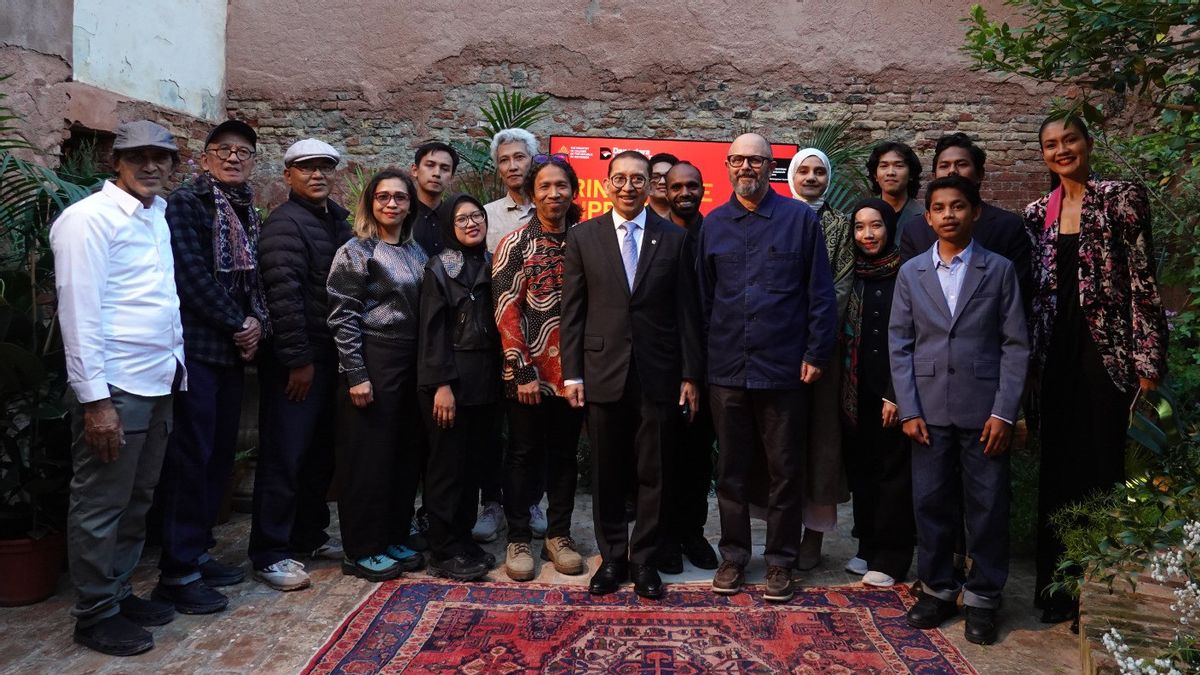


JAKARTA - Indonesia came to the Venice Biennale 2026 with a story that is rarely heard in world history. Through the Indonesian Pavilion entitled Printing the Unprinted, the artists use graphic art to reopen the memories, voices, and traces of Nusantara that have long been on the sidelines of global narratives.
The Indonesian Pavilion is present at the 61st International Art Exhibition La Biennale in Venice, Italy. The exhibition takes place at the Scuola Internazionale di Grafica, Cannaregio 1798, Venice, from May 9 to November 22, 2026. A preview day was held on May 7.
This pavilion is organized by the Indonesian Ministry of Culture through the Directorate General of Diplomacy, Promotion, and Cultural Cooperation. This program is supported by the Danantara Indonesia Trust Fund, and collaborates with the Scuola Internazionale di Grafica, Negeri Elok, National Talent Management for Cultural Arts, and Venice Art Factory.
Minister of Culture Fadli Zon said Indonesia's presence this year is important because it is the first participation under the Ministry of Culture which stands alone.
"Indonesia is not only present to introduce culture to the world, but also to participate in shaping global conversations through art," said Fadli Zon in Venice, Friday, May 8.
The Indonesian Pavilion was curated by Aminudin TH Siregar. He chose the Scuola Internazionale di Grafica because the space was close to the practice of graphic art, printmaking, and process-based artistic production.
With this approach, works are not only made in Indonesia and then sent to Venice. Artists also develop works through residencies, dialogues, and direct collaboration at the exhibition site.
Printing the Unprinted presents seven artists across generations, namely Agus Suwage, Syahrizal Pahlevi, Nurdian Ichsan, R.E. Hartanto, Theresia Agustina Sitompul, Mariam Sofrina, and Rusyan Yasin.
This exhibition departs from a fictional narrative of a great 15th-century voyage inspired by the imaginary manuscript of Datu Na Tolu Hamonangan from Harajaon Pusuk Buhit in Sumatra.
From this narrative, the artists open a new interpretation of the relationship between Asia and Europe. They also question the global history that is often built through the stories of arrival, discovery, and claims.
Fadli said Indonesia has a large cultural capital. He referred to more than 17,000 islands, 1,340 ethnic groups, and 718 regional languages as the basis of Indonesia's cultural ecosystem.
In addition to the main exhibition, the Indonesian Pavilion also held artist residencies, art discussions, workshops, and symposiums. This program involves seven young Indonesian talents through the National Talent Management of Cultural Arts with Negeri Elok.
The collaboration uses the art therapy approach. Art is placed as a space to treat memories, build empathy, and strengthen personal and collective resilience.
"Culture is a source of identity, values, and imagination, while the creative economy is a force that transforms culture into innovation, opportunity, and global influence," said Fadli.
The English, Chinese, Japanese, Arabic, and French versions are automatically generated by the AI. So there may still be inaccuracies in translating, please always see Indonesian as our main language. (system supported by DigitalSiber.id)
Popular


