

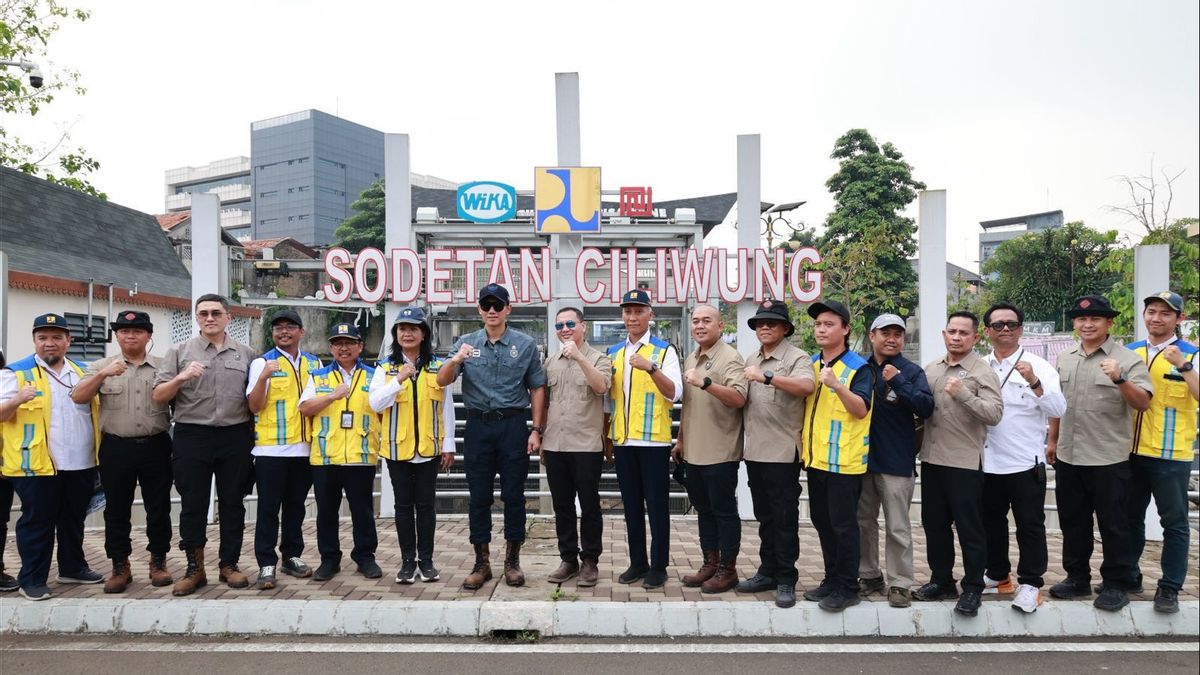


JAKARTA - The government admits that the Ciliwung River normalization project has not been running according to target. Until May 2026, the new handling reached 17 kilometers or about 52 percent of the total normalization target along 33 kilometers.
Coordinating Minister for Infrastructure and Regional Development Agus Harimurti Yudhoyono (AHY) said there were still about 16 kilometers of rivers that had to be completed to strengthen flood control in Jakarta.
"Currently, the development and revitalization, including the normalization of the river, has reached 17 km. The remaining 16 km must be completed immediately," said AHY when reviewing the Sodetan Inlet of the Ciliwung River in Jatinegara, East Jakarta, Thursday, May 7.
AHY explained that the Ciliwung River has a length of around 109 kilometers with a river basin reaching 521 square kilometers from the upstream to the downstream of Jakarta. According to him, the current river capacity is still unable to accommodate large water discharges when extreme rains occur in the Bogor area and its surroundings.
At a number of points, the width of the river is still around 15 to 25 meters with a capacity of around 200 cubic meters per second. The government targets the widening of the river to 35 to 50 meters so that the flow capacity increases to 570 cubic meters per second.
"This normalization must be carried out thoroughly, including the construction of embankments as high as 4 to 5 m so that the risk of flooding can be suppressed," said AHY.
Even so, the project is still stuck on the classic problem, namely land release on the riverbanks. This condition makes the target for completion, which was originally pegged at 2027, is estimated to be delayed until 2028 or 2029.
Deputy Minister of Public Works Diana Kusumastuti, said that the construction of the embankment could not be carried out in a number of locations because the land had not been released.
"When we will build these embankments, the land is not free so the work cannot be carried out," he said.
In addition to land acquisition, the government also highlighted the high level of garbage pollution in the Ciliwung River. Based on a waste management study, the volume of garbage in the river is estimated to reach 600 to 700 tons per day.
The Special Staff of the Coordinating Minister for Infrastructure and Regional Development for Legal and Regulatory Affairs, Sigit Raditya, said that handling the Ciliwung River could not rely solely on dredging and embankment construction.
"Ciliwung normalization is not if we only rely on embankment construction and river dredging. It requires strengthening of riverbank surveillance, technology-based waste handling, and community involvement so that flood control efforts can run effectively and sustainably," said Sigit.
The government has also begun encouraging the use of waste-to-energy (WtE) based waste processing technology to reduce waste piles in river basins. One of the options prepared is the use of modular incinerators that can be placed directly at river banks with a burning capacity of 500 to 1,000 kilograms per hour.
According to Sigit, the success of the normalization of the Ciliwung River is not only determined by the construction of infrastructure, but also changes in people's behavior in maintaining river cleanliness.
The English, Chinese, Japanese, Arabic, and French versions are automatically generated by the AI. So there may still be inaccuracies in translating, please always see Indonesian as our main language. (system supported by DigitalSiber.id)


