

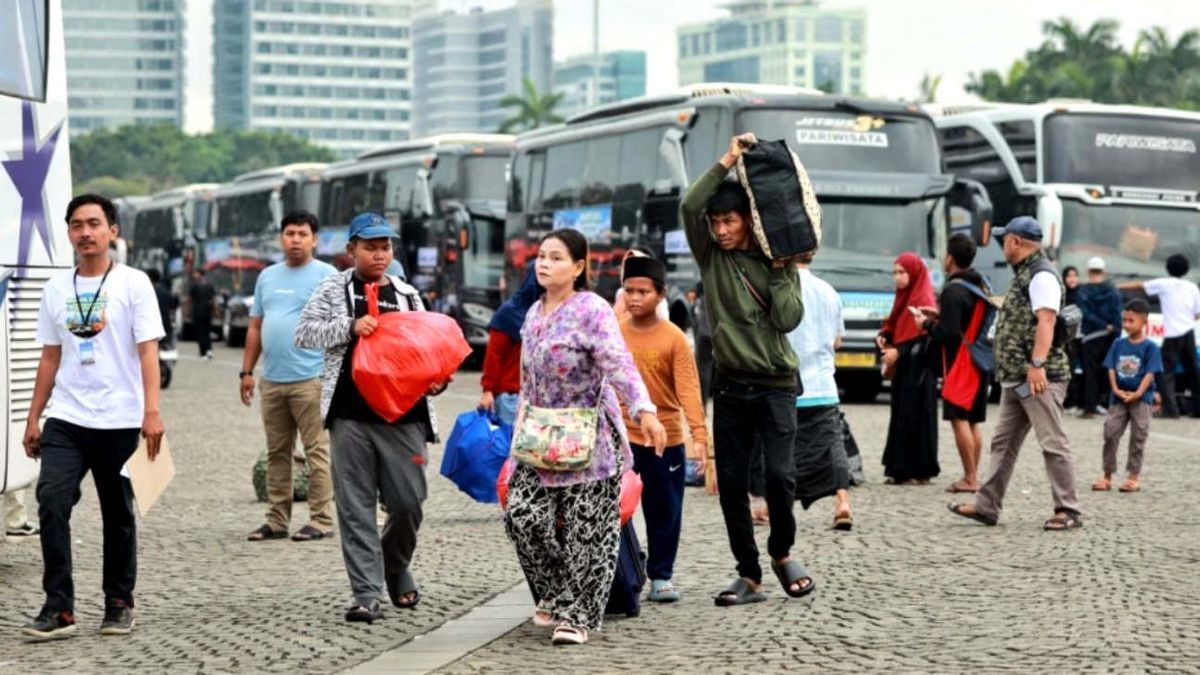


JAKARTA - The DKI Jakarta Population and Civil Registration Office (Dukcapil) recorded that the number of residents who left the capital was actually more than new arrivals after Lebaran 2026.
In the period from March 25 to April 30, 2026, the number of new arrivals was recorded at 12,766 people. Meanwhile, residents who moved out reached 22,617 people or almost twice as high.
Head of the DKI Jakarta Civil Registry Office Denny Wahyu Haryanto said this trend has been seen in recent years, marked by a decrease in the number of arrivals after Lebaran.
"The data is in line with the predictions as conveyed by the Governor of DKI Jakarta, Pramono Anung. From 2021 to 2023, the number of post-Eid arrivals is above 20,0000+ people. This number decreased in 2024 and 2025, namely a total of 16,0000 more people," Denny said in a statement, Thursday, May 7.
The phenomenon of many residents leaving Jakarta is inseparable from the policy of arranging population administration. The document regularization program according to domicile encourages residents who have actually lived in the buffer area for a long time to adjust their official addresses.
"Many residents who have lived in buffer areas such as Bogor, Depok, Tangerang, and Bekasi for years, but still use the Jakarta KTP-el. Through this program, they adjust the population administration to match their actual domicile," he explained.
Apart from administrative factors, the pressure of living costs and environmental quality in Jakarta also encourages population displacement. Residents are starting to look for housing in buffer cities that are considered more affordable and comfortable, but still connected to public transportation.
This condition reflects the symptoms of deurbanization, where residents are no longer concentrated in the core city. This shift is also driven by the emergence of new economic centers in the area around Jakarta.
The profile of residents who moved out is dominated by the productive age with a low income level. The main reason for the move is housing needs. Meanwhile, new arrivals who enter Jakarta have similar characteristics, but are driven by family reasons.
This change in mobility patterns also has an impact on the way the government manages population. The Population and Civil Registration Agency notes that there are still thousands of non-permanent residents living temporarily in Jakarta.
"Currently, the population who has registered as non-permanent is 5,499 people," said Denny.
On the other hand, the government has begun to direct population policies based on agglomeration areas. Jakarta is no longer seen as a single entity, but rather a part of an urban system connected to the buffer area.
Through Law Number 2 of 2024 concerning the Special Region of Jakarta Province, the concept of agglomeration areas is strengthened to harmonize cross-regional policies.
"The program for arranging and regulating population documents according to domicile has been regulated in Law No. 2 of 2024 as an effort to overcome the classic problem in Jakarta, namely the difference between de jure residents (according to ID cards) and de facto (who live in the field)," said Denny.
The English, Chinese, Japanese, Arabic, and French versions are automatically generated by the AI. So there may still be inaccuracies in translating, please always see Indonesian as our main language. (system supported by DigitalSiber.id)
Most Popular Tags
#Prabowo Subianto #donald trump #Febrie Adriansyah #8791 #giias 2026Popular


