


JAKARTA - The European Union announced its rejection of any territorial control changes in the Gaza Strip, following Israel's designation of the so-called "orange line" in the Gaza Strip.
Anwar Al-Anouni, spokesman for the European Union's foreign affairs office, told a news conference the EU rejected steps that increase Israel's territory to more than 60 percent in the Gaza Strip, instead of implementing additional withdrawals stipulated in the peace agreement.
He stressed that the European Union reaffirmed the importance of uniting the Gaza Strip with the West Bank under the Palestinian Authority Government, launching WAFA (5/5).
Furthermore, Al-Anouni noted that the European Union called for the immediate implementation of the peace plan for Gaza, expressing deep regret over the deteriorating humanitarian situation in the Gaza Strip.
He also called on Israel to immediately allow the entry of humanitarian aid into the Gaza Strip on a large scale and without obstacles, and to ensure its continued distribution.
Previously, the Israeli army recently introduced what is known as the "orange line," which extends beyond the "yellow line" set out in the ceasefire agreement that has been in effect since October 10, 2025.
The Yellow Line is a demarcation line that divides the territory into 47 percent under Palestinian control on the west side, as well as 57 percent under Israeli control, according to a map that is part of the Gaza Strip peace plan and the ceasefire announced October 2025.
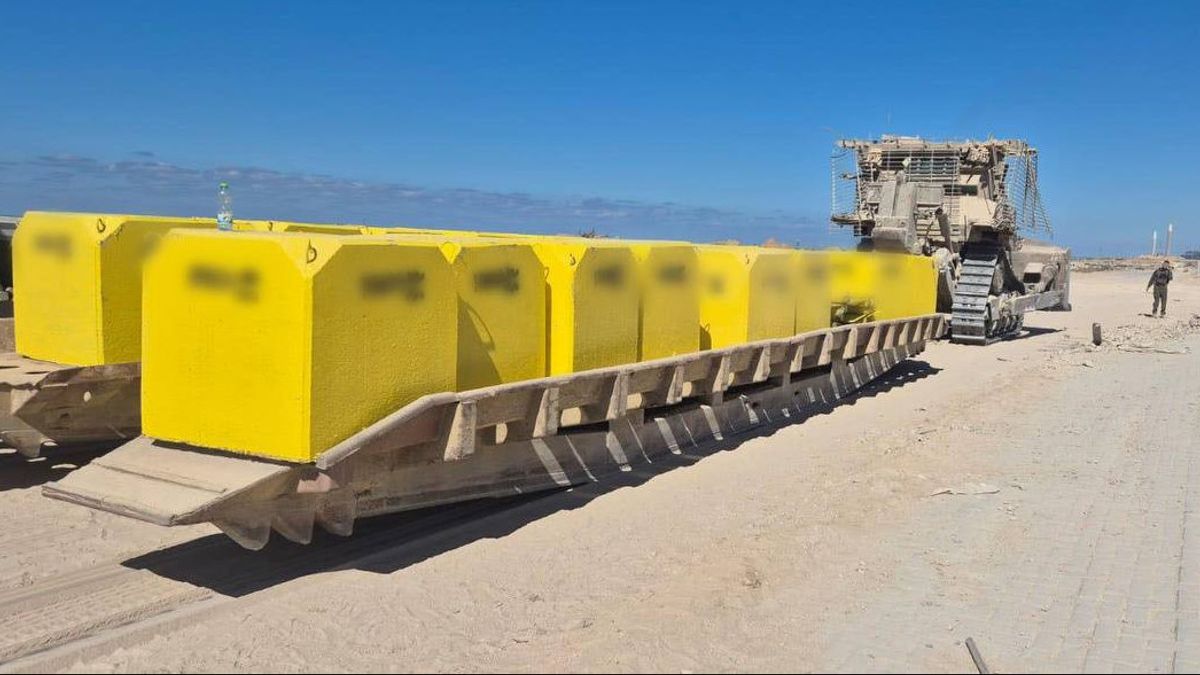
Late last month, Israel reportedly moved a yellow block marking the yellow line to the west along Salah Al Din Street - the main route connecting the north and south of the Gaza Strip.
The New Arab quoted Arabic-language media reports as saying that the Israeli army had turned the so-called Yellow Line in the Gaza Strip into a new border, through the establishment of dozens of new military posts.
Meanwhile, the Arabi21 report said the presence of checkpoints meant the military presence in the area was no longer temporary and effectively turned the Yellow Line into a new border.
Since Israel established the Green Line in October, the army has targeted and killed every Palestinian who approaches it, and has used the empty area around it to set up military posts.
According to reports, streetlights have been installed around the posts, and can be seen from the higher western part of Gaza.
The forward posts are mostly located in the buffer zone between Rafah and Khan Younis, with other posts in the Ma'an and Bani Suheila areas, as well as east of Deir al-Balah, al-Bureij, Shujaiya, and al-Maghazi.
For six months since the ceasefire, Israeli forces have shifted the agreed ceasefire line in Gaza to the west, expanding their zone of control and making the precarious situation even more dangerous for Palestinians, The Guardian reported.
The Yellow Line agreed to in the US-mediated ceasefire was supposed to be temporary pending further Israeli troop withdrawals, but the ceasefire, which was partially adhered to, stalled after its first phase amid disputes over Hamas disarmament, and continued Israeli bombardment of Gaza.
Since then, the yellow line has shifted forward in some places, expanding the military-held territory far beyond the 53 percent of Gaza implied in the original truce map.
According to the research institute Forensic Architecture, in December Israel had seized 58 percent of Gaza's territory and continued to advance.
Hamas senior official Bassem Naim told Anadolu, Israel has shifted the line by 8 to 9 percent into Gaza territory, thus increasing the area under Israeli control to more than 60 percent.
The changes have reduced the space available to Palestinians to about 38 percent of the enclave, exacerbating an already dire humanitarian crisis.
The announcement triggered a new wave of displacement, particularly in Khan Younis, eastern Gaza, and parts of northern Gaza, as families moved further west to escape the shelling.
This is also accompanied by air raids, artillery fire, and direct fire that have killed and injured Palestinians, often with claims of approaching or crossing the original line.
UN spokesman Stéphane Dujarric said Israeli authorities had introduced new limits outside the Yellow Line, which the humanitarian team called the "orange line."
"Now there is another color line. The line called the orange line has been introduced to our humanitarian colleagues," Dujarric told Anadolu.
He said the UN team had been told any movement beyond the line must be coordinated with Israeli authorities first.
"We have been informed that beyond these lines, humanitarian teams are expected to coordinate their movements in advance. This is in accordance with areas with increased risk of fighting and a higher probability of meeting Israeli forces," he added.
Officials and analysts warn that the ever-shifting boundaries risk becoming de facto reality on the ground.
Hamas had also warned of this change. Hamas spokesman Hazem Qassem said Israel's move violated the terms of the ceasefire brokered by mediators last October.
"The continued violations are exhausting civilians and limiting their lives," Qassem said, calling on mediators to intervene and ensure compliance, launching The National.
"We hold the Israeli side and the mediators responsible for the continuation of these violations and violations of the rights of the people of Gaza in various ways," Qassem said.
"As well as continuing policies that exhaust civilians, hinder their movement, and restrict their lives," he said.
Israeli officials have hinted at such a possibility.
Earlier this year, IDF Chief of Staff Lt. Gen. Eyal Zamir described the "Green Line" as a "new border line" and a forward defense line. Meanwhile, Israeli Defense Minister Katz said Israeli forces would remain in the area until Hamas was disarmed.
The English, Chinese, Japanese, Arabic, and French versions are automatically generated by the AI. So there may still be inaccuracies in translating, please always see Indonesian as our main language. (system supported by DigitalSiber.id)
Most Popular Tags
#Prabowo Subianto #donald trump #2026 World Cup #Febrie Adriansyah #8791Popular


