

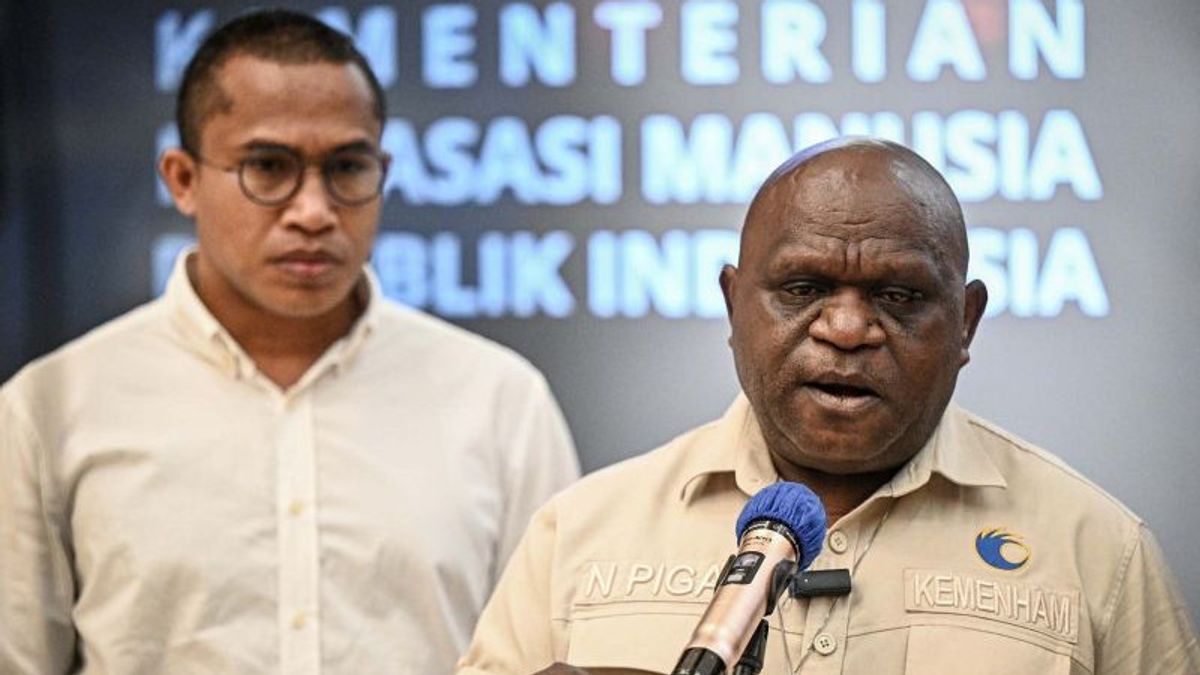


JAKARTA - Human Rights Minister Natalius Pigai emphasized that freedom of opinion within the framework of human rights (HAM) is not absolute, but has limits or must be in accordance with the law, both national and international.
"But human rights have limits, human rights have limits. Freedom of speech has limits. Therefore, not all opinions, thoughts and feelings that are expressed are guaranteed by law," said Pigai as quoted by ANTARA, Monday, May 4.
He referred to human rights limitation principles such as the Siracusa Principles and the International Covenant on Civil and Political Rights (ICCPR) as the basis for public expression to remain within the legal corridor.
The Siracusa Principles (Siracusa Principles) are international legal guidelines that regulate the limitations and derogations of human rights (HAM) in the International Covenant on Civil and Political Rights (ICCPR), especially in emergency situations.
According to him, the limit includes a ban on personal attacks, derogatory statements, and the potential for disruption to national stability.
"There must be limits, it's called the Siracusa Principle. The Siracusa Principle states that human rights can be limited but with various regulations. What are the various regulations? Various regulations state that it is not allowed "ad hominem", it is not allowed to attack honor, it is not allowed to attack dignity, it is not allowed to create national instability, it is not allowed to attack tribes, religions, races, classes," he said.
Ad hominem (Latin: "directed at the person") is a logical fallacy, namely someone attacking the character, motives, physique, or personal background of the interlocutor, rather than refuting the substance of the argument.
Regarding the statement of the Chairman of the Syura Council of the Ummat Party, Amien Rais regarding his statement that went viral on social media, Pigai assessed that there was an element of violation of human rights principles in the form of verbal attacks.
"There are several statements in the context of Human Rights, if we examine it in detail, what is conveyed is the first 'inhuman treatment', that is the first. Later check, I have conveyed it to several media. The second is 'inhuman degrading', the third is 'verbal torture'," he said.
He explained that these forms fall into the category of mental violence that cannot be justified in the human rights perspective.
"Verbal violence is also a mental attack, containing elements of mental attacks, physical attacks, mental attacks, and attacks on the soul and threats to the dignity and morality of individuals," he said.
However, Pigai emphasized that the resolution of the case should not be through the criminal approach by the state, but through an ethical mechanism and an apology.
"For that, it is enough for Pak Amien Rais to apologize, apologize, if in my opinion as the Minister of Human Rights to apologize or withdraw his statement," he said.
He also emphasized that the state should not use its authority to imprison citizens in cases related to expression.
However, he opened the door for those who felt aggrieved to take legal action personally.
"So, we don't want state institutions, let alone ministries or agencies, to be used to imprison Indonesian people, including Amien Rais," he said.
The English, Chinese, Japanese, Arabic, and French versions are automatically generated by the AI. So there may still be inaccuracies in translating, please always see Indonesian as our main language. (system supported by DigitalSiber.id)


