

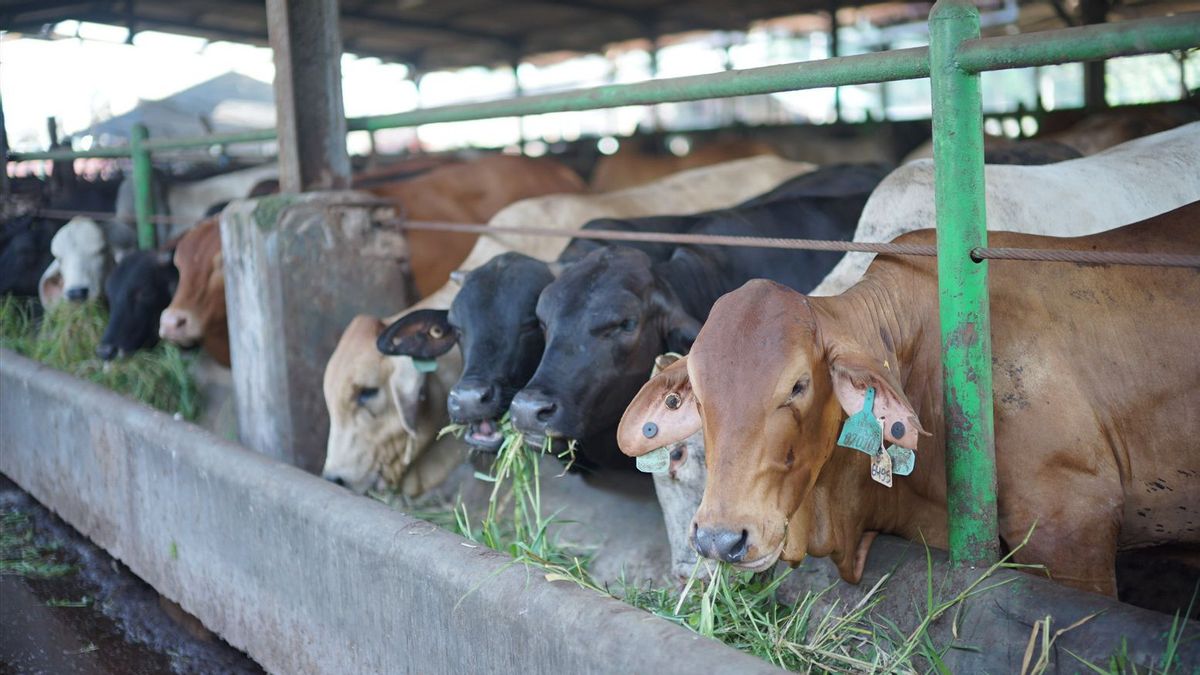


JAKARTA - Perumda Dharma Jaya targets the provision of 900 sacrificial cows to meet the needs of Jakarta residents ahead of Eid al-Adha 1447 Hijriah. This provision is claimed to have gone through a strict selection process to ensure the standard of Safe, Healthy, Whole, and Halal (ASUH).
Director of Perumda Dharma Jaya, Raditya Endra Budiman, said that all the cows prepared had passed the stages of verification of origin, quarantine, to re-examination by the DKI Jakarta Directorate of Food Security, Marine, and Agriculture (DKPKP).
"Our priority is to provide security guarantees for consumers. Each cow is brought from a verified area and must pass through the quarantine process and re-examination by the DKI Jakarta Provincial Directorate of Food Security, Marine, and Agriculture (DKPKP)," said Raditya in a statement, Thursday, April 30.
In addition to animal supplies, Dharma Jaya also relies on the Animal Slaughter House (RPH) in Cakung which has obtained the Veterinary Control Number (NKV) and halal certification. This facility is capable of cutting up to 200-250 cows per day.
A total of 100 personnel were alerted, including certified halal butchers (Juleha) and packaging teams. The company also opened a sacrificial meat processing service, from cutting to packaging in kilogram sizes to facilitate distribution.
"Through this integrated service system, we ensure that hygiene aspects are maintained from upstream to downstream. In addition, we also guarantee that waste management from cutting is carried out in accordance with applicable environmental regulations," said Raditya.
Dharma Jaya also opens access to information on stock and prices of sacrificial animals digitally through its official channel.
On the other hand, the DKI Jakarta Provincial Government emphasized the readiness of the implementation of the sacrifice not only on the availability of animals, but also on orderly and environmentally friendly governance.
The Assistant for Economy and Finance of the DKI Jakarta Regional Government, Suharini Eliawati, said that preparations were carried out thoroughly, starting from the Id prayer, the slaughter process, to the distribution of meat.
"In principle, we are preparing the best. Not only in terms of the needs of sacrificial animals, but also how it is organized, from the preparation of the Id prayer, the cutting process, to the distribution of meat to the community," said Suharini.
The Provincial Government also encourages the use of environmentally friendly containers to reduce the surge in plastic waste during Eid al-Adha. In addition, halal slaughter certification is considered important so that the slaughter process is in accordance with sharia and health standards.
Animal health supervision will be carried out one month before H-day, including at the points of sale of sacrificial animals throughout the Jakarta area.
"Usually, supervision has started one month earlier. Friends in the region will come down to ensure the health of animals and the feasibility of distribution," he said.
To ensure supply, the DKI Provincial Government has also coordinated with supplier areas such as Lampung and Central Java. This dependence is inseparable from the limitations of land in Jakarta.
"Coordination with the supplier area has been carried out. We also facilitate licensing so that the distribution of sacrificial animals to Jakarta runs smoothly," he continued.
Regarding the role of Dharma Jaya, the Provincial Government said that the regional company functioned as a support for the provision of animals and cutting facilities on a large scale.
"Usually the cuts at Dharma Jaya are made in the form of large pieces, such as divided into four, then handed over to the sacrificial committee to be distributed," added Suharini.
The English, Chinese, Japanese, Arabic, and French versions are automatically generated by the AI. So there may still be inaccuracies in translating, please always see Indonesian as our main language. (system supported by DigitalSiber.id)


