
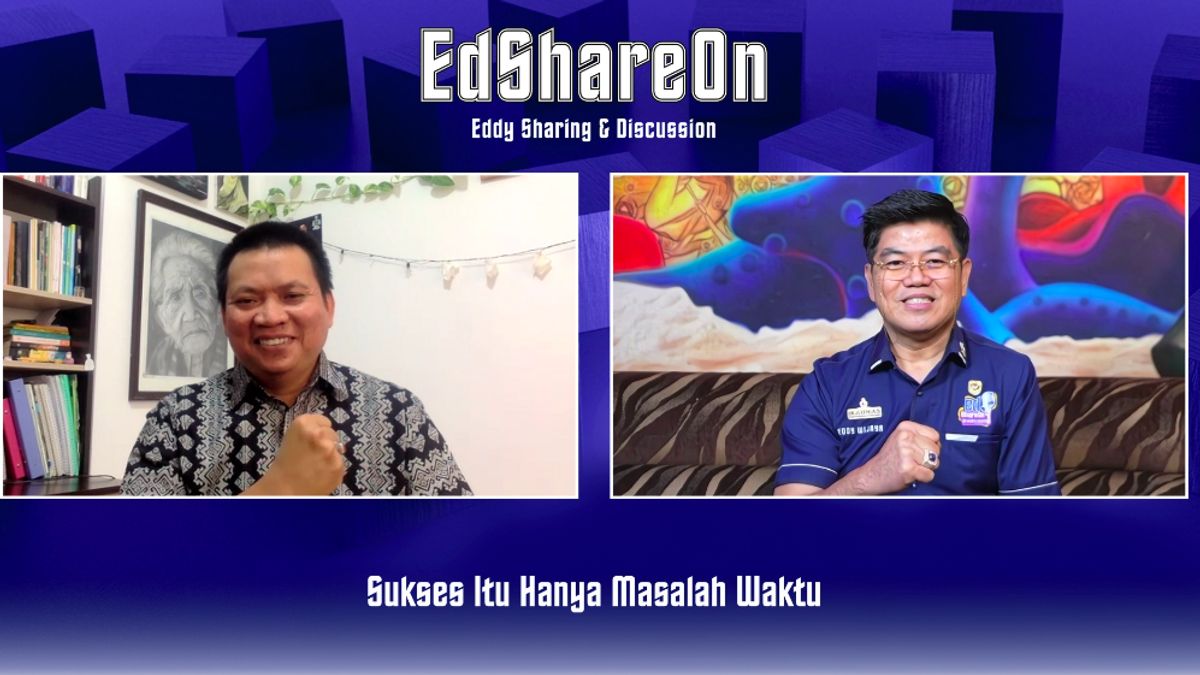


JAKARTA - The ceasefire between the United States-Israel and Iran can be said to be fragile. Bilateral negotiations are often deadlocked, which has resulted in the continued attacks from both sides since February 28, 2026 or more than 50 days ago.
The Indonesian diaspora who has lived in Qom, Iran for 20 years, Ismail Amin, said Iran is not afraid if geopolitical tensions with the US-Israel will continue, even leading to war. "Iran has been ready for war for a long time," he told Eddy Wijaya in the EdShareOnyang podcast aired on Wednesday, April 22, 2026.
Ismail said that Iranian society was an anomaly compared to other citizens for war affairs. In the midst of political tensions with the current US-Israel, Ismail said that Iranian society remained calm, did not seek protection, and did not worry about a military attack that could suddenly destroy their homes and families.
Even every night, residents routinely take to the streets and vehicle convoys to motivate their government to fight against the US-Israel. They carry national flags and posters of Iran's supreme leader as a form of support.
From the action, residents no longer want the government to negotiate with the opposing party, nor accept a ceasefire. Because for the Iranian people, the US-Israel cannot be trusted to comply with the results of the negotiations. From two negotiations, the US side still carried out two attacks.
"There are indeed groups that are happy with the death of Ayatollah Ali Khamenei and want this regime to be replaced. However, the masses who took to the streets want to shut down those voices. They support the government to reject the ceasefire," said Ismail.
According to this Iranian International Al Mustafa University doctoral student, local residents are not afraid of becoming victims of war. Rather, as Muslims, Iranian residents consider those killed in the war against the US-Israel to be martyrs, i.e. die in the condition of fighting in the path of God. This is because Israel and the US are enemies who have committed oppression and injustice.
"So their logic, if they are hit (killed in the US-Israeli attack) it means that God has chosen them to receive glory," he said. Even if there are relatives who die in the US-Israeli attack, the words for him are not only filled with condolences, but also congratulated for dying in martyrdom.
Meanwhile, the Iranian government, said Ismail, is responsible for dealing with the impact of the US attack. For example, the house of the victim who was destroyed by the US bomb will be repaired by the government.
Meanwhile, residents who are victims will be temporarily evacuated by the government to hotels, and their living expenses will be covered. In Tehran, the Iranian capital, at least 100 hotels have been prepared to accommodate victims before they can return to their homes after renovations.
"The broken refrigerator cabinet was replaced by the government," Ismail explained.
The perspective of martyrdom, followed by the government's readiness to mitigate, makes Iranian citizens relatively calm in responding to military attacks. Ismail said that so far there has been no shortage of commodities or mass panic or panic buying from Iranian citizens due to the US military attack.
Supermarkets, shopping centers, and markets remain open as usual. The government has anticipated the price increase of a number of goods with cash assistance to citizens' accounts and held a bazaar of cheap goods. Likewise in the medical sector, the government has been on standby by preparing emergency health facilities as during the pandemic.
It's different in the cyber sector. According to Ismail, Iran has its own chat applications such as Rubika and Eitaa. The government also creates a local internet network, so that Iranian citizens do not depend on the global system. "So they are trying to prevent hacking in this way.
"Because applications like Whatsapp, Zoom, so they can be monitored by foreign intelligence. So Iran prevents it by creating its own internet network and applications that are more secure," he said.
Ismail Amin: Iranian People Respect Indonesian PeopleThe history of good relations between Indonesia and Iran was felt by Ismail Amin during more than 20 years of living in the Land of the Mullahs. The man who is pursuing a doctoral degree at the International University of Al Mustafa Iran said that every time he knew he was from Indonesia, Iranian citizens usually showed respect.
One of the reasons is because the Iranian people know that Indonesia is the country with the largest Muslim population in the world with 242 million people (Pew Research Center research, 2026).
Another reason is because many Iranians know Indonesia's first president, Sukarno. Ismail explained, Sukarno was known there as a figure of the Non-Aligned Movement, a defender of Palestine, and anti-colonialism - matching Iran's ideology.
"If we wear a turban, we will definitely be identified as Indonesians. And Indonesians are considered Sukarnois who are anti-oppressive," said Ismail when talking to Eddy Wijaya in the EdShareOn podcast which aired on Wednesday, April 22, 2026.
Even while in Iran, he as a foreign citizen continued to receive good treatment. Ismail even received cash assistance, donations, and basic necessities. He admitted that, since the beginning of the US-Iran attack, he had continued to receive a flood of assistance from his neighbors.
"From the beginning of the war until now I haven't bought rice because I'm constantly given by my neighbors. It's true that Iranians are fond of giving alms and helping people, and are also friendly to guests like me."
According to Ismail, Indonesian citizens in Iran also grew solidarity by creating a post with light food and drink facilities. This post is usually visited by people who support the Iranian government.
Meanwhile, support in the country is reflected in the number of donations for the renovation of Iran which was led by the Iranian Embassy to Indonesia. As of April 11, 2026, it was recorded that there was a donation worth Rp. 9.06 billion from more than 24 thousand Indonesians for Iran. The high number of Indonesian people's participation is considered by the Iranian Embassy to Indonesia as a form of solidarity and the closeness of emotional relations between the two nations.
Who is Eddy Wijaya, this is his profileEddy Wijaya is a podcaster born on August 17, 1972. Through the YouTube account @EdShareOn, Eddy interviewed many national figures ranging from state officials, legal experts, political experts, national politicians, to local celebrities.
The man with a characteristic right cheek dimple is also a nationalist who is an activist for the marginalized and social observers by helping the community through the Wijaya Peduli Bangsa Foundation. He is also active in the field of sports by serving as the Chairman of the Indonesian Equestrian Sports Association (Pordasi) Pacu and also served as Deputy General Chairman of the Indonesian Badminton Association (PBSI) East Jakarta.
Eddy also served as an Advisory Board of the Indonesian Chinese Social Marga Association, 2022-2026 term of office. His ideas were formed because of his hard work to be independent from the age of 13 until he was successful as he is now.
For Eddy, the world of work is not as smooth as imagined, failure and rejection are common. This is what makes him hold on to the tagline "Success is just a matter of time". (ADV)
The English, Chinese, Japanese, Arabic, and French versions are automatically generated by the AI. So there may still be inaccuracies in translating, please always see Indonesian as our main language. (system supported by DigitalSiber.id)
Most Popular Tags
#Prabowo Subianto #donald trump #2026 World Cup #Febrie Adriansyah #8791Popular


