
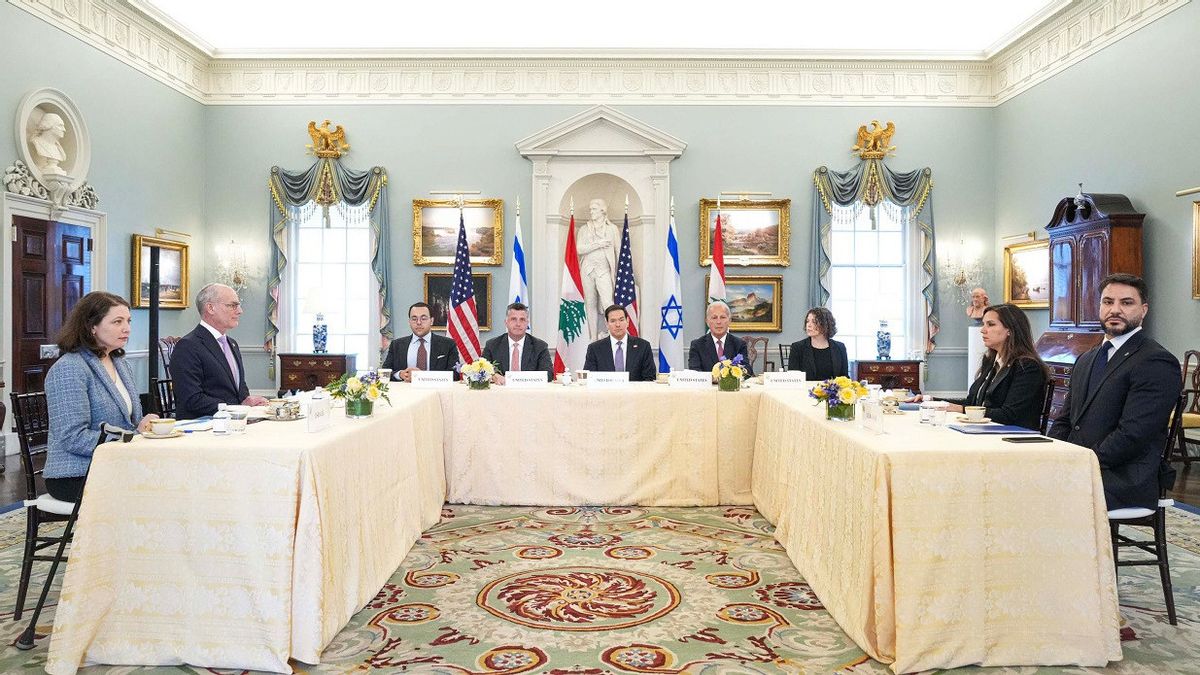


JAKARTA - Lebanese and Israeli envoys will meet for the second time in two weeks in Washington, United States on Thursday, continuing the newly established contacts between the two countries, with the hope of Beirut to extend the fragile ceasefire between Hezbollah and Israel.
The 10-day U.S.-mediated ceasefire was previously due to end on Sunday. Last week, the two countries' delegations held historic direct talks for the first time in more than 40 years in Washington.
A Lebanese official said Thursday's meeting would focus on two agendas: extending the ceasefire and exploring dates for broader negotiations beyond the ambassadorial level, where Lebanon would push for the withdrawal of Israeli forces, the return of Lebanese citizens detained in Israel, and the establishment of land borders, launching Al Arabiya (22/4).
Other officials said Lebanon would ask for a one-month extension of the ceasefire at the meeting.
The official, who spoke on condition of anonymity given the sensitivity of the topic, said, "Lebanon will ask for a one-month extension of the ceasefire, a cessation of bombing and destruction by Israel in the areas where they are, and a commitment to the ceasefire."
Lebanon's position is that an extension of the ceasefire is a prerequisite for talks to move to broader negotiations, the official said.
Underlining its fragility, Iran-backed Hezbollah said on Tuesday it fired rockets into northern Israel in response to Israeli violations. Meanwhile, Israel also accused the group of violations.
Hostilities between Hezbollah and Israel flared again on March 2, when the group fired to support Tehran in a regional war.
Washington's mediation on Lebanon comes at the same time as Pakistan's efforts to end the US war with Iran, which demands that Lebanon be part of the ceasefire. Washington denies any connection between the two efforts.
According to Lebanese authorities, more than 2,400 people have been killed in Lebanon since Israel launched the offensive in response to Hezbollah's March 2 attack.
Israel itself has seized the border area with Lebanon where its troops are still stationed, citing the need to create a buffer zone to protect northern Israel from Hezbollah attacks, which fired hundreds of rockets into Israel during the conflict.
The English, Chinese, Japanese, Arabic, and French versions are automatically generated by the AI. So there may still be inaccuracies in translating, please always see Indonesian as our main language. (system supported by DigitalSiber.id)


