

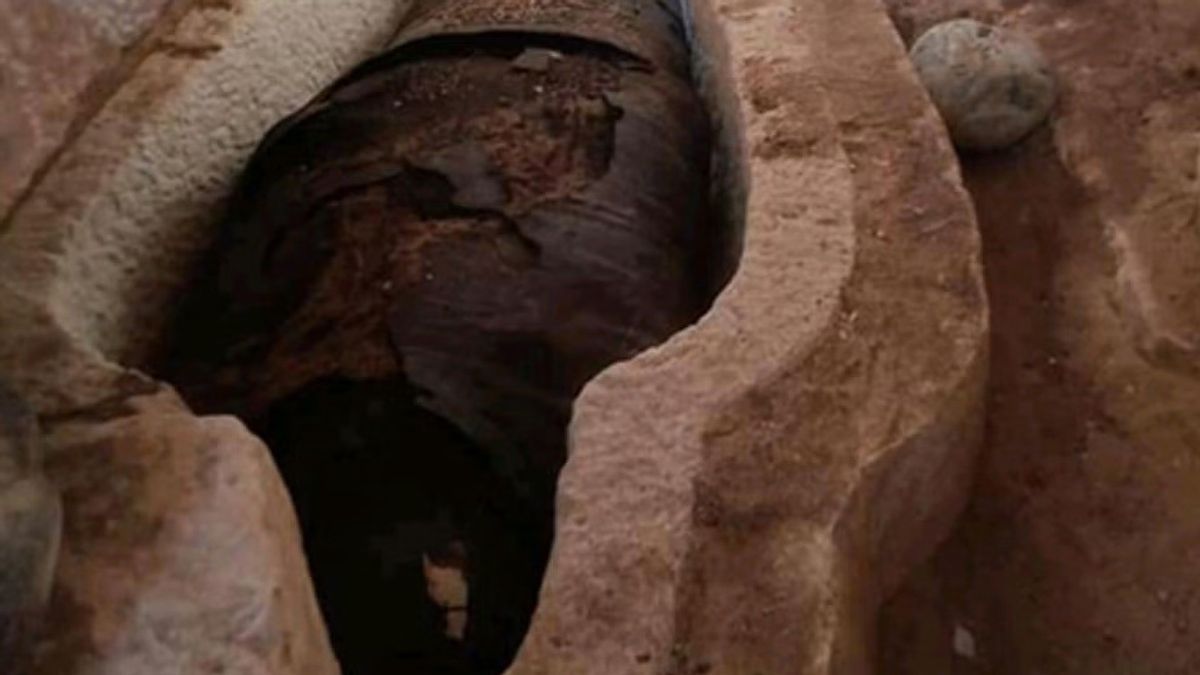


JAKARTA - A papyrus fragment containing Homer's Iliad was found in the stomach of an ancient Egyptian mummy buried about 1,600 years ago in Oxyrhynchus. This finding is said to be the first, because for the first time a Greek literary text was found in the context of mummification.
Quoted from The Independent report, Wednesday, April 22, the mummy was found by a team of researchers from the University of Barcelona in excavations in November-December 2025. The papyrus was placed in the abdomen as part of the embalming process. Previously, mummies from the same period had been found carrying Greek-language papyri, but the contents were magical or ritual texts.
Oxyrhynchus, which in the time of the Pharaohs was known as Per-Medjed, was one of the important cities of Greco-Roman Egypt. The area is now in Al-Bahnasa, about 190 kilometers south of Cairo, near the branch of the Nile known as Bahr Yussef.
According to the researchers, the text found comes from Book II of the Iliad, specifically the part known as the "ship catalog", which contains a list of the Greek forces before the attack on Troy. The researchers admitted that they did not know why the part was chosen to be included in the mummy's body.
Ignasi-Xavier Adiego, a professor in the Department of Classical, Roman, and Semitic Languages, said the discovery of Greek papyri in the mummification process was not actually new. "But until now, the content is mainly magical," he said. According to Adiego, what is really new in this finding is the inclusion of literary papyri in the context of the funeral.
In the Roman era, the practice of mummification in Oxyrhynchus combined Egyptian, Greek, and Roman elements. The bodies were preserved for more than 40 days with natron salt to dry the body, then wrapped in linen cloth. However, instead of using the traditional canopic jars to store organs, the body was filled with preservatives along with papyrus sealed with clay in the chest or pelvis. The coffin and mummification also often combine Egyptian and Roman motifs.
So far, excavations at Oxyrhynchus have uncovered three limestone chambers containing Roman-era mummies and ornate wooden sarcophagi. Previously, researchers also found 52 Ptolemaic-era mummies. More than a dozen of them have "golden tongues", symbols of preparation for life after death.
This finding gives clues that in the process of mummification in Oxyrhynchus, Greek literary works apparently were also used, not just magical or ritual texts.
The English, Chinese, Japanese, Arabic, and French versions are automatically generated by the AI. So there may still be inaccuracies in translating, please always see Indonesian as our main language. (system supported by DigitalSiber.id)


