

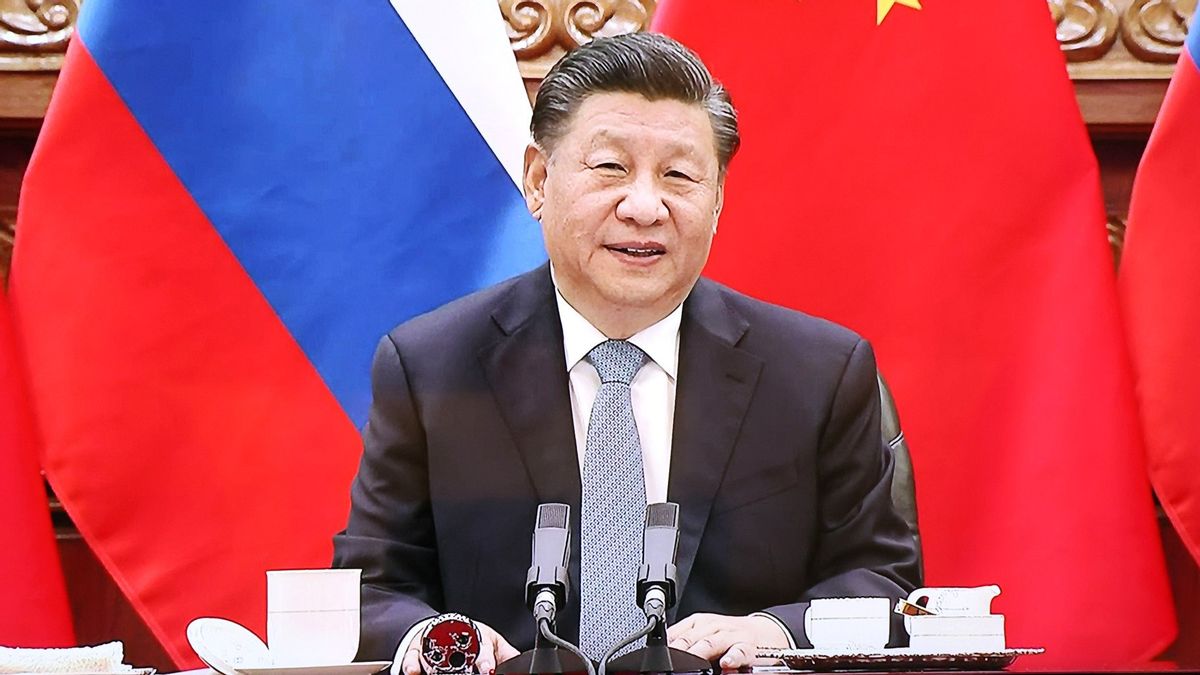


JAKARTA - Chinese President Xi Jinping stressed that the normalization of the Strait of Hormuz is a top priority for China and the international community, so it must continue to be pursued.
This was conveyed when speaking by telephone with the Crown Prince and Prime Minister of Saudi Arabia Mohammed bin Salman bin Abdulaziz Al Saud, Monday (20/4) afternoon.
"The Strait of Hormuz must maintain the smooth flow of normal shipping traffic, because the route serves the common interests of countries in the region as well as the international community. China supports countries in the region in building a 'common home' based on the spirit of good neighborliness," said President Xi on the Chinese Foreign Ministry website. quoted by ANTARA in Beijing, Tuesday, April 21.
Regarding the current situation in the Middle East and the Gulf region, President Xi stressed that China called for an immediate and comprehensive ceasefire.
"China supports all efforts conducive to the restoration of peace, as well as supporting the resolution of disputes through political and diplomatic channels," President Xi added.
President Xi also stated that China attaches great importance to relations with Saudi Arabia, and always maintains a position of mutual respect, equality, and mutual benefit with Saudi Arabia.
Meanwhile, Crown Prince Mohammed bin Salman said the ongoing armed conflict in the Middle East threatened the security of Gulf countries as well as severely disrupted global energy supplies and the world's economic performance.
"Saudi Arabia is committed to resolving disputes and differences through dialogue, and hopes to prevent further escalation," Mohammed bin Salman said.
He said China is a responsible big country, which has consistently upheld a just position and supported Middle Eastern countries in seeking good neighborliness, dialogue, and cooperation.
"Saudi Arabia is ready to strengthen communication and coordination with China to maintain a ceasefire, prevent the recurrence of hostilities, ensure the safety and freedom of navigation in the Strait of Hormuz, and work together to find a path to lasting peace and stability in the region," he added.
The conflict between Iran, the United States and Israel to date has also not subsided with US President Donald Trump threatening to blow up "a lot of bombs" if a ceasefire with Iran ends.
"A lot of bombs are going to start going off," Trump told PBS News, Monday (20/4), when asked about the possibility.
On Sunday (19/4), Trump said the US delegation was heading to Islamabad, Pakistan, for a second round of negotiations with Iran after the first round of negotiations on April 11-12 failed to produce an agreement.
However, Iranian Foreign Ministry Spokesperson Esmaeil Baqaei on Sunday (19/4) said Iran had no plans to hold a new round of negotiations with the US.
"The Islamic Republic of Iran does not accept any time limit or ultimatum in fighting for its national interests," Baqaei said.
Iranian Foreign Minister Abbas Araghchi in a telephone conversation with his counterpart from Pakistan, Ishaq Dar, also said the latest US threats against Iranian ports, coasts, and ships, accompanied by demands that he considered contrary and unreasonable, showed Washington was not serious in diplomacy.
On February 28, the US and Israel launched an attack on Iran, including in Tehran, causing damage and civilian casualties. Iran responded by attacking Israeli territory and US military facilities in the Middle East.
On April 7, Washington and Tehran announced a two-week ceasefire until April 22, 2026.
Following the failure of the first negotiations on April 12 in Islamabad, Trump ordered the US Navy to blockade Iranian ports, in order to force Tehran back to the negotiating table.
So on April 13, the US Navy began closing all maritime traffic entering and leaving Iranian ports on both sides of the Strait of Hormuz, which accounts for about 20 percent of global oil, petroleum products, and LNG supplies.
The English, Chinese, Japanese, Arabic, and French versions are automatically generated by the AI. So there may still be inaccuracies in translating, please always see Indonesian as our main language. (system supported by DigitalSiber.id)
Most Popular Tags
#Prabowo Subianto #donald trump #2026 World Cup #bgn #konflik timur tengahPopular


