

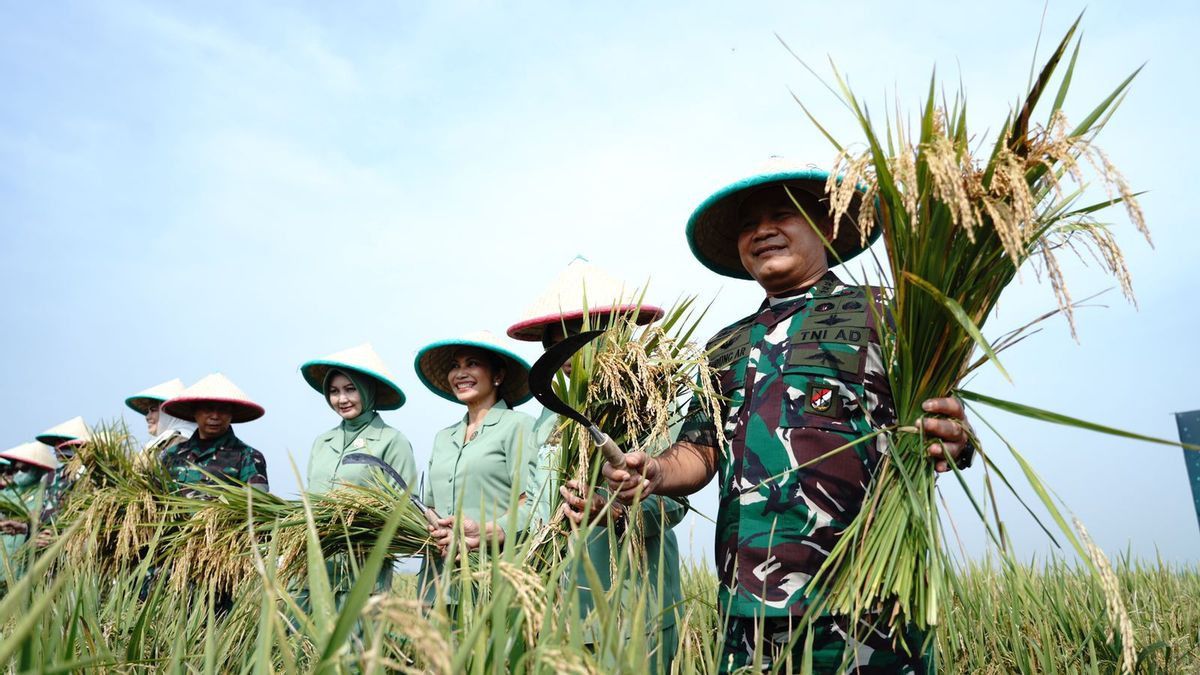


BOGOR - The surge in agricultural land of 1.7 million hectares in 2025 to 2026 has sparked heated discussions among academics.
Researcher from IPB University, Edi Santosa, called this phenomenon a success in the implementation of the "Hexahelix" concept, where the security apparatus now holds a real vital role in the field to maintain the stability of national food production through escorting the distribution of resources.
Edi Santosa assessed that the physical presence of the police at the lower level was a solution to the classic problems of farmers, especially related to water distribution conflicts.
The involvement of Babinsa and Bhabinkamtibmas has proven to be able to create order that has been difficult to achieve independently by farmers.
"In the past, farmers often fought just because of the issue of water distribution. Now, they just report to the officers, and the problem is solved without anyone daring to 'play around'. This is the new strength that maintains production stability," said Edi when interviewed in Bogor, Monday, April 20, 2026.
Interestingly, there is a division of labor that has begun to be mapped naturally in the field, where the TNI tends to be more active in escorting rice commodities, while the National Police has entered the corn commodity.
Although this involvement is difficult to measure quantitatively in statistics, field facts show significant changes in productivity.
"One new thing that may not have been much in the literature is the role of the apparatus. We can call it not Pentahelix, but 6-Helix (Hexahelix). I see it from the functional side: its real role in the field," added Edi.
However, Edi also gave a critical note on the performance of the state civil apparatus (ASN) which has the main task in counseling.
He observed that there was a disparity in activity in the field, where security officers were actually seen to be more agile than agricultural extension workers.
According to him, the harmonization between the security function and the technical extension function must continue to be improved so that the acceleration of planting can run more optimally in the future.
As physical evidence of this self-sufficiency claim, Edi referred to the abundance of rice stocks in Bulog warehouses, which currently reach 4.6 million tons.
This figure is considered the most valid evidence to support statistical data regarding the increase in planted land area.
"For this year, for the first time we can see the surplus in Bulog warehouses. That is the first evidence that makes me believe. If anyone doubts the data, please check it yourself at Bulog," he concluded.
The English, Chinese, Japanese, Arabic, and French versions are automatically generated by the AI. So there may still be inaccuracies in translating, please always see Indonesian as our main language. (system supported by DigitalSiber.id)


