

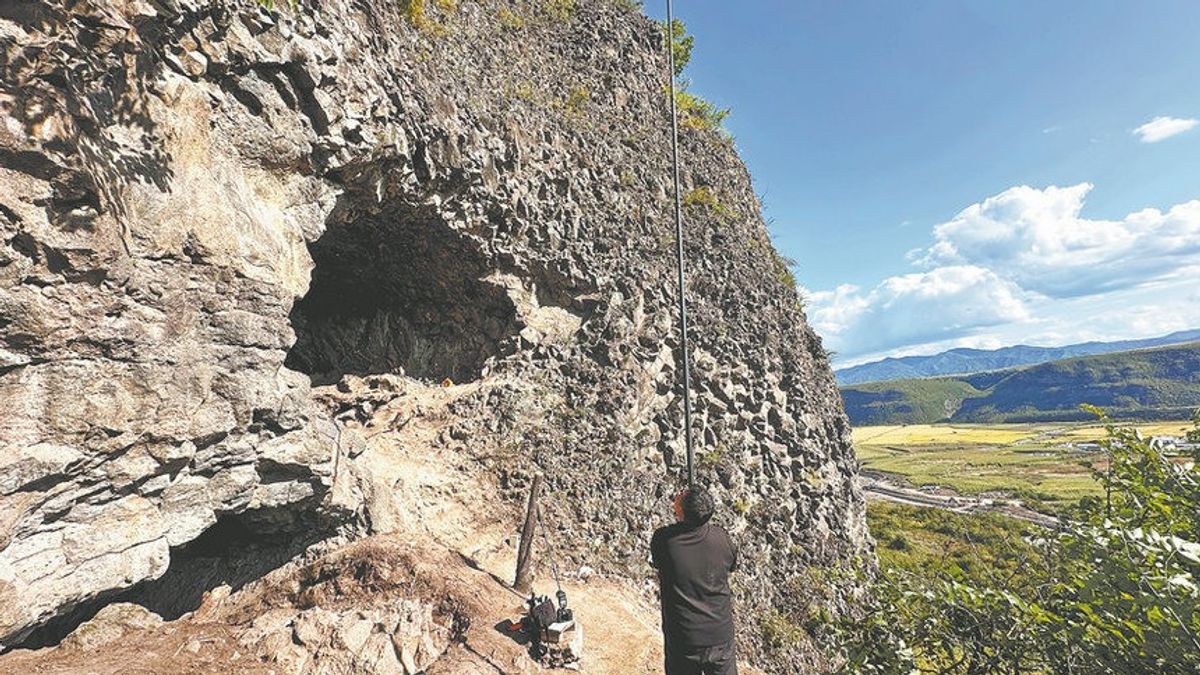


JAKARTA - Archaeological research in the Changbai Mountains, northeast China, reveals the great role of obsidian in the life of ancient humans in the harsh northern region. According to China Daily, which was quoted on Friday, April 17, findings from a series of sites in the region show traces of human activity that have emerged around 220,000 years ago and continued until 15,000 years ago.
The major research program, which began in 2021, covers an area of more than 100,000 square kilometers. In five years, the research team has surveyed more than 6,500 square kilometers and identified more than 1,000 locations containing flint tools. As reported by China Daily, the density of these findings overturned the long-held assumption that the Changbai region was only crossed by a small group with limited activity.
Xu Ting, a professor of archaeology from Liaoning University, said excavations at five major sites - Dadong, Jidi, Shangtiandong, Fenglin, and Xianrendong - formed a long cultural sequence from about 220,000 to 15,000 years ago. Xianrendong pushed back the human activity footprint in the area to about 220,000 years ago.
The younger sites show important changes in technology. Dadong and Fenglin record the emergence and refinement of microblade techniques from around 28,000 years ago. Shangtiandong shows the transition phase from the Paleolithic to the Neolithic to the Bronze Age, including bone finds that are thought to be related to early ritual practices.
"Therefore, we have basically built a cultural sequence of this region," said Xu. According to him, the findings helped researchers read the traces of the earliest human activities, the types of stone tools used at different times, and the cultural characteristics in each phase.
Frequent volcanic activity produces large amounts of obsidian. This material is considered ideal for tool making because it is hard, its structure is uniform, and it is durable. At the same time, volcanic ash enriches the soil, supports plants, and attracts animals.
A number of sites also preserve evidence of humans living during the Last Glacial Maximum, around 26,500 to 19,000 years ago. Archaeologists suspect that microblade tools helped humans adapt when resources were scarce and the range of movement had to be expanded.
Researchers also traced the origin of obsidian at the sites. In Dadong, most of the material came from around Lake Tianchi in Changbai, but a small part was traced to the Russian Far East. In the early phase, humans took more obsidian from the riverbed near the location. Later, they began to obtain materials from primary volcanic deposits about 200 kilometers away. This shows that the range of their activities has expanded considerably.
Another interesting finding. In Dadong, archaeologists found a stone grinding tool that was about 27,000 years old, older than the general assumption that had previously associated it with the Neolithic period. In Jidi, they also found a giant blade core 53 centimeters long, a rare find.
Overall, this research suggests that ancient humans in Changbai were not just passing through, but living, adapting, and developing technology in a harsh environment for tens of thousands of years.
The English, Chinese, Japanese, Arabic, and French versions are automatically generated by the AI. So there may still be inaccuracies in translating, please always see Indonesian as our main language. (system supported by DigitalSiber.id)
Most Popular Tags
#Prabowo Subianto #donald trump #2026 World Cup #Febrie Adriansyah #8791Popular


