

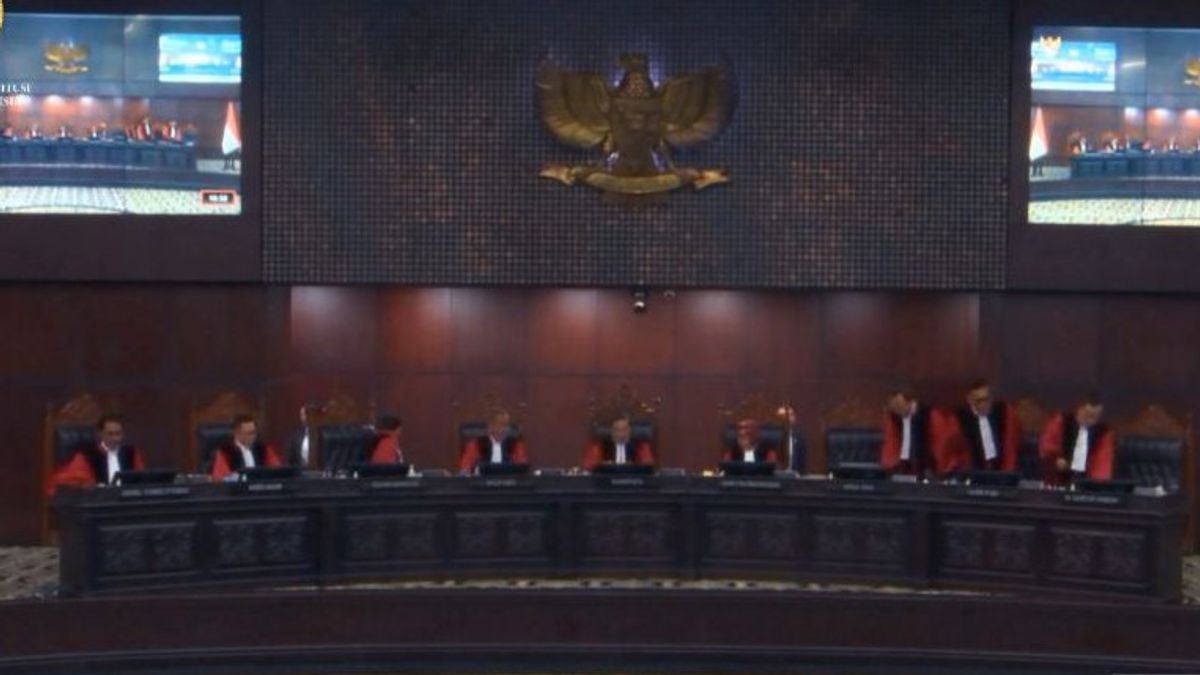


JAKARTA - The Constitutional Court (MK) judge questioned the association of telecommunications organizers and a number of mobile operators as parties concerned in the application for testing the Job Creation Law regarding the controversy over the burnt internet quota.
Eight of the nine constitutional judges present peppered the parties with questions regarding the testimony they provided in the case on Thursday, April 16.
Constitutional Justice Adies Kadir got the first opportunity to ask questions which he addressed to each provider (Telkomsel, XL, Indosat) and also to the Association of All Indonesian Telecommunications Operators (ATSI).
The judge from the DPR line asked ATSI about his statement that the unused quota was a burden of loss for the provider.
"Please simulate what the load is like, so that it results in losses due to unused quotas," asked Adies, quoted by ANTARA.
He also asked Telkomsel for additional information regarding access rights, unused quotas until the deadline is not beneficial to the provider. According to him, the business of managing the internet must have its benefits, so it needs to be explained from where the benefits are, so that the court can decide carefully.
Adies also asked where the remaining quota that was not used up but the deadline had expired. He also asked if the internet service provided by PLN was the same as other providers.
Meanwhile, Constitutional Justice Asrul Sani asked the provider what would be the loss if the applicant's application regarding the expired internet quota was granted by the Constitutional Court.
Asrul saw that there were product variants from each provider that accumulated the remaining quota with the applicable terms and conditions.
"So when there is a variant of this kind of product, it means there is an opportunity for accumulation," said Asrul.
Meanwhile, Constitutional Justice Ridwan Masyur said that the need for the internet has become a basic need for all people, from young to old, for work, education, business and so on.
However, according to him, the rules that make the quota just hang when the validity period has expired result in there being parties who are harmed, namely the community of internet service users.
Ridwan emphasized the importance of sitting together to find solutions to the problem of expired quotas, and the importance of socialization. So that the norms that are tested are not just right and wrong.
Constitutional Justice Guntur Hamzah emphasized the principle of justice which is in the acronym of tariff (transparency, accountability, responsiveness, independence, and fairness/fairness).
According to him, where is the justice if the internet quota is purchased by the public with a certain nominal and a certain time limit. For example, buy a quota with a time limit of 30 days, but in 28 days it is over. If a year the public buys 12x with, but if the time limit is only 28 days, then they have to buy 13 times from a year.
"Do providers understand what tariffs are? It's not just a price, but an abbreviation of the principles of good governance, good corporate principles. So this issue of fairness needs to be studied," said Guntur.
Meanwhile, Judge Daniel Yusmic P Foek asked the parties to explain the need for the internet network infrastructure as presented in his statement, the costs incurred were also related to the development of large internet network infrastructure.
Daniel wants to know how much the construction of the infrastructure costs, so that the rules for the upper and lower tariff quota prices are regulated by the government in such a way.
"I imagine that in the future the price (of internet quotas) will definitely be cheaper, because now the construction of infrastructure requires quite expensive costs, so it is estimated that this expenditure determines the main infrastructure factor, from what percentage of the infrastructure," he asked.
In line with this, Constitutional Justice Enney Nurbaningsih also asked the same question that she had asked the government as a regulator in the previous hearing, regarding the accumulation of money from the quota that had been paid for where it was allocated by each provider.
The question was delivered firmly by Constitutional Judge Saldi Isra who emphasized that the internet has become the lifeblood of many people, not goods but services. Although the providers do not get any profit from the remaining quota that is burned, but there are citizens who are harmed from the burning of the internet quota.
He asked the provider to provide an explanation regarding what innovations could be done so that service users would not be harmed.
"So the aspirations of the people become a bond for brothers (providers) not to be free to determine everything. That's what we have to think about," said Saldi.
Finally, the Chairman of the Constitutional Court, Suhartoyo, asked where the reference to the regulation came from, sectorally or domestically. the practice of buying and selling quotas is not a sale of goods (internet quotas) does not fall under the 2nd book cluster of civil law.
It is explained that the sale and purchase of internet quotas is a sale and purchase of access rights and the framework is contractual (contractual agreement). In this regard, in the manabest mark (reference), has Indonesia ever ratified this international agreement or regulation, then who determines it.
"This is the regime from where it was obtained. Please if there is an international reference, please tell me. So that we do not buy 'cats in sacks', the term. So that this is clear, it does not only apply in Indonesia," he said.
After listening to the statements of the providers, the Constitutional Court still scheduled a hearing with the agenda of listening to additional statements from the association, providers and PLN on Monday (4/5).
The court held a follow-up hearing with the agenda of hearing the statements of the association, provider and PLN for the application number 33/PUU-XXIV/2026. In addition, the application number 273/PUU-XXIII/2025 was also presented in the trial.
The English, Chinese, Japanese, Arabic, and French versions are automatically generated by the AI. So there may still be inaccuracies in translating, please always see Indonesian as our main language. (system supported by DigitalSiber.id)
Most Popular Tags
#Prabowo Subianto #donald trump #2026 World Cup #venezuela #konflik timur tengahPopular


