

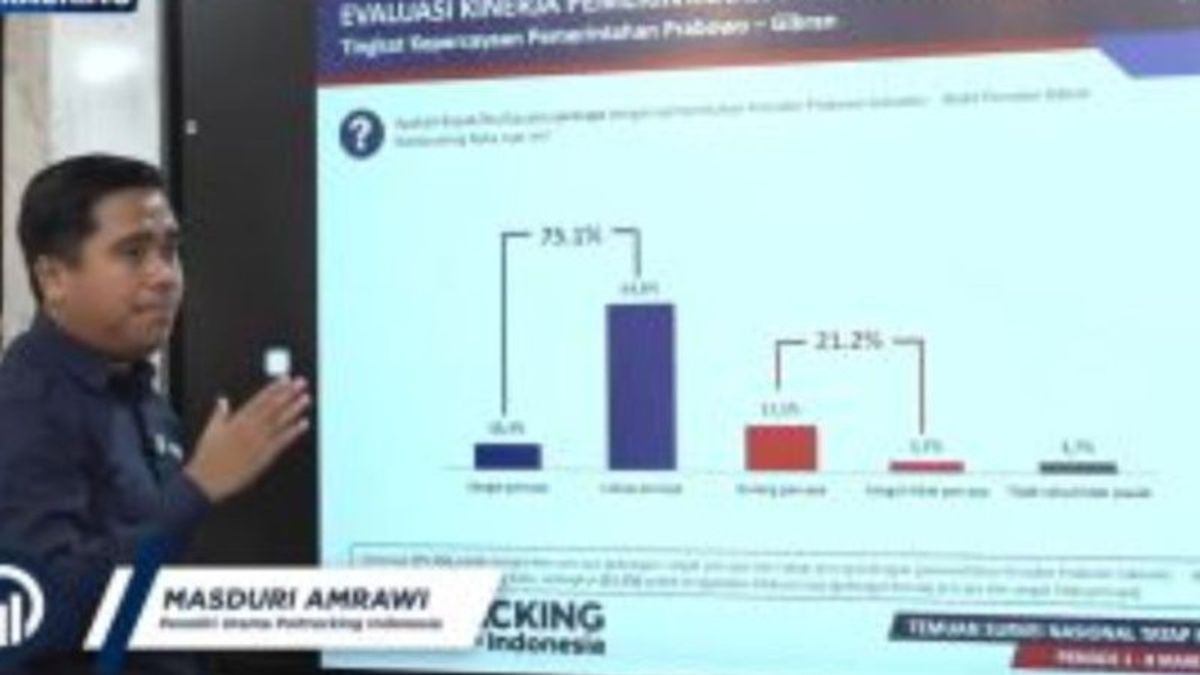


JAKARTA - President Prabowo Subianto's electability still prevails in the "top of mind" simulation based on the Poltracking Indonesia survey, along with the high level of public satisfaction with the government's performance, which is above 70 percent.
"As many as 32.9 percent of respondents spontaneously chose Prabowo as the presidential candidate," said Poltracking Indonesia's Principal Researcher Masduri Amrawi in an online release of the results of the evaluation of government performance and national priority programs, Monday, April 13, reported by ANTARA.
"Top of mind" simulation is a method or technique for measuring what first comes to a person's mind when hearing a certain word, brand, issue, or category.
"This is a top of mind question, so we ask directly without mentioning names spontaneously. As many as 32.9 percent of our voters, still choose President Prabowo Subianto. Then there is Dedi Mulyadi at 13.5 percent, then Anies Baswedan at 9.2 percent," he said.
Thus, he said, the findings put Prabowo as the top candidate, followed by Dedi Mulyadi and Anies Baswedan, while other candidates were below five percent.
"However, there are still 28.8 percent of respondents who have not made a choice (undecided voters)," he said.
This condition shows that the political dynamics space is still open, but the dominance of Prabowo's electability reflects the strong public perception of the current national leadership.
This advantage is in line with the public's satisfaction level with the government's performance which reached 74.1 percent, as well as satisfaction with the President's performance of 74.9 percent and the public's confidence level of 75.1 percent.
The survey also showed a high spread of public satisfaction in various regions. West Java recorded the highest satisfaction of 89.2 percent, followed by Kalimantan 87.2 percent and Maluku-Papua 83.8 percent.
Other regions such as East Java recorded 80.7 percent and Sumatra 74.2 percent, while Central Java was at 67.5 percent and Bali-Nusa Tenggara 69.7 percent. Sulawesi showed a relatively balanced level of satisfaction.
"This difference is certainly related to access, exposure to information, and the impact of policies in each region," said Masduri.
The Indonesian Poltracking survey institution released the results of evaluating the performance of the government and national priority programs by emphasizing the transparency of the methodology as the basis for the validity of the findings.
The survey was conducted on March 2-8, 2026, with 1,220 respondents who are Indonesian citizens aged 17 years or older or married, using the "stratified multistage random sampling" method with a "margin of error" of 2.9 percent and a confidence level of 95 percent.
Data collection was carried out through face-to-face interviews by trained enumerators with sampling units from the village/subdistrict level to individual respondents. Validation was carried out by comparing the 2020 Central Statistics Agency census data and sample weighting.
Quality control includes a 20 percent "spot check" of samples, re-verification via phone, and the use of an application-based "real-time" system equipped with photos and geolocation to ensure data accuracy.
The English, Chinese, Japanese, Arabic, and French versions are automatically generated by the AI. So there may still be inaccuracies in translating, please always see Indonesian as our main language. (system supported by DigitalSiber.id)
Most Popular Tags
#Prabowo Subianto #donald trump #2026 World Cup #Febrie Adriansyah #8791Popular


