

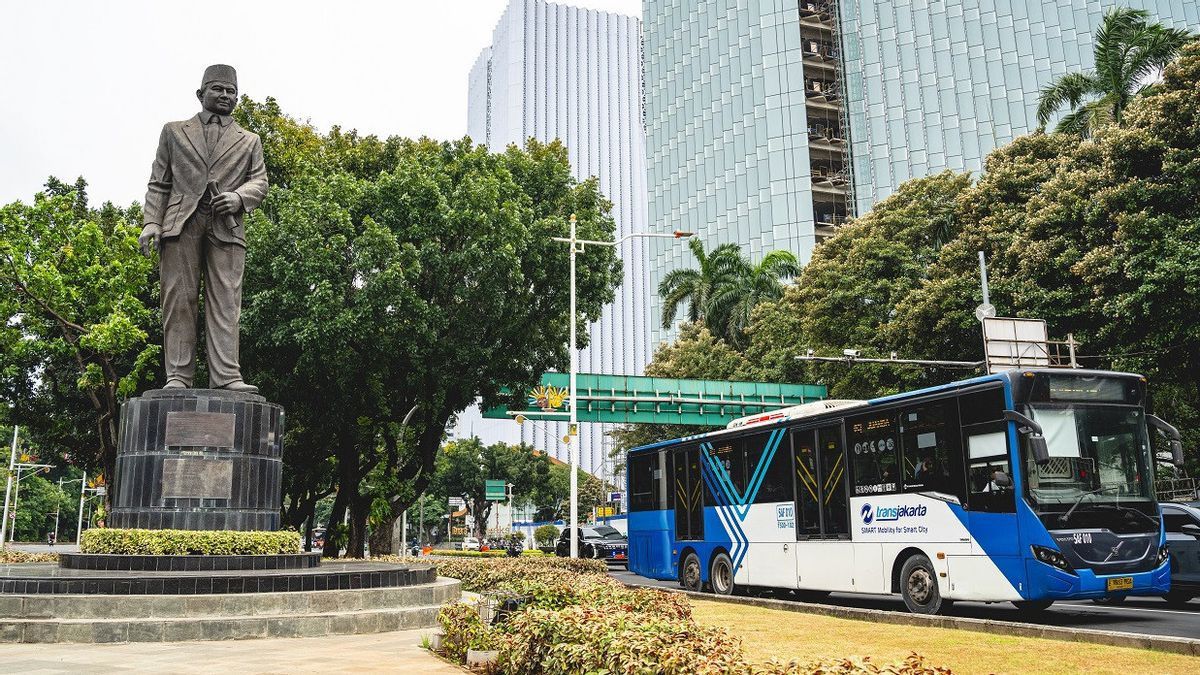


JAKARTA - The Directorate of Traffic (Dirlantas) of the Metro Jaya Police said that the implementation of the work from home (WFH) policy for state civil servants (ASN) has proven to be able to reduce traffic density, especially in a number of locations that are usually the knots of congestion.
"It is indeed seen today that there is a significant difference seen from the volume of vehicles that use this WFH policy, as seen from monitoring traffic flow," said the Directorate of Traffic of the Metro Jaya Police, Kombes Pol Komarudin, quoted by Antara, Friday, April 10.
This was conveyed by Komarudin who had monitored in the field since morning until around 09.20 WIB. He also said that Jakarta today was smoother on several roads such as Sudirman from south to north, then north to south.
"Then meet several other roads such as Asia Africa, the Youth Gate, which is usually in Layang Ladokgi, there is a fairly long queue until now, including those who access Jakarta from west to east, it is indeed lively but not until there is a significant density," he said.
Komarudin added that the density at the nodes, which is usually the case, such as in Semanggi, is not too long, it is dense, but not too long.
Even so, Komarudin said that there were roads that were still crowded and not too affected by the welfare of WFH, namely from west to east to Semanggi, which was caused by the crossing factor (a situation where vehicle traffic from one direction intersects directly or passes through the vehicle lane from the other direction).
"We know that there is an off frame from inside the toll road that will go out to Semanggi, it is a crossing with the TransJakarta line, then a crossing also with the one from the artery from Slipi to Semanggi. In addition, there is a crossing on a small street from Benhil. It also includes a crossing from Semanggi to Sudirman, from Benhil to Cawang, this is one of the causes," said Komarudin.
Komarudin added that the traffic flow situation on the implementation of WFH today around the Jakarta road was smoother, the rest of the vehicle volume density.
DKI Jakarta Governor Pramono Anung Wibowo admitted that he had signed Circular Letter (SE) Number 3/SE/2026 regarding the implementation of the work from home or work from home (WFH) rules every Friday.
The circulation letter states that the proportion of ASN employees who can carry out WFH is at least 25 percent or at most 50 percent of the number of ASN employees in the smallest sub-field/sub-section/section/sub-group/work unit that is carried out selectively by taking into account the characteristics of the tasks and types of work in each work unit.
"For work from home or work from anywhere, I as the Governor have signed the SE. So for each regional apparatus organization (OPD), the range is between 25 to 50 percent who work from home," explained Pramono at the Jakarta City Hall, Tuesday.
The circular also states that employees who can carry out WFH must meet the criteria, namely not being undergoing or in the process of punishment/discipline, and/or have worked for more than two years.
Employees who carry out WFH are required to report their attendance online through the mobile attendance application twice, namely from 06.00-08.00 WIB and 16.00-18.00 WIB.
The English, Chinese, Japanese, Arabic, and French versions are automatically generated by the AI. So there may still be inaccuracies in translating, please always see Indonesian as our main language. (system supported by DigitalSiber.id)


