

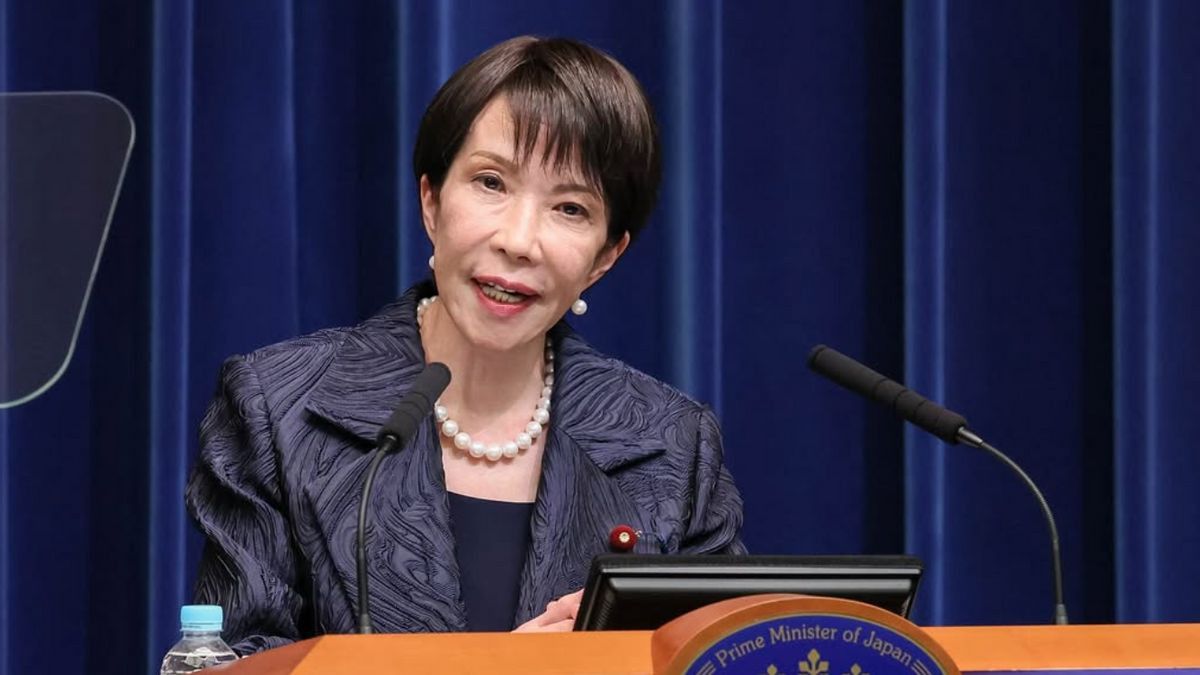


JAKARTA - Japanese Prime Minister Sanae Takaichi urged Iranian President Masoud Pezeshkian to immediately guarantee safe navigation for all countries' ships in the Strait of Hormuz. The appeal was made in a telephone conversation on Wednesday, after a two-week conditional ceasefire agreement was announced between Iran and the United States.
According to a Kyodo News report quoted on Wednesday, April 8, after the 25-minute conversation, Takaichi told reporters that he also conveyed the importance of de-escalation as soon as possible in the conflict in the Middle East. Both leaders agreed to keep in touch.
Takaichi stressed that the Strait of Hormuz is an important location for global logistics and international public assets. He also welcomed the ceasefire agreement as a positive step. Japan, he said, hopes that a final agreement through diplomatic channels can be reached soon. This discussion was the first between Takaichi and Pezeshkian.
The ceasefire agreement was announced by Pakistan as a mediator, shortly before the deadline set by US President Donald Trump expired on Tuesday night. At that time, Tehran was asked to reopen the Strait of Hormuz or face the threat of destroying its vital infrastructure.
Iranian Foreign Minister Abbas Araghchi said his country's military would stop defensive operations if attacks on Iran were stopped. He also said safe passage through the Strait of Hormuz would be possible for two weeks through coordination with the Iranian Armed Forces, taking into account technical limitations.
Since the United States and Israel began attacking Iran in late February, Iran has effectively blocked the Strait of Hormuz. This route is an important bottleneck for global energy transport. The blockade triggered oil supply disruptions and price spikes.
For Japan, this issue is very sensitive. More than 90 percent of Japan's crude oil imports come from the Middle East, and most pass through the Strait of Hormuz. Japan is also a close ally of the United States, but has maintained friendly relations with Iran.
Takaichi's administration has condemned Iran's de facto blockade of the Strait of Hormuz as well as Tehran's attacks on other countries in the Middle East. However, Tokyo has not given a legal assessment of the US-Israeli military operation against Iran.
During the talks, Takaichi also called for a quick resolution of the case of a Japanese citizen who was released on bail on Monday after months of detention in Iran. The person is suspected of being the head of Tehran's bureau of public broadcaster NHK.
The English, Chinese, Japanese, Arabic, and French versions are automatically generated by the AI. So there may still be inaccuracies in translating, please always see Indonesian as our main language. (system supported by DigitalSiber.id)
Most Popular Tags
#Prabowo Subianto #donald trump #Febrie Adriansyah #8791 #giias 2026Popular


