
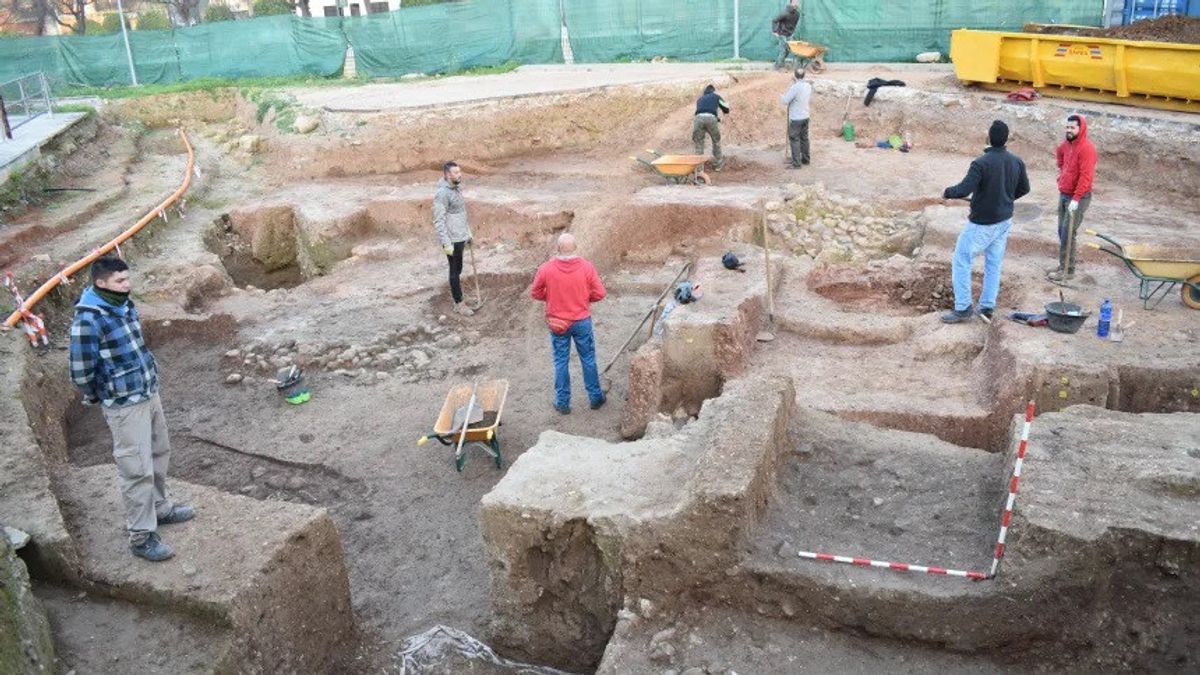


A team of archaeologists in Spain has discovered a 2,200-year-old elephant bone, believing it belonged to an animal that served as a "war machine" in an army sent to invade the Roman Republic.
After finding the ankle bone at the Colina de los Quemados archaeological site in the southern Spanish city of Cordoba, researchers used radiocarbon dating to confirm that the bone belonged to an elephant that lived around the early fourth century to the late third century BC, according to a study published in the "Journal of Archaeological Science: Reports."
Around this time, the City State of Carthage, in what is now Tunisia, was at war with the Roman Republic for supremacy in the Mediterranean.
According to research, the Carthaginians were known to use elephants as "war machines" in their armies, and classical records show that the famous commander Hannibal had led an army of 37 elephants through modern Spain and France, and eventually tried to invade Italy by crossing the Alps during the Second Punic War, which lasted from 218 to 201 BC, quoted from CNN (1/4).
The extraordinary sight of Hannibal's elephants left its mark in the historical record, but no direct physical evidence of their presence in Western Europe has been found before.
In addition to the radiocarbon dating, which roughly aligns with the timeline of the Second Punic War, the researchers say clues to their Hannibal theory also include 12 spherical stone balls used in artillery they found alongside the bones, which "may indicate a military context."
Although they acknowledged that the discovery of a single bone separately does not indicate that the entire animal was at this location, because the bone could have been brought there as an antique or souvenir, "historical and archaeological records show its connection with the events of the Second Punic War, both directly and indirectly, providing the most plausible explanation," the researchers wrote in the study.
They cited the presence of projectiles and arrowheads, which may have been left behind after episodes of violence.
War elephants at the time were "a prestigious weapon but also a psychological weapon," according to Fernando Quesada-Sanz, the lead author of the study and archaeologist at the Autonomous University of Madrid, Spain.
The animals "were very impressive and frightening for the troops who were not used to dealing with them," he told CNN in a statement on Thursday.
"They are also very useful against cavalry and to disrupt the enemy's infantry lines," continued Quesada-Sanz.
"They are even used as spearheads to lead attacks on the fortress fence while enemies such as campaign camps," he said.
"This is the first time, as far as we know, that the remains of an elephant from a Carthaginian army have been found on European soil," Quesada-Sanz said, adding it may have been part of one of the 21 elephants that classical sources say Hannibal left in Iberia before he set off for Italy.
"This finding may be a warning to study collections from old excavations stored in museum storage rooms in Spain, southern France, or even Italy that may produce more examples," he explained.
"In addition, the bones from future excavations must be carefully examined," he said.
Meanwhile, archaeologist and senior lecturer in ancient history at Cardiff University, Wales, and author of "Carthage: A New History" Eve MacDonald who was not involved in the research told CNN, this discovery is significant because it finally provides physical evidence for the long-held belief that the Carthaginians introduced elephants to the Iberian Peninsula during the third century BC.
The context of the findings, in a cache of artillery and other war instruments, adds "an interesting layer to the interpretation" of the study's authors, he said.
"There is something very satisfying about those moments when archaeological evidence emerges and confirms what history has long suggested," MacDonald said by email.
"The legend of Hannibal crossing the Alps with 37 elephants has captivated people's imaginations for thousands of years, the ancient Romans were amazed by it and we are still amazed today," he continued.
"This little bone brings us one step closer to one of the most extraordinary military stories of the ancient world," he concluded.
The English, Chinese, Japanese, Arabic, and French versions are automatically generated by the AI. So there may still be inaccuracies in translating, please always see Indonesian as our main language. (system supported by DigitalSiber.id)
Popular


