

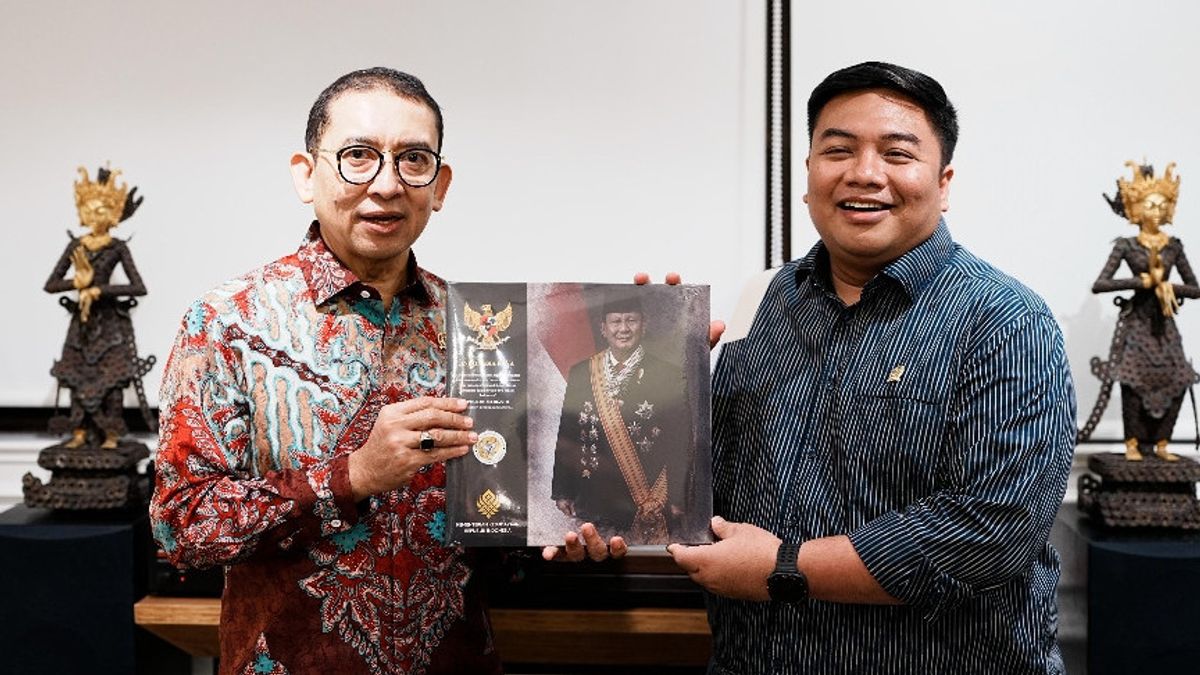


JAKARTA - Minister of Culture (Menbud) Fadli Zon encourages culture not to stop as a symbol of identity. The government now wants to place it as a source of new economic growth. This attitude emerged in Fadli's meeting with the National Creative Economy Movement (GEKRAF) at the Ministry of Culture's office, Jakarta, Wednesday, April 1.
The meeting discussed strengthening the cultural economic ecosystem, developing creative talent, to the utilization of cultural heritage as a source of economic value. Menbud Fadli emphasized that culture is upstream, while creative economy is downstream that grows from the same root.
"Culture is in the upstream sector, while creative economy is in the downstream sector. The foundation of the creative industry is culture. Therefore, our task is not only to protect and preserve, but also to ensure that culture can be utilized and developed into a cultural economic force," said Fadli Zon.
According to the Minister, Indonesia has a large capital in the form of cultural diversity that can be processed into a cultural industry and creative industry. This wealth is considered inexhaustible as long as the human being remains alive and takes care of it. Therefore, the Ministry of Culture encourages the use of cultural heritage through the development of museums, strengthening the ecosystem of cultural heritage that has been recognized by UNESCO, to the development of derivative products such as quality merchandise that have economic value.
In addition to products, attention is also directed at human quality. The government and GEKRAF discuss training, talent management, and literacy strengthening so that cultural and creative economic actors are more ready to compete in the global market.
Secretary General of GEKRAF Temmi Sumarlin said that his organization in recent years has focused on building the foundation of a creative economy based on regional and community potential. He assessed that the next challenge is to ensure that cultural products have strong economic value so that the younger generation sees this sector as the future.
"We see that culture and creative economy have a very close relationship," said Temmi.
The meeting also agreed on collaboration in talent development, curation of creative products, promotion of Indonesian culture at the international level, and strengthening cultural diplomacy. The Ministry of Culture will also utilize the Cultural Preservation Center in 33 provinces as a node for cooperation between cultural and creative economy actors in the region.
The English, Chinese, Japanese, Arabic, and French versions are automatically generated by the AI. So there may still be inaccuracies in translating, please always see Indonesian as our main language. (system supported by DigitalSiber.id)
Most Popular Tags
#Prabowo Subianto #donald trump #2026 World Cup #Febrie Adriansyah #8791Popular


