

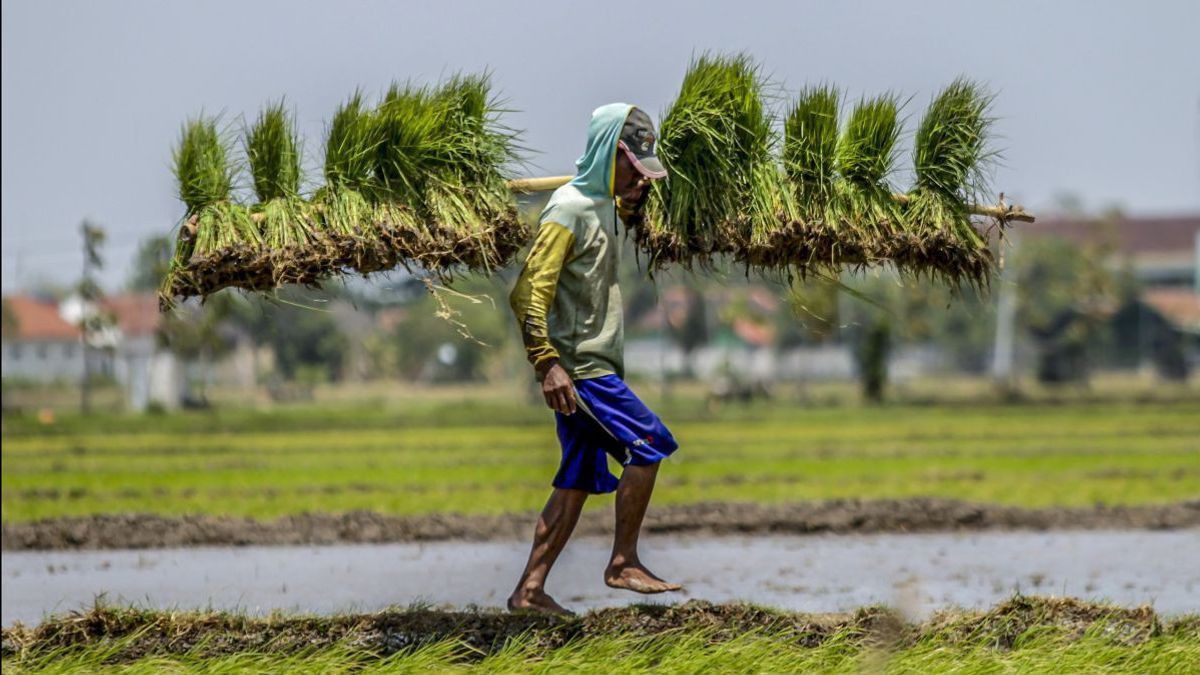


JAKARTA - The rise in fuel prices due to the US-Israeli war against Iran has begun to squeeze Thai farmers. The Guardian quoted Friday, March 27, reported that farmers are now having trouble getting solar to irrigate their fields, while fertilizer prices for the next planting season are also threatened to rise.
In Ayutthaya, central Thailand, rice farmer Thanadet Traiyot had to queue for hours at a gas station while carrying jerrycans, but still failed to get solar because the stock was gone. Five days later, his fuel supply is still not back to normal. In his field, he now has to manage which water pumps can be turned off so that the remaining solar is enough.
"We are very affected because farmers depend on fuel to work. We need fuel to care for plants and pump water so that rice stays alive," said Thanadet.
According to The Guardian, Thailand and a number of neighboring countries that rely on imported energy from the Middle East are now at the forefront of the energy crisis. The Thai government said the national energy reserves were sufficient for 100 days. However, in many areas, long queues and "out of stock" signs began to appear at gas stations. The impact has spread to taxi services, tourist boats, to cremations in a number of temples.
This pressure is also felt by farmers and fishermen. Thailand is one of the main exporters of rice, sugar, and canned and processed fish. Farmers have difficulty getting solar to power their machines, including during harvest, while many fishermen cannot go to sea. The fishing group even warned that the industry could stop completely in a matter of days if the government did not help with fuel costs.
The price of gasoline in Thailand rose to 38.94 baht per liter on Thursday, after the government subsidy ended. Before the war, the price was 29.94 baht per liter. For farmers, this surge is a new burden because the need for solar is expected to be greater when the harvest season arrives.
Another farmer in Ayutthaya, Pairote Rodpai, said his family who worked on 11.2 hectares of land began to worry about the direction of prices. His uncle, Theerasin Thanachawaroj, said his family had been farming for three generations, but had never faced disruptions like now.
Another problem that has begun to overshadow farmers is fertilizer. President of the Thai Farmers Association Pramote Charoensilp said that in a month farmers will start buying fertilizer for the next harvest, while the commodity is also related to supplies from the Middle East. If the war continues until May, according to him, the price pressure will be much heavier.
The Guardian also wrote, the Persian Gulf is an important center for global fertilizer production and exports. Unlike oil, the fertilizer sector has no international strategic reserves. The United Nations Food and Agriculture Organization has warned that this war could be a major shock to the world food system. The World Food Program estimates that the number of people facing acute hunger could reach a record 363 million by 2026 if the conflict continues.
Thailand has prepared assistance, including plans to buy rice above market prices and subsidize fertilizer. But for many farmers, the current choice is only one: bear the rising costs.
"We can't let the plants rot and die in the fields," Thanadet said, quoted by The Guardian.
The English, Chinese, Japanese, Arabic, and French versions are automatically generated by the AI. So there may still be inaccuracies in translating, please always see Indonesian as our main language. (system supported by DigitalSiber.id)


