

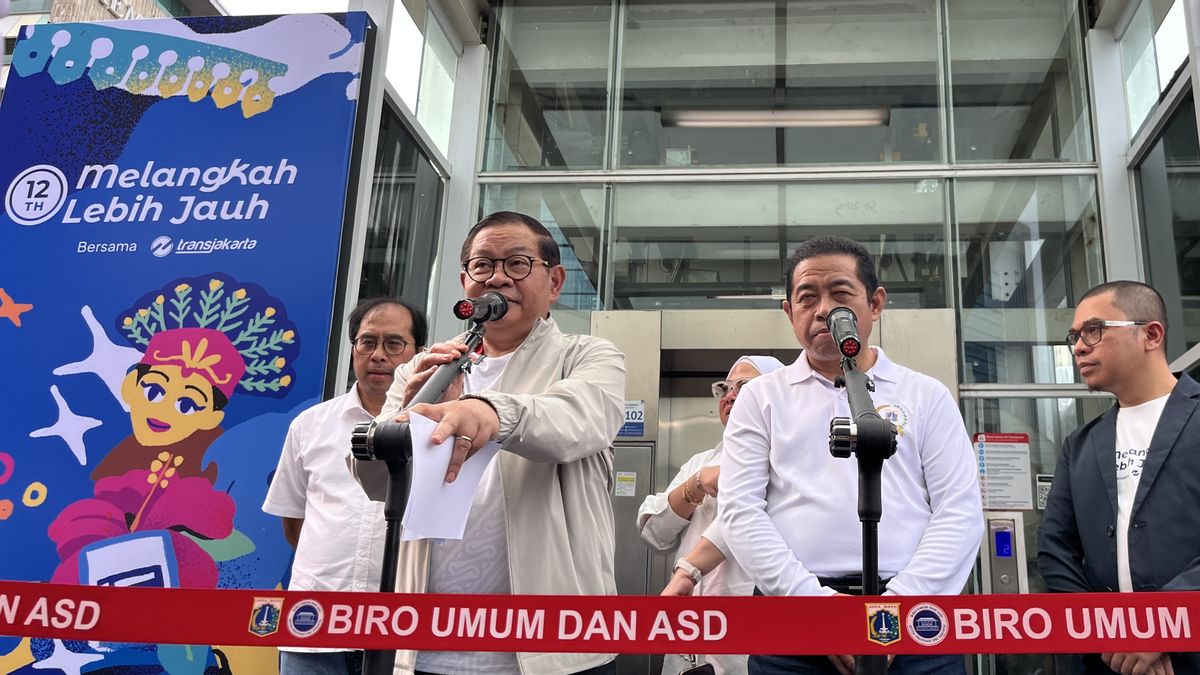


JAKARTA - DKI Jakarta Governor Pramono Anung estimates that the number of new arrivals to the capital will increase after the 2026 Lebaran reverse flow period. This prediction is based on the trend of migrant movements returning to Jakarta, both through booking transportation modes and those who join their families.
"We predict that there will be an increase in the number of travelers who will return to Jakarta with their relatives, which is approximately 10 to 12 thousand," said Pramono at the Tosari Transjakarta Stop, Friday, March 27.
Pramono emphasized that the figure was still temporary and had not become final data. The DKI Jakarta Provincial Government will still monitor the development of the arrival of residents in the near future.
"This can be concluded like that from the trend of people booking vehicles or also those who go with their families and so on," explained Pramono.
In line with the potential surge, the DKI Provincial Government again reminded people who want to come and settle in Jakarta to be prepared, especially in terms of jobs and survival skills in big cities.
Pramono also ensured that the government would not carry out judicial operations against new arrivals as had been implemented in the past. However, he emphasized the importance of individual readiness before deciding to migrate to the capital.
"Jakarta does not have a judicial operation, but Jakarta certainly asks anyone who wants to complain about working in Jakarta they must prepare themselves," he said.
Meanwhile, the DKI Jakarta Population and Civil Registration Office recorded the number of new arrivals to DKI Jakarta as many as 365 people in the period 25-26 March 2026.
Of this number, there were 186 male migrants or 50.96 percent, while 179 women or 49.04 percent. The sex ratio was recorded at 104, which means that for every 100 women there are 104 men.
Based on the destination area, the most immigrants headed to East Jakarta with 113 people or 30.96 percent. Followed by South Jakarta 99 people (27.12 percent), West Jakarta 87 people (23.84 percent), North Jakarta 46 people (12.60 percent), and Central Jakarta 20 people (5.48 percent).
The age composition shows that the majority of immigrants are in the productive age (15-64 years) as many as 304 people or 83.29 percent, consisting of 154 men and 150 women. The child age group (0-17 years) was recorded as 71 people or 19.45 percent, with details of 39 men and 32 women. Meanwhile, the elderly (60 years and over) as many as 11 people or 3.01 percent, consisting of 4 men and 7 women.
Based on the assumption of income from the type of work, as many as 61.92 percent of immigrants fall into the low-income category, while 38.08 percent are not included in that category.
In terms of the reasons for moving, the family factor was the most dominant with 126 people or 34.10 percent. Followed by other reasons for 116 people (30.44 percent), jobs for 70 people (18.95 percent), housing for 45 people (12.33 percent), education for 6 people (1.62 percent), and health for 2 people (0.54 percent).
The English, Chinese, Japanese, Arabic, and French versions are automatically generated by the AI. So there may still be inaccuracies in translating, please always see Indonesian as our main language. (system supported by DigitalSiber.id)


