

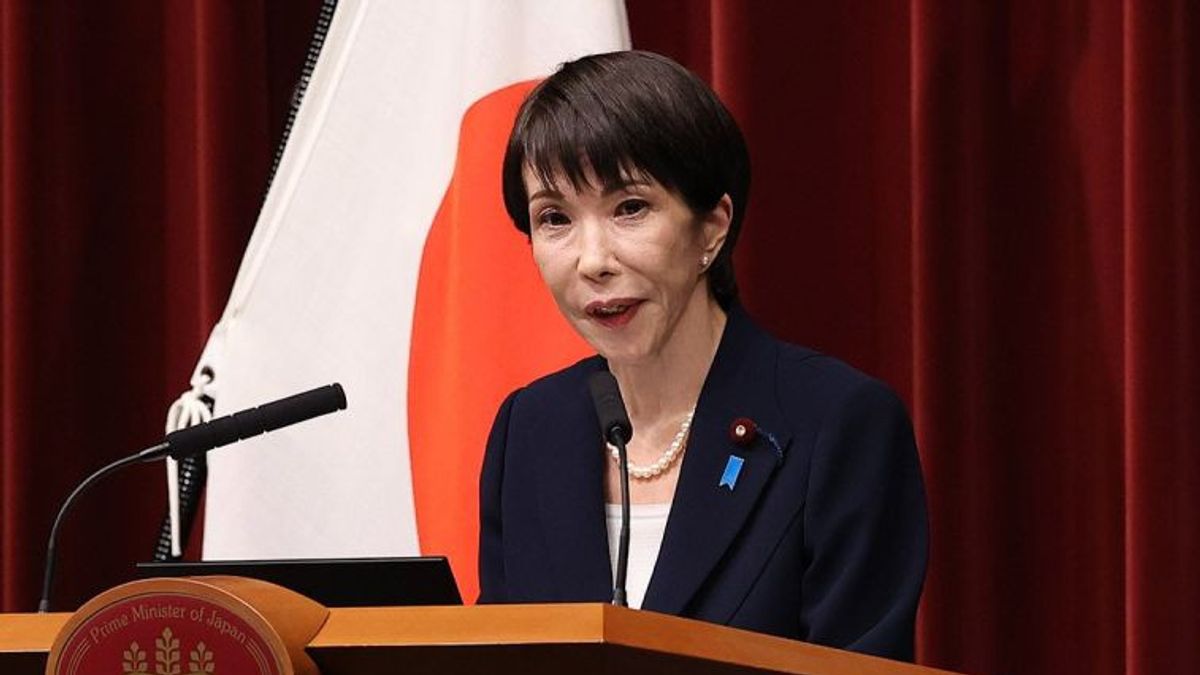


Japanese Prime Minister Sanae Takaichi said Tokyo would make "every possible diplomatic effort" to ease tensions around the Strait of Hormuz amid the US-Israeli war with Iran.
"We will continue to work with the international community and will make every possible diplomatic effort," Takaichi told parliament, according to Tokyo-based Kyodo News, as reported by Anadolu, Monday, March 23.
The statement was made after his summit meeting with US President Donald Trump in Washington last week.
Trump has demanded that Japan deploy naval forces to join US military operations to open the Strait of Hormuz, which is under the effective control of Iran.
Nearly 90 percent of Japan's energy supply passes through this vital waterway, and Japanese vessels remain affected, and Tokyo has begun releasing its strategic oil reserves to meet domestic demand.
During his summit with the US president, Takaichi told lawmakers Trump said "ensuring the security of the Strait of Hormuz is very important" and asked for contributions from Japan and other countries related to navigation safety.
"I replied by saying that I was also aware of ensuring navigation safety from the perspective of a stable energy supply and explained in detail what can and cannot be done within the scope of our country's laws," Takaichi said, according to public broadcaster NHK.
Japan's pacifist constitution does not allow it to join combat overseas.
Separately, Kyodo News reported that Tokyo "is considering buying" crude oil from Kazakhstan.
Japanese state-backed oil and gas exploration company Inpex Corp., which holds crude oil rights in Kazakhstan, "may shift some to Japan," the report said.
"However, the transportation of crude oil from Kazakhstan to Japan is likely to take longer due to the longer distance, and the cost of procurement may also be relatively higher," according to the report.
The report said Inpex "is also considering doing business with Azerbaijan and Australia, where they also hold rights to crude oil and natural gas."
Regional escalation in the Middle East has continued to escalate since the joint US-Israeli attack on Iran on February 28, which has so far killed more than 1,300 people, including Iran's then-supreme leader, Ali Khamenei.
Iran retaliated with drone and missile attacks targeting Israel, along with Jordan, Iraq, and Gulf states hosting US military assets, causing casualties and infrastructure damage as well as disrupting global markets and flights.
Tehran has also imposed controls on the Strait of Hormuz, a waterway vital for global energy and other supplies to much of Asia.
The English, Chinese, Japanese, Arabic, and French versions are automatically generated by the AI. So there may still be inaccuracies in translating, please always see Indonesian as our main language. (system supported by DigitalSiber.id)
Most Popular Tags
#Prabowo Subianto #donald trump #firearm #8791 #giias 2026Popular


