

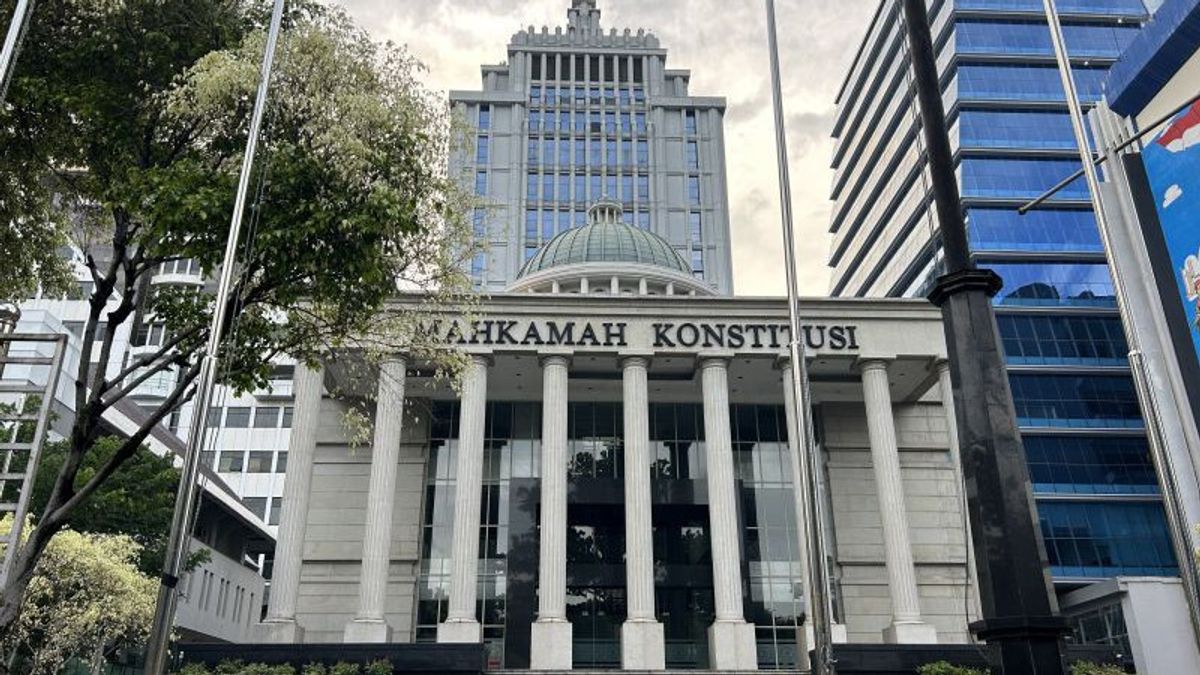


JAKARTA - The Constitutional Court (MK) rejected the application of Roy Suryo Notodiprojo and friends (et al) for testing the Criminal Code (KUHP) and Law Number 11 of 2008 concerning Information and Electronic Transactions (ITE) because the petitum was unclear.
The decision on Roy Suryo et al's petition with case number 50/PUU-XXIV/2026 was read by the Chairman of the Constitutional Court Suhartoyo together with two other cases, namely Number 47/PUU-XXIV/2026 and Number 56/PUU-XXIV/2026 because they have the same essence, especially the same order.
"To judge, declare the applications for Number 47/PUU-XXIV/2026, Number 50/PUU-XXIV/2026 and Number 56/PUU-XXIV/2026 inadmissible," said Chief Justice Suhartoyo as reported by ANTARA.
In the legal consideration, the Chairman of the Constitutional Court, Suhartoyo, explained that the main request (petitum) from number 2 to number 6 requested by the applicants, the Court did not find an explanation in the reason for the request (posita) section explaining why the applicants requested the norms in question were only excluded for academics, researchers or activists.
Meanwhile, for other legal subjects that are within the scope of the a quo norms, said the Chief Justice, they are not excluded or still in force.
Thus, the interpretation requested in the petitum of numbers 2 to 6 is indeed specifically requested only for the benefit of the applicants.
In fact, said Suhartoyo, if the norms in question are interpreted as requested by the applicants. Its interpretation will apply in general (erga omnes).
In addition, there is no argument related to the constitutional issue of the norm that is requested for testing that explains why the norm is problematic for academics, researchers or activists.
In addition, continued the Chairman of the Constitutional Court, the petitum numbers 7 to petitum number 9 which request that certain norms be linked to other norms using the word "juncto" is stated to be contrary to the 1945 NRI Law and does not have the binding force of conditional law.
"According to the Court, it is a petitum besides being unusual and also cannot understand its meaning and purpose in this case whether the applicants want to test the two norms that are connected," said the judge.
If that is what the applicants want, said Suhartoyo, it should be formulated in a separate petitum, as is the case with petitum number 2 to petitum number 6 which mentions one norm that the examiner is asking for in one petitum.
"In the context of the a quo petition, the formulation of the petitum model from number 7 to number 9 poses its own difficulties for the Court to understand the actual meaning of the applicants' request," said the Chief Justice.
It is known that Roy Suryo, Tifauzia Tyassuma, and Rismon Hasiholan tested the Criminal Code and Law Number 11 of 2008 concerning ITE to the Constitutional Court because they felt criminalized.
They feel criminalized because they were named as suspects in connection with research related to the degree of former President Joko Widodo (Jokowi). The three of them are currently in the status of suspects for defamation at the Polda Metro Jaya.
The articles tested by Roy Suryo et al. are Article 310 paragraph (1) and Article 311 paragraph (1) of the old Criminal Code, Article 433 paragraph (1) and Article 434 paragraph (1) of the new Criminal Code, as well as Article 27A, Article 28 paragraph (2), Article 32 paragraph (1) and paragraph (2) and Article 35 of the ITE Law.
The English, Chinese, Japanese, Arabic, and French versions are automatically generated by the AI. So there may still be inaccuracies in translating, please always see Indonesian as our main language. (system supported by DigitalSiber.id)
Popular


