

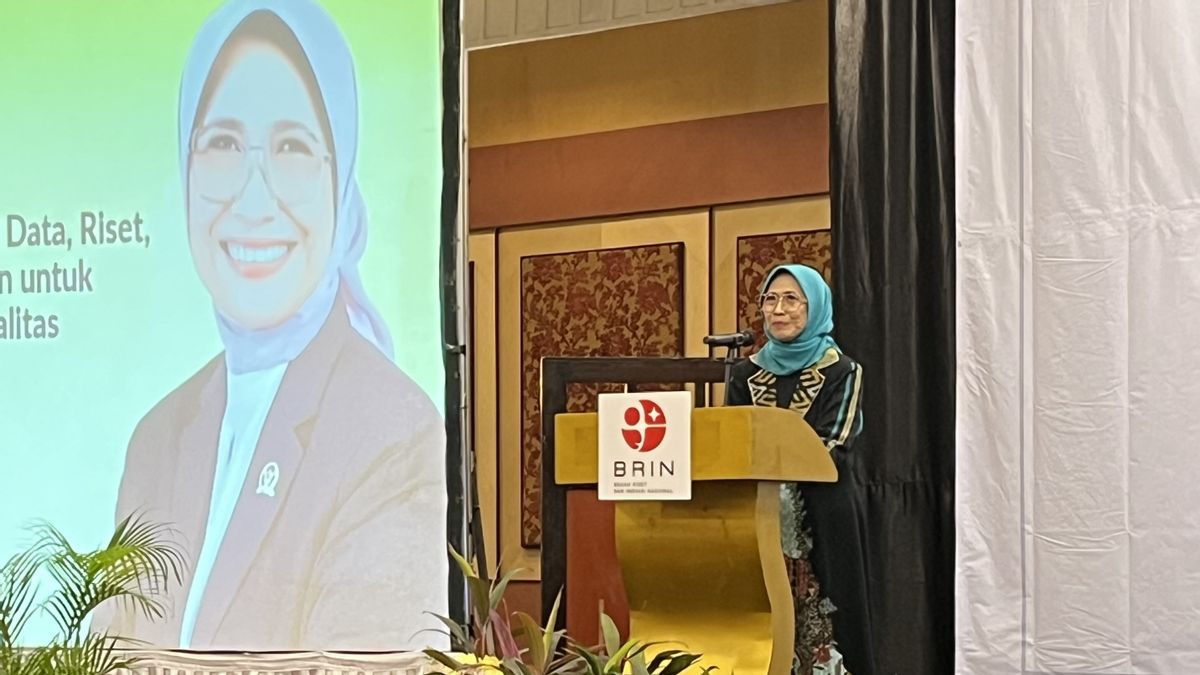


JAKARTA - House of Representatives Commission X Chairman Hetifah Sjaifudian encourages data-based journalism and artificial intelligence (AI) in the midst of the rapid flow of information and the development of artificial intelligence technology. He assessed that journalism is required to be more adaptive by utilizing data, scientific research, and digital technology without abandoning the basic principles of accurate, balanced, and reliable reporting.
This was conveyed by Hetifah in a discussion entitled "Smart Journalism: Integration of Data, Research, and Artificial Intelligence for Quality Reporting" at the Grand Ballroom Lobby of the Mega Anggrek Hotel, Jakarta, Sunday, March 15.
According to him, digital transformation has fundamentally changed the landscape of the media industry. He said, the integration between journalism, research, and artificial intelligence is an important need for the media to continue to be able to present quality information to the public.
Hetifah assessed that the use of technology should be positioned as a tool to strengthen journalistic work, not to replace the critical and ethical roles that are the foundation of the journalist profession. In addition, he also emphasized that artificial intelligence (AI) should not be seen as a substitute for journalists, but as a copilot that helps facilitate journalistic work.
"In the era of information flooding like now, the quality of reporting is very decisive. Therefore, collaboration between journalists, researchers, and data experts is important so that the information conveyed to the public is not only fast, but also based on strong data and research," said Hetifah.
Hetifah said that AI technology can be used to support the data processing process, initial research, to the analysis of information more quickly and efficiently. However, he emphasized that AI cannot replace the main role of journalists because journalistic work still requires editorial judgment, sensitivity to social context, fact verification in the field, as well as integrity and ethics of the profession that cannot be replicated by machines.
The Golkar legislator from the East Kalimantan District also assessed that research institutions have a strategic role in supporting data-based journalism. Hetifah hopes that collaboration between the research world and the media can enrich the perspective of reporting while increasing public literacy on strategic national issues.
This discussion also featured speakers from among researchers and statistical experts, namely Hanif Fakhrurroja, Research Associate at the National Research and Innovation Agency, and Setia Pramana, Director of Statistical Methodology and Data Science at the Central Statistics Agency. The two discussed the importance of using data, statistical methodology, and artificial intelligence technology to strengthen the quality of analysis and media reporting.
In their presentation, the speakers highlighted that future journalism will increasingly depend on the ability to accurately process data and utilize AI technology to support the information analysis process. However, journalistic integrity remains the main factor so that technology is not misused in news production.
Hetifah explained that this discussion activity also became a space for dialogue between the media, research, and policy makers to strengthen a healthy and quality public information ecosystem.
"The media has a strategic role in building public literacy. Therefore, we need to ensure that the development of digital technology actually strengthens the quality of democracy through accurate, data-based, and public interest-oriented reporting," he explained.
The English, Chinese, Japanese, Arabic, and French versions are automatically generated by the AI. So there may still be inaccuracies in translating, please always see Indonesian as our main language. (system supported by DigitalSiber.id)
Popular


