

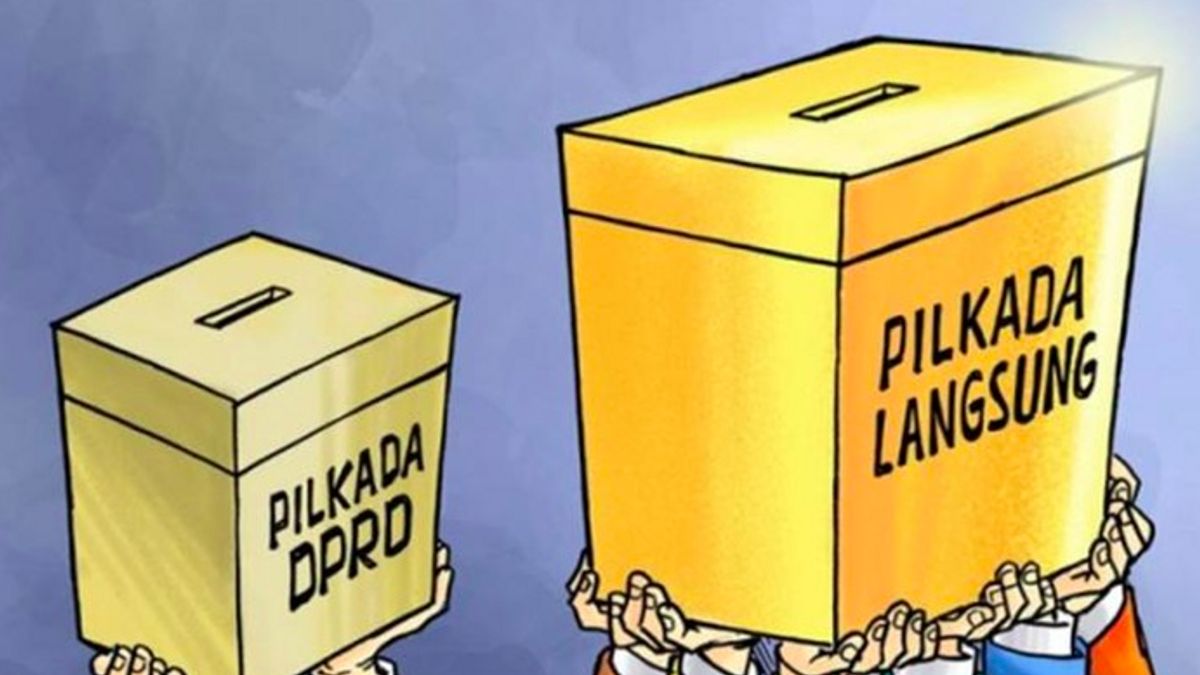


JAKARTA - The Executive Director of Aljabar Strategic Indonesia, Arifki Chaniago, said that the wave of hand-catching operations (OTT) of the Corruption Eradication Commission (KPK) could be a gateway to redesign the system for the election of regional heads (pilkada) in Indonesia.
Because, the prevalence of OTTs of a number of regional heads has re-emerged in the debate regarding the high cost of politics, which is considered as one of the factors that drive the occurrence of corruption practices at the regional level.
According to Arifki, the recurring OTT phenomenon shows that the problem of corruption of regional heads cannot be separated from the high political cost structure in the election, where regional head candidates often have to spend large amounts of money from the nomination process to the campaign.
"Expensive political costs create pressure for regional heads after being elected. It is not uncommon for there to be an urge to return the political costs through abuse of authority," he said, Sunday, March 15.
Therefore, Arifki considered it reasonable for political and academic elites to start thinking about the design of the election, whether it is still through direct elections by the people or returned through the DPRD as it was previously implemented.
"When the issue of political costs and corruption of regional heads is back on the rise, usually the discourse on changing the pilkada system also arises. The discussion revolves around two options, improving the direct pilkada mechanism or reconsidering the model of election through the DPRD," he added.
However, he reminded that the change in the regional election system should not be solely driven by a reaction to the prevalence of corruption cases. The reason is that the evaluation of the system must be carried out comprehensively so as not to weaken the quality of local democracy.
"The issue of corruption of regional heads is not only about the election system, but also related to the transparency of political funding, party kaderization, and the mechanism for monitoring power in the region," said Arifki.
He stated that the current developing discourse could be an early signal that discussions on the design of the regional election could potentially reappear in the future legislative agenda. However, he emphasized that changes to the system must consider the balance between political efficiency and the quality of democratic representation at the local level. "If this discourse continues to develop among political elites and academics, it is not impossible that the issue of revising the regional election regulation will again be included in the agenda for discussion in the DPR," concluded Arifki.
The English, Chinese, Japanese, Arabic, and French versions are automatically generated by the AI. So there may still be inaccuracies in translating, please always see Indonesian as our main language. (system supported by DigitalSiber.id)


