
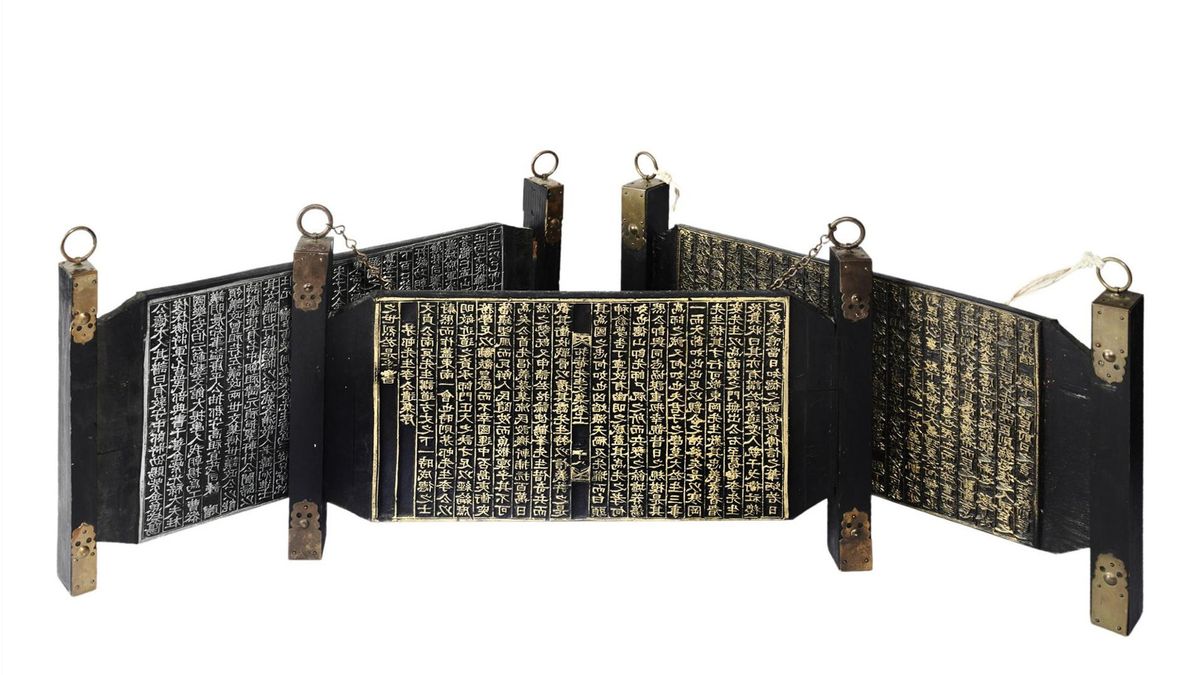


JAKARTA - Three sets of historic wood-block prints, carved between the early 19th century and the early 20th century and then brought to the United States through private hands, have returned to South Korea.
The beams, which were once used to print a literary collection dedicated to the main figures of the late Joseon Dynasty (1392-1910), were donated to the Korea Heritage Service (KHS) and the Overseas Korean Cultural Heritage Foundation (OKCHF) last month.
The three sets were taken abroad in the early 1970s by Americans stationed in the Land of Ginseng and brought home as souvenirs.
Treated as merchandise rather than cultural artifacts, the wooden beams were physically altered to increase their decorative appeal, ornate metal fittings and handles were added so that they could be mounted on the wall and the surface of the carving was painted gold and silver.
This modification occurred before Korea had a Law on the Protection of Cultural Heritage to regulate the export of heritage items. According to both institutions, their history traces a broader trend from that period, when many lost or stolen artifacts were repackaged as merchandise and secretly removed from the country, reported by The Korea Times (10/3).
Believing that there are still similar cases that have not been revealed, KHS and OKCHF plan to continue follow-up efforts in the US to find related materials and encourage their return.
One of the works found was "Beonamjip," which was carved in 1824. The collection contains poems and prose works by Chae Je-gong (1720-1799), an 18th-century scholar-official at the Joseon palace.
In 2015, the work was added to the UNESCO Memory of the World Register as part of a documentary heritage collectively called "Woodblock Prints of Confucianism in Korea."
The printing plate was originally obtained from a South Korean antique dealer and brought to the US, where it was given as a gift to Kim Eun-hye's family. Kim, the current owner, donated it on this occasion.
The other group comes from "Cheokamjip," which was carved in 1917. The text collects the writings of Kim Do-hwa (1825-1912), a civilian leader of the Andong-based guerrilla force during the anti-Japanese uprising of 1895. Like "Beonamjip," this work is also listed on the World Memory Register with the same designation.
The "Cheokamjip" blocks were purchased in the early 1970s by Alan Gordon, who was then working at the South Korean office of the United States Agency for International Development (USAID).
After he died, his wife Tamra Gordon, kept the artifact and last year contacted the Smithsonian's National Museum of Asian Art about a possible donation. The collection was eventually returned to Korea through KHS and OKCHF.
The last collection, "Songja Daejeon," contains the writings of the leading Confucian scholar Song Si-yeol (1607-1689). First published in 1787, the original edition was completely destroyed by Japanese forces in the early 20th century before being re-engraved in 1926.
These slabs were also obtained by Alan Gordon and then passed on to his sister, Alicia Gordon, before being included in this donation.
The English, Chinese, Japanese, Arabic, and French versions are automatically generated by the AI. So there may still be inaccuracies in translating, please always see Indonesian as our main language. (system supported by DigitalSiber.id)


