

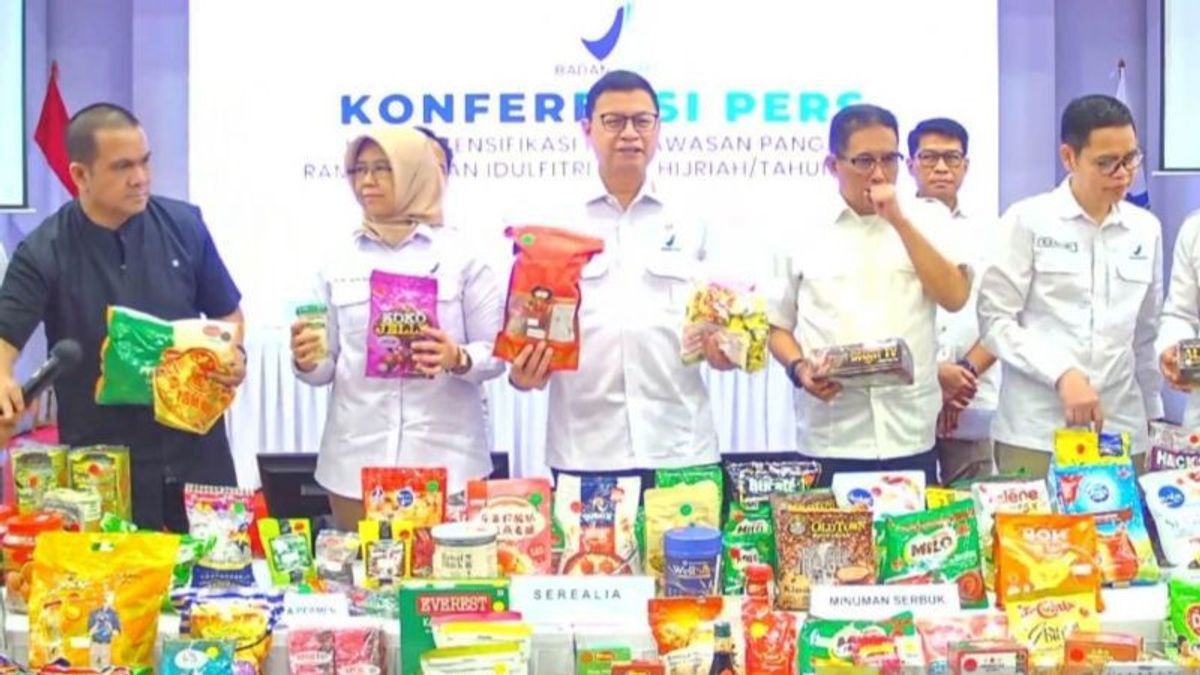


JAKARTA - A total of 56,027 processed food products were withdrawn from circulation in various regions ahead of Ramadan and Eid al-Fitr 1447 Hijriah. The withdrawal was carried out after various violations were found in the intensification of supervision carried out by the Food and Drug Supervisory Agency (BPOM).
Head of BPOM Taruna Ikrar said that tens of thousands of products did not meet the provisions, ranging from not having a distribution permit, expired, to being damaged.
"This supervision is part of the intensification carried out to anticipate the increase in consumption of processed food during the month of Ramadan until Eid al-Fitr," said Taruna at a press conference in Jakarta, Antara, Wednesday, March 11.
He detailed that the findings consisted of 27,407 products without distribution permits, 23,776 expired products, and 4,844 products in damaged condition.
For products without distribution permits, the largest findings were in Palembang, South Sumatra, with a total of 10,848 products or about 39 percent of the total findings.
In addition, the findings were also recorded in a number of other areas, such as Batam with 2,653 products, Palopo in South Sulawesi with 2,756 products, Sanggau in West Kalimantan with 1,654 products, and Tarakan with 1,305 products.
In this intensification activity, BPOM involved 76 Technical Implementation Units (UPT) which carried out simultaneous supervision throughout Indonesia.
Until the third phase on March 5, 2026, BPOM has examined 1,134 processed food circulation facilities spread across 38 provinces.
Most of the facilities inspected were modern retail with a share of 50.2 percent, followed by traditional retail at 32.5 percent, distributor warehouses at 16.6 percent, importer warehouses at 0.6 percent, and e-commerce warehouses at 0.1 percent.
Of the total facilities inspected, 739 facilities or 62.2 percent were found to meet the provisions. Meanwhile, 395 facilities or 34.8 percent did not meet the provisions.
Taruna explained that the high number of findings of products without distribution permits was triggered by the high demand from consumers which encouraged the entry of products from illegal channels.
"As an island nation, we have many border routes that are difficult to fully monitor. Unofficial routes or rat routes are often used to enter illegal products," he said.
According to him, the withdrawal of tens of thousands of food products is important to protect the public from health risks.
If food products that do not meet these provisions continue to circulate and are consumed, it has the potential to cause health disorders to food poisoning.
The English, Chinese, Japanese, Arabic, and French versions are automatically generated by the AI. So there may still be inaccuracies in translating, please always see Indonesian as our main language. (system supported by DigitalSiber.id)


