
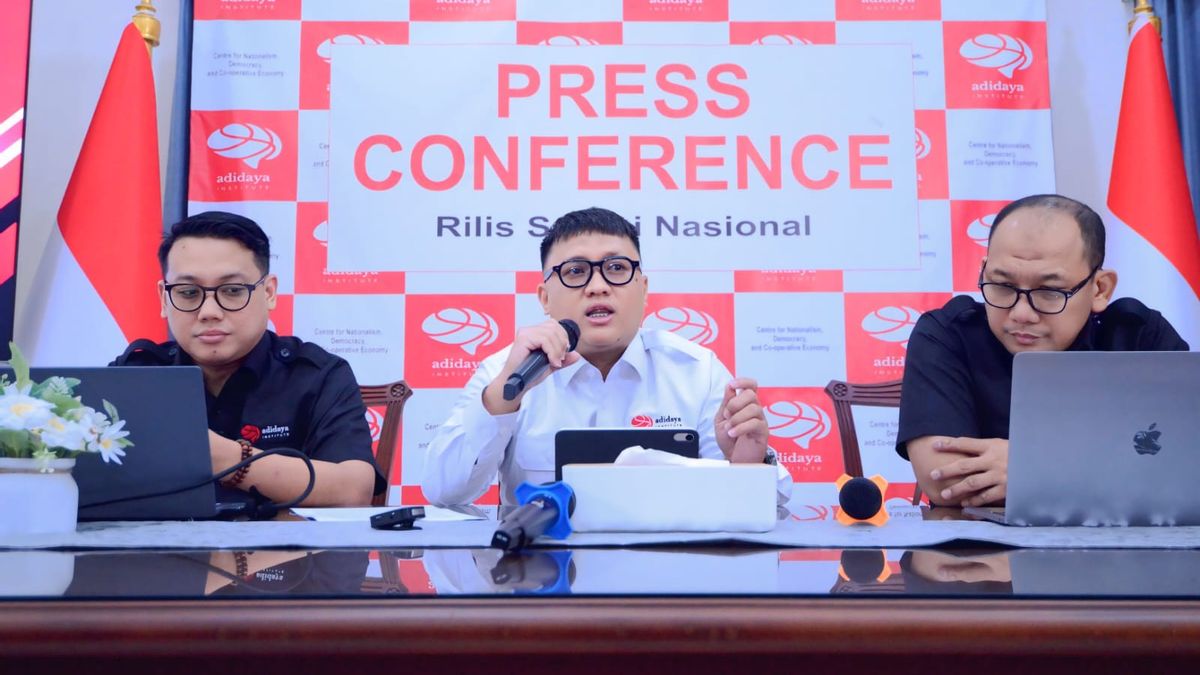


JAKARTA - Adidaya Institute assesses the escalation of the conflict between Iran and the United States and Israel alliances, marking a significant change in the Middle East geopolitical dynamics. According to Adidaya Institute, this conflict is no longer merely a regional security episode, but has the potential to be a catalyst for a broader shift in the global power configuration. Starting from energy stability, international trade routes, to the balance of power in the multipolar system that is being formed.
"For Indonesia, this dynamic has strategic implications that go far beyond the Middle East region," said Adidaya Institute Economist Bramastyo B Prastowo in a statement to the media, Monday.
Referring to the results of the Adidaya survey conducted to 72 national experts, the issue of a Free Palestine indeed has the highest strategic weight, around 23 percent. Thus, the issue of a Free Palestine is indeed a source of moral and political legitimacy for the Prabowo Gibran government to determine its position in the international escalation.
"The results of the analysis show that the issue of a Free Palestine has the highest strategic weight, about 23 percent, which places it as the main Anchor in the strategic policy structure of President Prabowo Subianto. This finding has important geopolitical implications. Palestine is not only an issue of humanitarian solidarity, but a source of normative legitimacy that determines the credibility of Indonesia's position in the international system," he explained.
However, the Adidaya Institute assesses that Indonesia does have a unique opportunity to play a role as a swing state of global diplomacy. As a country with an anti-colonial history, a free and active foreign policy tradition, and a relatively balanced relationship with various global power blocs, Indonesia has the space to become a balancing actor in the international architecture of peace.
In this context, one of the most controversial issues is Indonesia's involvement in the Board of Peace (BoP) diplomacy configuration. A number of community members and policy observers have submitted input and criticism regarding the strategic benefits of the BoP configuration for Indonesia's national interests.
"The government's decision to remain in the BoP should be understood as a strategic step, not just a short-term political choice. This participation is in line with the mandate of the 1945 Constitution which states that Indonesia must actively play a role in creating world order. However, the Adidaya Institute also notes that the escalation of attacks by Israel and the United States against Iran has the potential to lower the level of international confidence in the effectiveness of the BoP architecture in building peace and reconstruction of Palestine," said Bram.
Therefore, the Adidaya Institute considers that the government does need to calibrate or calculate geopolitics quickly for each strategic configuration that affects Indonesia's interests. If in the evaluation process the government considers it necessary to adjust Indonesia's position in the BoP configuration, then this step needs to be carried out in a measured manner while maintaining a constructive diplomatic relationship with the United States.
"The government certainly does not need to rush to take steps out of (BoP). In the midst of an increasingly uncertain global geopolitical situation, a calm, rational, and strategic attitude is needed. Indonesia's presence in the BoP must be seen as a diplomatic opportunity that can be used to fight for humanitarian interests and world peace," he said.
Bram explained that for decades, the discourse on sending peacekeepers to Gaza has always been hit by various international political obstacles. However, through the BoP mechanism, for the first time a more realistic opportunity has opened up for Indonesia to participate directly in peace missions in the region.
On the other hand, if confidence in the BoP weakens due to the escalation of the conflict played by America and Israel, then the decision to calibrate the membership decision in the BoP. Of course, the decision must still be carried out in a measured manner by considering Indonesia's relationship with the United States which has a broad strategic dimension. Including in the fields of trade, investment, technology, and domestic economic stability.
"If confidence in the Board of Peace continues to weaken due to the escalation of the conflict, then the government needs to make a strategic calibration. But the calibration must still maintain a positive diplomatic relationship with the United States because Indonesia's geoeconomic interests are also large."
In the context of the current escalation of the Middle East conflict, the Adidaya Institute considers that Indonesia's position should be directed at three strategic steps. First, maintain the consistency of Palestinian Independence as an Anchor of Indonesian diplomatic legitimacy, so that moral position and international credibility are maintained.
Second, take an active role in the diplomacy of de-escalating conflicts, by utilizing Indonesia's position as a non-bloc country that has constructive relations with various parties. Third or last, conduct a strategic evaluation of the configuration of global diplomacy, including the effectiveness of various peace initiatives that are currently developing.
Previously, in a survey of experts conducted by the Adidaya Institute in December 2025 to February 2026, there was a finding that 23.30 percent of experts considered the program to support a free Palestine as an anchor program. Then 43 percent of experts assessed the fishing village program, KDKMP, and 3 Million Houses as an engine (engine) of economic growth. Furthermore, other programs such as People's Schools, Free Health Checks, Food Storage and Free Nutritious Meals (MBG) fall within the framework of social stabilization programs alias stabilizers.
The Adidaya Institute survey was conducted in 12 major cities in Indonesia (Medan, Bandar Lampung, Jakarta, Bandung, Yogyakarta, Surabaya, Denpasar, Samarinda, Banjarmasin, Makassar, Manado and Ternate). The survey involved 72 expert respondents with backgrounds in various professions including academics (22 people), legislators (12 people), bureaucrats (14 people), business actors (13 people), health workers (7 people) and activists (4 people). The survey was also conducted using the analyctical hierarchy process method and in-depth interviews along with the agenda of focus group discussion (FGD).
The English, Chinese, Japanese, Arabic, and French versions are automatically generated by the AI. So there may still be inaccuracies in translating, please always see Indonesian as our main language. (system supported by DigitalSiber.id)


