

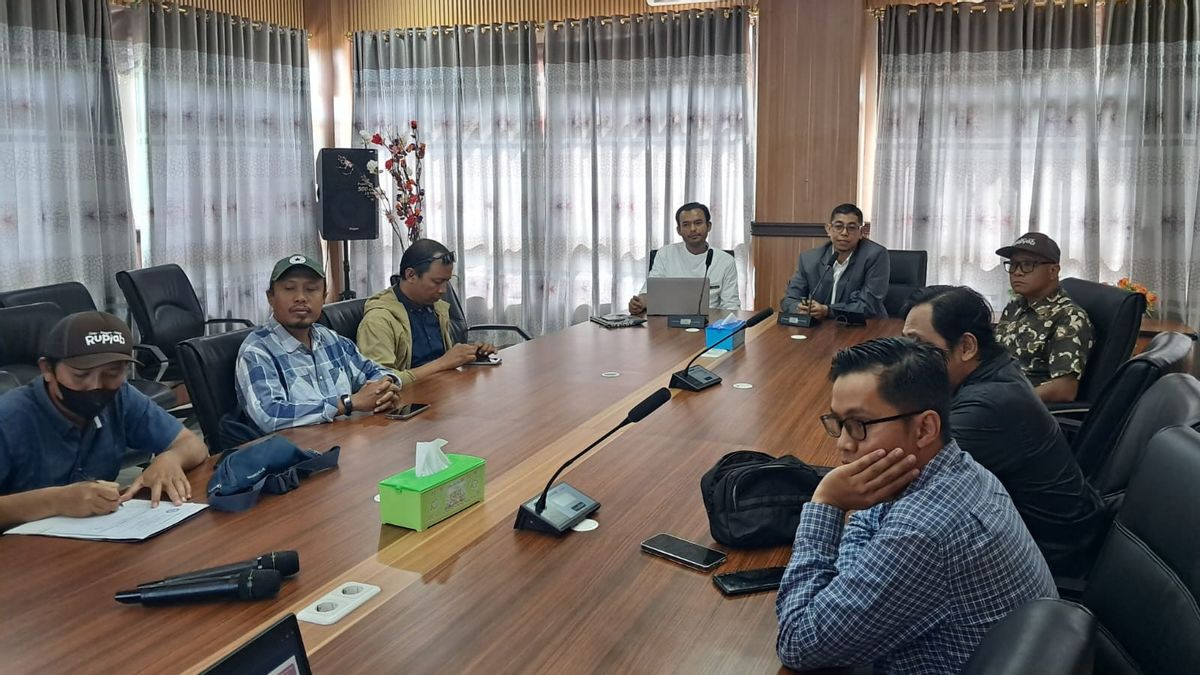


TARAKAN - The Rector of Tarakan Borneo University, North Kalimantan (Kaltara), Yahya Ahmad Zein, assessed that the concerns of some members of the press regarding the implementation of the new Criminal Code (KUHP) did not need to be over-reacted to.
According to him, the regulation can actually clarify the boundaries between professional journalistic products and content circulating on social media.
This was conveyed by Prof. Yahya when discussing with reporters in the rector's office meeting room of the UBT Rectorate, in Tarakan, North Kalimantan, Monday, March 9.
He emphasized that journalistic activities still have special legal protection through the Press Law. Therefore, any legal issues arising from journalistic products should first be resolved through the mechanisms regulated in the Press Law.
"The Press Law is a lex specialis. If there is a legal problem that originates from journalistic products, then the solution in principle must be through the mechanism of the Press Law, not directly referring to the Criminal Code," said Yahya.
He explained that legally, the press has protection that individuals who produce and disseminate content freely on social media do not have. The principle of lex specialis derogat legi generalis places the Press Law as a special rule that regulates journalistic activities.
"The presence of the new Criminal Code can actually be a momentum to clarify the difference between journalistic works produced through a professional process and content produced without an editorial mechanism," he explained.
Yahya revealed that legal protection for journalists only applies if the work is produced through a correct journalistic process, starting from the collection of information, fact verification, to publication to the public.
"This Criminal Code will actually show a contrasting difference in the public space, which is really a journalistic product and which is not," he said.
He added, if a content is not produced through a legitimate journalistic mechanism, then the content is outside the protection of the Press Law and can immediately be subject to criminal provisions in the Criminal Code.
"Later there will be a number of sensitive articles in the new Criminal Code, such as articles on insulting state institutions and spreading false news, but the regulation will not limit the scope of the press as long as journalists work professionally and based on facts," said Rector Yahya.
He also appealed to media practitioners to continue to maintain journalistic work standards and make the Press Council a reference in maintaining the quality and integrity of reporting.
"As long as the press friends adhere to the code of ethics, there is nothing to worry about. Professionalism is the best fortress in facing the existing legal dynamics," he concluded.
The English, Chinese, Japanese, Arabic, and French versions are automatically generated by the AI. So there may still be inaccuracies in translating, please always see Indonesian as our main language. (system supported by DigitalSiber.id)
Most Popular Tags
#Prabowo Subianto #donald trump #Febrie Adriansyah #8791 #giias 2026Popular


