

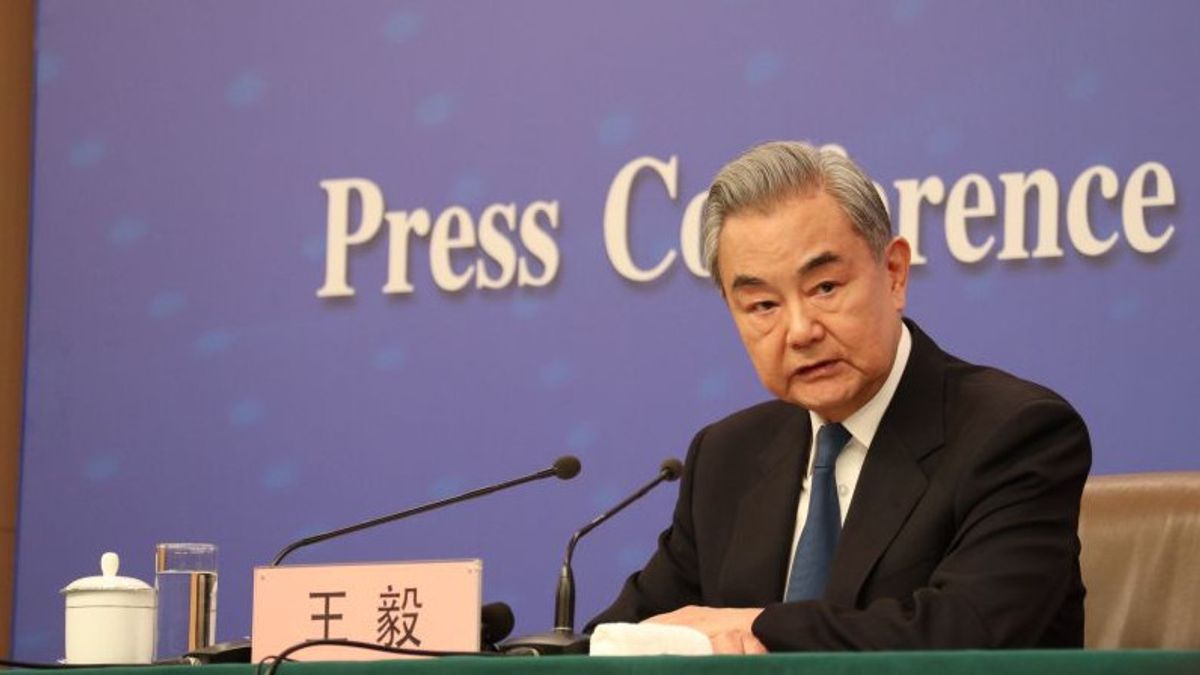


JAKARTA - Chinese Foreign Minister Wang Yi said the direction of China-Japan relations in the future depends on the attitude of the government of Prime Minister Sanae Takaichi.
"Where the direction of China-Japan relations will move depends on the choice of the Japanese side," Foreign Minister Wang Yi said at a press conference on "China's foreign policy and foreign relations" in Beijing, quoted by Antara, Sunday, March 8.
In 2025, Wang Yi said it was the 80th anniversary of the victory of the "Chinese People's War of Resistance against Japanese Aggression" which should be a time for Japan to reflect on the bad record of invasion and colonization of China, including Taiwan.
However, the current Japanese leader, said Wang Yi, actually stated that if something happened in Taiwan, it would be a 'survival crisis situation' for Japan, and on that basis Japan could exercise what is called the collective self-defense right even though the right to self-defense must be based on the prerequisite that the country itself has experienced an armed attack.
"I want to ask, Taiwan's affairs are China's internal affairs, with what right does Japan interfere? If something happens in China's Taiwan region, with what authority can Japan exercise the right of self-defense? Does the so-called collective self-defense right mean to replace the peaceful constitution that stipulates the rejection of the right to war?" said Wang Yi.
"If it is linked to the fact that Japan's militarism in the past has used the excuse of 'survival crisis situations' to launch overseas aggression, then it is impossible for the Chinese people and the people of various Asian countries not to feel very alert and anxious," he said.
"Where is Japan going?" asked Wang Yi.
Wang Yi also hopes that the Japanese people can open their eyes clearly and not let anyone act recklessly today and repeat the mistakes of the past.
"China, which has developed and strengthened, and 1.4 billion Chinese people will also never allow anyone to justify colonialism or reverse the verdict on aggression," said Wang Yi.
In addition, Wang Yi also said that Taiwan has always been China's territory.
"In the past, present, and future, Taiwan is absolutely not possible to become a country. The return of Taiwan to China is the result of the victory of the Chinese People's War of Resistance against Japanese aggression, and also the fruit of the victory of World War II," said Wang Yi.
This means that any effort to create "Two Chinas" or "One China, one Taiwan", said Wang Yi on the international arena will definitely fail.
"The Democratic Progressive Party stubbornly adheres to the separatist position of 'Taiwan independence' and is a source of chaos that undermines peace and stability in the Taiwan Strait," Wang Yi said.
"Facts have repeatedly proved that the more clear the international community's stance against separatist 'independence of Taiwan'," Wang said.
The more firm the attitude of upholding the principle of one China, the more peace and stability in the Taiwan Strait will be ensured, he said, adding.
"The Taiwan issue is China's internal affairs and is the core of China's core interests. This red line must not be crossed or trampled on. We will never allow anyone or any power to separate Taiwan, which has been restored for more than 80 years, from China," said Wang Yi.
The Chinese Foreign Minister said the historical process to resolve the Taiwan issue and realize the full reunification of the Chinese homeland cannot be stopped.
"Whoever follows the current will be prosperous, whoever fights against it will perish," said Wang Yi.
Previously on November 7, 2025, Japanese Prime Minister Sanae Takaichi said China's use of military force against Taiwan could "create a situation that threatens Japan's survival".
His statement still raises tensions in China-Japan relations because it is understood that the Japanese government allows the Self-Defense Forces to act in support of Taiwan if China imposes a maritime blockade on Taiwan or other forms of pressure.
In response to Takaichi's statement, China has taken a number of retaliatory actions, including resuming imports of Japanese seafood products, cutting off high-level government meetings, advising its citizens not to travel or study in Japan, stopping the release of Japanese films, and promising to retaliate firmly if Tokyo is involved militarily in Taiwan affairs.
Currently, Taiwan is led by Lai Ching-te of the Democratic Progressive Party (DPP). He is known as a leader who is very persistent in fighting for Taiwan's independence.
Beijing has called him "dangerous" and a member of a "separatist group" that could trigger a cross-strait conflict.
The English, Chinese, Japanese, Arabic, and French versions are automatically generated by the AI. So there may still be inaccuracies in translating, please always see Indonesian as our main language. (system supported by DigitalSiber.id)


