

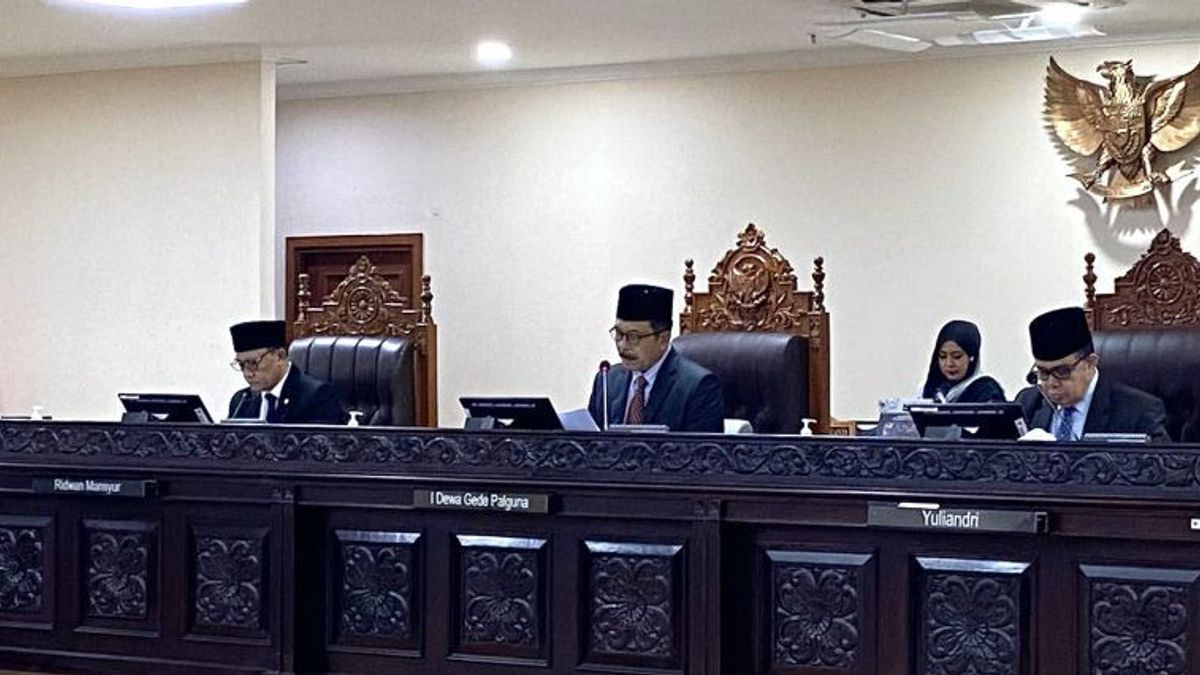


JAKARTA - The Constitutional Court Honor Assembly (MKMK) confirmed the limits of the authority of state inter-institutions that are intertwined in the report of alleged violations of the code of ethics and conduct of Constitutional Judge Adies Kadir.
This was stated by MKMK Member Yuliandri in the legal consideration of the ruling on report number 03/MKMK/L/ARLTP/02/2026 with the Constitutional and Administrative Law Society or CALS as the reporter.
"These restrictions are important in order to respect the existence and authority of each state institution and maintain the independence of each state institution," said Yuliandri at the Constitutional Court Building, Jakarta, Thursday.
Meanwhile, CALS reported Adies Kadir because he suspected that his nomination as a constitutional judge proposed by the DPR RI violated the code of ethics and conduct of constitutional judges as well as laws and regulations.
In its report, CALS reasoned that the nomination of Adies Kadir as a constitutional judge to replace Arief Hidayat was inappropriate because it was carried out after Commission III of the Indonesian House of Representatives chose another candidate, namely Inosentius Samsul.
The MKMK associates the alleged violation with its authority to maintain the honor and dignity of the Constitutional Court. In this regard, the panel felt it necessary to make a firm distinction between the authority of the DPR and the MKMK.
The 1945 Constitution of the Republic of Indonesia and the Constitutional Court Law stipulates that constitutional judges are proposed by the three branches of power, namely the Supreme Court, the DPR, and the President.
Yuliandri said that each state institution authorized to nominate constitutional judges is given the discretion to determine the procedures for selection, election, and submission.
When the state institution has appointed someone to be a constitutional judge, the next procedure is the ratification through a presidential decree. In that context, the MKMK emphasized that it was not authorized to interfere.
"Despite the harsh and harsh criticism of this flawed recruitment mechanism, ... the Honor Assembly not only does not have the authority, but is also unethical to interfere or intervene," said Yuliandri.
"Even the Honorary Assembly, the Constitutional Court does not have the authority to interfere in the procedural stage of the recruitment of constitutional judges," he added.
He further said that in the procedural stages of the election and appointment of a person as a constitutional judge, the Constitutional Court was not involved institutionally. The Constitutional Court is positioned as the party that accepts anyone who has been elected and appointed as a constitutional judge.
Therefore, according to the MKMK, the institutional relationship between state institutions authorized to nominate constitutional judges and the Constitutional Court in the context of filling constitutional judges' positions is not a slice, but only a "point of confusion".
"If in the process of filling the position of constitutional judge, the Constitutional Court, institutionally, does not have a slice of authority with the state institution that is authorized to propose constitutional judges, then so is the authority of the Honor Council," he said.
However, Yuliandri emphasized that this establishment does not mean that MKMK is closing itself off and ignoring the news circulating in the community regarding the election process for Adies Kadir.
For this reason, the MKMK emphasized that the Constitutional Law has in fact given signs to state institutions that are authorized to nominate constitutional judges to pay attention to the principles of transparency and participation in the nomination of constitutional judges.
In its decision, the MKMK stated that it was not authorized to examine, try, and decide on the report of alleged violations of the code of ethics and conduct of Constitutional Judge Adies Kadir submitted by CALS.
In addition, the MKMK also stated that it was not authorized to try the other two reports related to Adies Kadir, namely report number 01/MKMK/L/ARLTP/02/2026 which was reported by lawyer Syamsul Jahidin and report number 02/MKMK/L/ARLTP/02/2026 with the reporter lawyer Edy Rudyanto.
The English, Chinese, Japanese, Arabic, and French versions are automatically generated by the AI. So there may still be inaccuracies in translating, please always see Indonesian as our main language. (system supported by DigitalSiber.id)
Most Popular Tags
#Prabowo Subianto #donald trump #firearm #8791 #giias 2026Popular


