



Member of the House of Representatives from the Gerindra Party Faction, Azis Subekti, also escalated the tension between the United States, Israel, and Iran with the awareness that this is not just a regional conflict.
According to him, air raids, drone and missile retaliation, the expansion of the front to Lebanon, and threats to the Strait of Hormuz show that tensions have moved from the diplomatic room to the open confrontation arena.
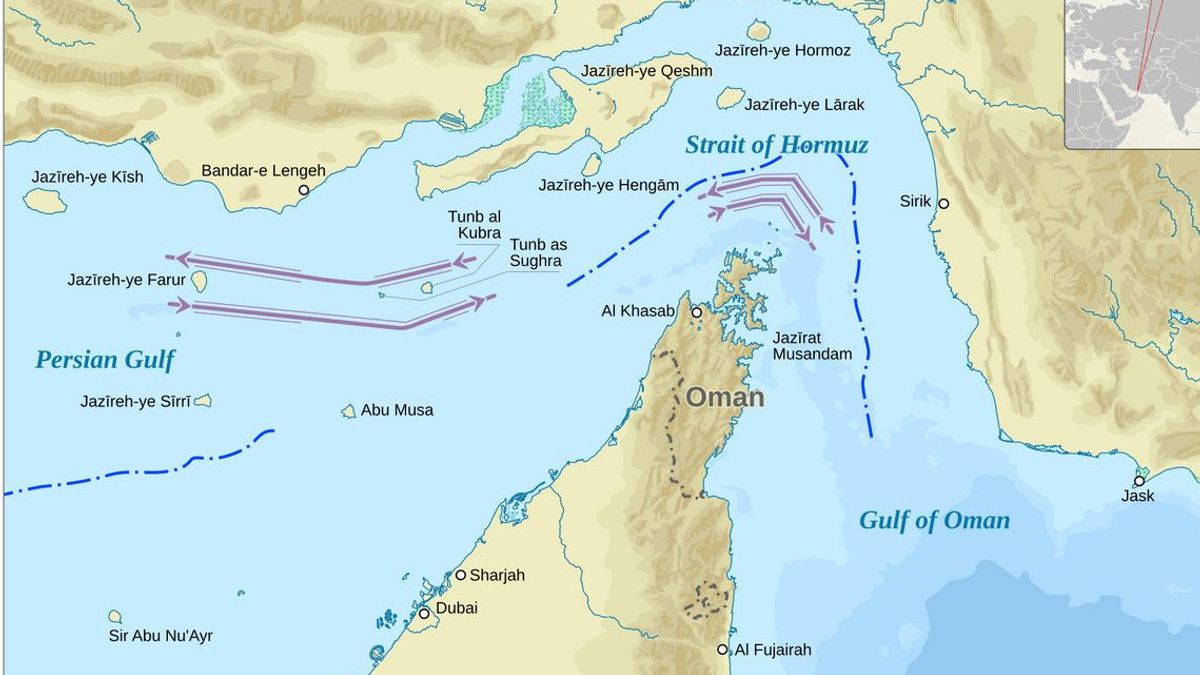
"And when the Strait of Hormuz, the route through which about 20 percent of the world's oil supplies pass, enters the vortex of conflict, the world no longer talks about limited wars. The world talks about systemic risks," Azis said in his statement, Wednesday, March 4.
Azis said the crisis in the Strait of Hormuz was not just about geography, but about global energy arteries. Once this route is disrupted, said Azis, the market reacts quickly, oil prices soar, shipping insurance premiums increase, and global supply chains shake.
"In a matter of days, uncertainty replaces stability. A world that has not fully recovered from previous geopolitical pressures is again faced with the threat of inflation and slowing growth," he said.
The legislator from the Central Java VI constituency assessed that the increase in energy prices was not a standalone event but also spread to transportation costs, industrial production, food prices, to interest rate policies. "Central banks in various countries are forced to recalculate. Investors are holding back expansion. Global growth is potentially slowing down. This conflict comes at a time when the world's economic architecture is indeed experiencing cracks, trade fragmentation, de-risking supply chains, and increasingly open competition between major powers," he explained.
"In this kind of landscape, Indonesia cannot feel far away," Azis added.
According to Azis, as a country that still imports crude oil and a number of strategic energy products, Indonesia is directly exposed to global price spikes. Where the increase in oil prices means that import costs increase, the demand for US dollars rises, the rupiah is at risk of being depressed, and import inflation strengthens.
"The government is also facing a classic but difficult dilemma: maintaining domestic prices through bloated subsidies or adjusting prices at the risk of social pressure and a decline in purchasing power," he said.
Azis assessed that too much subsidy would erode the fiscal space, the space that should support education, health, and social protection. Too sharp price adjustments could weaken domestic consumption, the backbone of national economic growth.
"In the worst-case scenario, if the conflict continues and high energy prices persist for a long time, Indonesia could face simultaneous pressures on the fiscal, exchange rate, and growth. However, reading this crisis as only an economic threat is not enough. This conflict also takes place in the context of a shift in the global order," he said.
"The United States seeks to maintain its strategic influence in the Middle East while facing competition from other powers. Regional countries are rearranging their positions. Energy routes and strategic chokepoints are increasingly becoming geopolitical instruments. The world is moving towards a more fragmented direction," he continued.
In the midst of this dynamic, Azis added, Indonesia has a position that is not small. Indonesia is the largest economy in Southeast Asia, a member of the G20, the largest Muslim country in the world, and a large democracy with a free and active foreign policy tradition. This position gives Indonesia moral legitimacy as well as strategic weight to play a balancing role.
"Therefore, our response must run on two tracks. First, active and substantive diplomacy. Indonesia needs to encourage de-escalation and a ceasefire through international forums, strengthen the voice of the Global South, and affirm the stability of global energy supply is a common interest. Neutrality does not mean passive; it means keeping distance from the power bloc while actively building a space for dialogue," he explained.
"Second, structural strengthening in the country. This crisis must be a momentum to accelerate energy diversification, strengthen strategic reserves, reform subsidies to be more targeted, and encourage renewable energy investment. Energy transition is no longer a long-term agenda that can be postponed; it is a national resilience strategy," continued Azis.
In addition, Azis reminded, fiscal and monetary coordination must also be disciplined. The stability of the rupiah, inflation control, and market confidence are the main support so that external shocks do not turn into a domestic crisis. Social support for vulnerable groups needs to be prepared from the start, not after the pressure is felt widely.
Behind all the calculations, the member of Commission II of the DPR assessed that there was a humanitarian dimension that should not be ignored. Every escalation brings civilian casualties, displacement, and trauma. Global economic stability ultimately is rooted in humanitarian stability. Without it, according to Azis, growth is only a fragile figure.
"The world is now at a crossroads: whether it will continue to sink into fragmentation and pressure politics, or rediscover the courage to strengthen multilateral mechanisms and diplomacy. Indonesia must not be absent in that process. We may not be the main military actors, but we have a voice, legitimacy, and interest to push for a more stable direction," he said.
"The crisis in the Strait of Hormuz may be thousands of kilometers away from the archipelago. But when the global energy line trembles, our kitchen feels the heat. The choices made by world leaders today will determine tomorrow's economic stability. And the choices we make in our country, in diplomacy and in reforming the economic structure, will determine whether Indonesia is merely affected, or able to stand as a strong and moral middle power in an uncertain world," concluded Azis.
The English, Chinese, Japanese, Arabic, and French versions are automatically generated by the AI. So there may still be inaccuracies in translating, please always see Indonesian as our main language. (system supported by DigitalSiber.id)


