
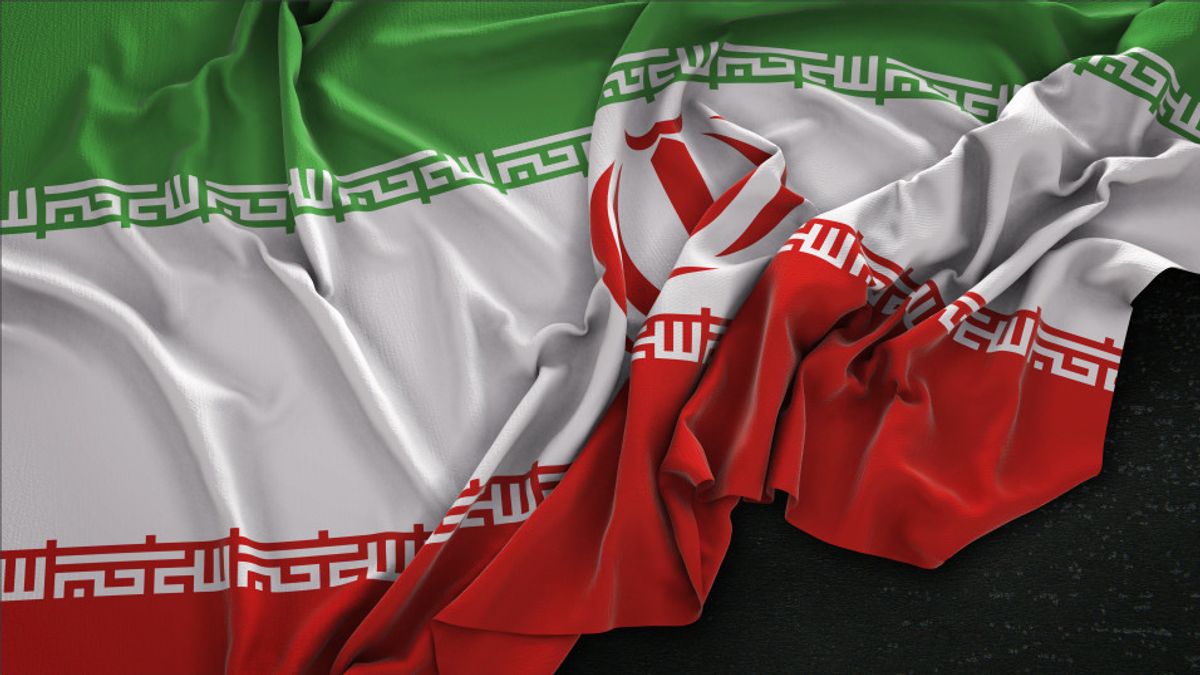


YOGYAKARTA - The attacks of America and Israel on Iran have once again put the Middle East in the center of the world's attention. Many people have become Iran's history, when missiles and drones pass over the sky of Tehran which trigger geopolitical tensions.
For many Westerners, the Persian name is back in vogue. But for its people, the land has always been called Iran. An identity that has its roots long before modern geopolitics took shape.
Reported by VOI from The Daily Star and Grey Art Museum, here are some interesting facts about Iran that you need to know:
Iran's History: From Persia, a Meaningful NameThe Persian term comes from the Greek word Persís, which refers to the Parsa region in southwestern Iran. This region was the center of the Achaemenid Empire founded by Cyrus the Great.
To the classical world, Persia was a symbol of a great empire that stretched from the Indus River to the Aegean Sea. But it was a designation from the outside.
For the Iranian population, they will call the land "Iran" or "Eran", which comes from the word Arya which means "noble nation". The name lives on in inscriptions and royal titles for centuries, including in the Sassanid and Safavid eras.
Only then did the official change take place in 1935. Under the reign of Reza Shah Pahlavi, the government asked the international community to use the name Iran in diplomatic relations. It was not just a change of terminology, but a statement of sovereignty.
Read also the article How will the regime change in Iran after Ali Khamenei is gone?
Modern Iran and the Wounds of Foreign InterventionUnderstanding today's conflict cannot be separated from the history of the 20th century. Iran was once the scene of a struggle for influence between Russia and Britain in the "Great Game". In 1907, the two powers divided the area of influence in Iran.
At home, the people demanded a constitution. The Constitutional Revolution of 1905-1911 gave birth to the first parliament. Hope grew. But foreign intervention again broke that spirit.
In 1925, the Qajar Dynasty collapsed and Reza Shah established the Pahlavi Dynasty. Modernization was carried out. The Trans-Iran train was built, and the University of Tehran was established in 1934.
But power is also centralized.After World War II, his son, Mohammad Reza Pahlavi, ascended the throne. In 1951, Prime Minister Mohammad Mossadeq nationalized Iran's oil industry.
The move was popular domestically. But in 1953, CIA and MI6 covert operations had overthrown him.
For many Iranians, it is a wound of history. Foreign interference again stopped the democratic process.
1979 Revolution and New IdentityThe wave of protests peaked in the late 1970s. Economic inequality, political repression, and dissatisfaction with the monarchy magnified public anger.
In January 1979, the Shah left Iran. A few weeks later, Ruhollah Khomeini returned from exile. The Islamic Republic of Iran was born.
Since then, Iran's relations with the United States and Israel have deteriorated drastically. Economic sanctions, nuclear tensions, and proxy conflicts have characterized the following decades.
2026 Attack: New Chapter of TensionNow, in 2026, an American and Israeli attack on Iran opens a new chapter. The military operation called "Operation Epic Fury" triggers missile and drone responses from Tehran.
Iran's capital, Tehran, is tense. The Middle East region is again on the brink of a large-scale escalation.
Some analysts see this as a continuation of a long-standing geopolitical rivalry. Others see it as a consequence of increasingly complex regional dynamics.
But one thing is clear: Iran is not just a war headline. It is a long civilization that was once called Persia, with a collective memory of foreign intervention, revolution, and sovereignty struggles.
Persia is an integral part of Iran's long history. Iran, not in a name change, but rather an identity that continues to be tested across time to modern conflicts.
The English, Chinese, Japanese, Arabic, and French versions are automatically generated by the AI. So there may still be inaccuracies in translating, please always see Indonesian as our main language. (system supported by DigitalSiber.id)


