
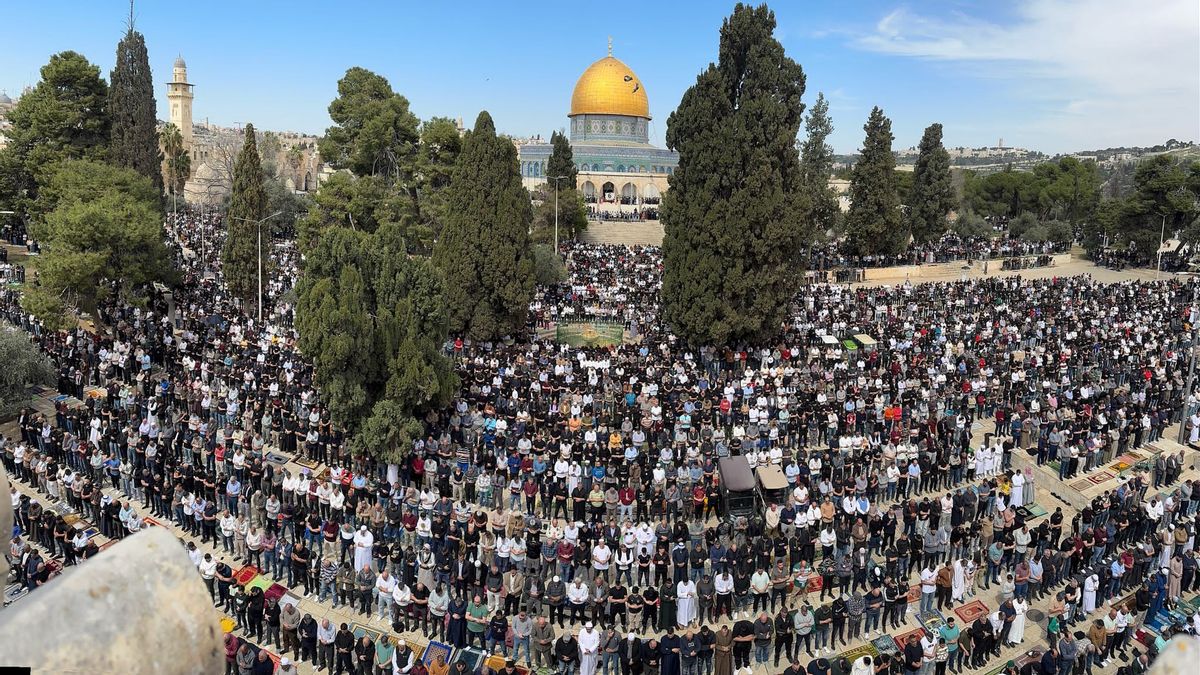


JAKARTA - The Israeli authorities announced plans to limit the number and age of Palestinian worshippers for Friday prayers at the Al-Aqsa Mosque during Ramadan 2026 or 1447 Hijriah.
Israel announced it would limit the number of Palestinian worshippers from the occupied West Bank to perform Friday prayers at the Al-Aqsa Mosque in east Jerusalem to 10,000 during the holy month, which begins on Wednesday local time.
Israeli authorities have also imposed age restrictions on Palestinians in the West Bank, allowing only men over 55, women over 50, and children up to 12 years old to enter.
"Ten thousand Palestinian worshippers will be allowed to enter the Temple Mount for Friday prayers throughout the month of Ramadan, provided they obtain a special daily permit first," COGAT, the Israeli Defense Ministry body responsible for civilian affairs in the Palestinian territories, said in a statement, as reported by Al Arabiya from AFP (18/2).
"The entry permit for men applies to those aged 55 years and above, for women aged 50 years and above, and for children up to 12 years of age if accompanied by a first-degree relative," he explained.
COGAT told AFP that the restrictions only apply to Palestinians traveling from the West Bank, which has been occupied by Israel since the 1967 Arab-Israeli war.
"It is emphasized that all permits depend on the prior security approval of the relevant security authorities," COGAT said.
"In addition, residents who travel to pray at the Temple Mount will be required to undergo digital documentation at the border when returning to the Judea and Samaria region after completing prayers," he said, using the biblical term for the West Bank.
During Ramadan, hundreds of thousands of Palestinians traditionally attend prayers at Al-Aqsa Mosque, the third holiest site in Islam, located in east Jerusalem, which Israel captured in 1967 and later annexed in a move not recognized internationally.
Since the war in Gaza broke out in October 2023, the number of pilgrims present has decreased due to security concerns and Israeli restrictions.
The Palestinian government of Jerusalem said this week that Israeli authorities had prevented the Islamic Waqf - a Jordanian-run body that manages the site - from carrying out routine preparations ahead of Ramadan, including installing shade structures and setting up temporary medical clinics.
A senior imam of the Al-Aqsa Mosque, Sheikh Muhammad al-Abbasi, told AFP that he was also banned from entering the complex.
"I have been banned from entering the mosque for a week, and the ban can be extended," he said.
Abbasi said he was not told the reason for the ban, which took effect Monday.
Under a long-standing agreement, Jews can visit the Al-Aqsa compound - which they revere as the site of the first and second Jewish temples - but they are not allowed to pray there.
Israel says it is committed to maintaining this status quo, although the Palestinians fear it is being eroded.
In recent years, more and more Jewish ultra-nationalists have opposed the ban on prayer, including right-wing politician Itamar Ben Gvir, who prayed at the site while serving as national security minister in 2024 and 2025.
The English, Chinese, Japanese, Arabic, and French versions are automatically generated by the AI. So there may still be inaccuracies in translating, please always see Indonesian as our main language. (system supported by DigitalSiber.id)


